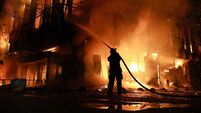
Iran death toll may reach 40,000

Officials in Iran fear that up to 40,000 people may have died when a powerful earthquake reduced much of a city to rubble.

Iran death toll may reach 40,000

Officials in Iran fear that up to 40,000 people may have died when a powerful earthquake reduced much of a city to rubble.

Relatives and rescuers used everything from bare hands to bulldozers to retrieve victims of the quake that crumbled vast swathes of the ancient city of mud-brick buildings into powder and frost-chilled rubble, killing thousands of people.

The destruction was so all-encompassing that a reliable death toll in the city of 80,000 was still unavailable yesterday. Most people were asleep when the earthquake measuring 6.6 on the Richter scale, struck at 5.28am local time (1.58am Irish time) on Friday.

The Interior Ministry estimated the death toll at 20,000 but officials in the region said it could be double that amount.

“An unbelievable human disaster has occurred,” said Akbar Alavi, the governor of Kerman, the provincial capital. “As more bodies are pulled out, we fear that the death toll may reach as high as 40,000.”

But other officials said later that the number of dead would be lower.

“The figures are not correct. No precise statistics on the number of casualties are available yet but it seems that number of the victims is less,” Deputy Governor Mohammad Farshad told the official Islamic Republic News Agency.

The Interior Ministry estimated the number of injured at 30,000.

Bam, in south east Iran around 630 miles from Tehran, suffered such extreme damage because most of the buildings are made of unreinforced mud brick and the quake was centred only about 10 miles outside the city.

After shocks registered as high as 5.3, according to the geophysics institute of Tehran University.

Searchers carried the injured in their arms, on stretchers and in the backs of trucks, seeking help outside Bam’s ruined hospitals or at the airport while awaiting evacuation to Kerman.

A provincial government official, Saeed Iranmanesh, said that 3,000 bodies have been recovered and buried, and more than 9,000 of the injured were sent to hospitals throughout the country.

About 150 people, including an infant, were pulled alive from the rubble, Revolutionary Guards officer Masoud Amiri said. The baby was buried more than 24 hours but was listed in stable condition at a hospital, he said.

By late afternoon, a one-and-a-half mile line of vehicles waited to enter Bam as Iranians rushed to find relatives or to bring emergency supplies.

Iran opened its airspace to all planes carrying emergency supplies and waived visa requirements for foreign relief personnel.

“The disaster is far too huge for us to meet all of our needs,” President Mohammad Khatami said as he declared three days of mourning.

Governments and relief organisations mobilised around the globe, with rescue workers, search dogs and supplies arriving from a long list of countries.

The United States, which has no diplomatic relations with Iran, will send 75 tons of medical supplies and dispatch teams of about 200 search-and-rescue and medical experts, US officials said.

The leader of an Iranian relief team, Ahmad Najafi, said he also feared the toll could reach 40,000.

On one street alone, 200 bodies were extracted from the rubble in a single hour, he said.

In another part of Bam, a grey-bearded man in his 50s, wearing the white turban common to rural villages in this south-eastern corner of Iran, watched with resignation as four men dug with their bare hands and a single shovel.

What once was his home was a flattened pile of rubble and dust. He pointed to where the bedrooms should have been, seemingly resigned that none of his three teenage children or his wife would be found alive.

He fainted as he spotted a slender hand protruding from a red pyjama sleeve in the debris.

Behind him, the body of a girl in her teens was excavated and quickly covered with a blanket. Then the bodies of his sons and a woman in her 40s were found.

No one was alive.

In another neighbourhood, a man interrupted Interior Minister Abdolvahed Mousavi Lari as he spoke to reporters.

“My father is under the rubble,” the man said, tears rolling down his face. “I’ve been asking for help since yesterday, but nobody has come to help me. Please help me. I want my father alive.”

Lari tried to calm the man and asked an aide to help him.

“There is not a standing building in the city. Bam has turned into a wasteland,” the minister said.

Thousands of survivors prepared to spend a second night outdoors, sleeping in tents or under blankets or whatever they could find as temperatures dropped to freezing.

The earthquake collapsed the walls of the local prison, allowing all 800 inmates to escape, guard Vahid Masoumpour said.

The quake destroyed most of Bam’s citadel – a medieval fortress that is the city’s best-known structure. The tallest section, including a distinctive square tower, crumbled like a sand castle.

The UN cultural agency, Unesco, considered declaring the citadel a protected World Heritage Site.

Some of the citadel’s walls were still standing yesterday, but they were damaged.

“My grief is two-fold,” said Reza Husseini, a 25-year-old archaeology student, as tears streaked through the dust that covered his hair and his bruised face. “I’ve lost two members of my family, and I’ve lost my history, my citadel.”

Iran has a history of devastating earthquakes, including one of measuring 7.3 that killed about 50,000 people in north-west Iran in 1990.

More in this section

Cookie Policy Privacy Policy Brand Safety FAQ Help Contact Us Terms and Conditions

© Examiner Echo Group Limited