Suicide bomb strikes Baghdad UN HQ
A cement truck packed with explosives detonated outside the offices of the top UN envoy in Iraq, killing him and 19 other people.
At least 100 others were injured in the attack that devastated the UN headquarters in Baghdad.
The bomb yesterday blasted a 6ft crater in the ground, shredded the facade of the Canal Hotel housing UN offices and stunned an organisation that had been welcomed by many Iraqis in contrast to the US-led occupation forces.
Except for a new concrete wall built recently, UN officials at the headquarters refused heavy security because the UN “did not want a large American presence outside”, said Salim Lone, the UN spokesman in the Iraqi capital.
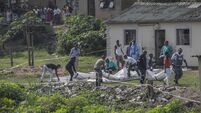
Emergency workers pulled bloodied survivors from the rubble and lined up the dead in body bags. Survivors said other victims were still buried.
The 4.30pm local time (1.30pm Irish time) blast brought down the office of the top UN envoy in Iraq, Sergio Vieira de Mello, where he was meeting with other UN officials.
Mr Vieira de Mello – a 55-year-old veteran diplomat serving in what one UN spokesman called the world body’s toughest assignment – was wounded and trapped in the rubble, and workers gave him water as they tried to extricate him. Hours later, the United Nations announced his death.
“Those who killed him have committed a crime, not only against the United Nations but against Iraq itself,” UN Secretary-General Kofi Annan said in a statement, calling the Brazilian diplomat “an outstanding servant of humanity”.
Fiona Watson, a British member of Mr Vieira de Mello’s staff, was also named by the UN as being among the dead.
At the UN headquarters in New York, all the national flags that ring the UN headquarters’ entrance were removed from their poles, and the blue-and-white UN flag was lowered to half mast.
UN and US officials called the bombing a “terrorist attack”, but there was no immediate claim of responsibility. The bombing came nearly two weeks after a car exploded and killed 19 people at the Jordanian Embassy in Baghdad and after a string of dramatic attacks on oil and water pipelines in Iraq.
Like the remote-controlled explosion at the Jordan Embassy, the suicide bombing on the UN headquarters focused on a high-profile target with many civilians inside and resembled attacks blamed on Islamic militants elsewhere in the world.
It was far more sophisticated than the guerrilla attacks that have plagued US forces, featuring hit-and-run shootings carried out by small bands or remote control roadside bombs.
As FBI agents joined the investigation, Bernard Kerik, the former New York City police commissioner who is rebuilding the Iraqi police force, told reporters that evidence suggested the attack was a suicide bombing.
But he said it was “much too early” to say if Osama bin Laden’s al-Qaida network was behind the attack. “We don’t have that kind of evidence yet.”
US forces have been focusing on trying to put down Saddam Hussein loyalists thought to be behind the guerrilla campaign against American troops. But the military has also warned of foreign Islamic militants slipping into the country and has said an al-Qaida linked group, Ansar al-Islam, was a possible suspect in the Jordanian Embassy bombing.
In yesterday’s attack, a cement truck – packed with twice the amount of explosives as the embassy blast – detonated at the concrete wall outside the three-story Canal Hotel. The blast occurred while a news conference was under way in the building, where 300 UN employees had worked.
Fifteen bodies in white bags were counted by a UN worker at the hotel, and a survey of Baghdad hospitals by The Associated Press found five other people who had died in the blast. UN officials said 14 of those killed were UN workers and 100 people were wounded.
An AP reporter counted 40 wounded people lying in the front garden and receiving first aid. Some were loaded into a constant stream of helicopters which ferried the injured away. A senior UNICEF official also was seriously wounded in the blast, UN. officials said.
A senior US official said in Baghdad that the truck did not breach the wall that had been erected around the hotel within the past month. He said the truck was parked on an access road just outside the compound.
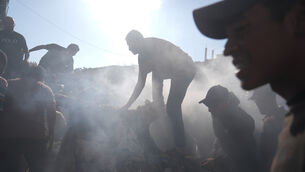
Paul Bremer, the top US civilian administrator in Iraq, walked through the scene of destruction as workers dug through the rubble with their hands. Mr Bremer had tears in his eyes and hugged Hassan al-Salame, an adviser to Mr Vieira de Mello.
“We will leave no stone unturned to find the perpetrators of this attack,” he said.
Mr Vieira de Mello began work on June 2 and would have finished his assignment at the end of September, though his spokesman said many UN officials wanted him to stay on.
Syria’s Deputy Ambassador Fayssal Mekdad, whose country holds the UN Security Council presidency, said “such terrorist incidents cannot break the will of the international community” and that UN programmes would continue.
The United Nations distributes humanitarian aid and is developing programs aimed at boosting Iraq’s emerging free press, justice system and monitoring of human rights. United Nations weapons inspectors worked out of the hotel during the period before the war.
The Canal Hotel operates more as an office building than a hotel. The cafeteria is a popular place for humanitarian workers and journalists to meet. US officials often were at the compound as well for discussions with their UN counterparts.
Also yesterday, Taha Yassin Ramadan, a former Iraqi vice president known as “Saddam’s knuckles” for his ruthlessness against regime enemies, was captured in Mosul by Kurdish fighters, authorities said.
Ramadan, 65, who was reportedly disguised in peasant clothing when he was caught, once was considered Iraq’s second-most powerful man, but his influence declined in the later years of Saddam Hussein’s regime. He was number 20 on the US list of most-wanted former regime figures.
CONNECT WITH US TODAY



Be the first to know the latest news and updates