Juno space probe set to enter Jupiter’s orbit
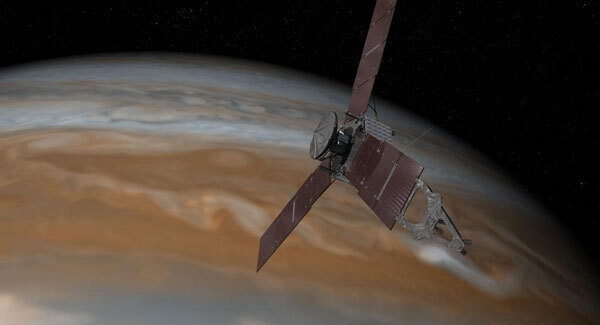
The Juno probe will orbit closer to the giant planet than any spacecraft has done before, flying to within 2,900 miles of Jupiter’s swirling cloud tops.
It will study the planet’s composition, gravity, magnetic field, and the source of its raging 384mph winds. A panoramic camera will also take spectacular colour photos.
To complete its risky mission, Juno will have to survive a circuit-frying radiation storm generated by Jupiter’s powerful magnetic field.
The maelstrom of high energy particles travelling at nearly the speed of light is believed to be the harshest radiation environment in the Solar System.
To cope with the conditions, the spacecraft is protected by special radiation-hardened wiring and sensor shielding.
Its all-important “brain” — the flight computer — is housed in an armoured vault made of titanium and weighing almost 172kg.
Dr Scott Bolton, Juno’s principal investigator from Southwest Research Institute in San Antonio, US, said: “We are not looking for trouble, we are looking for data.
“Problem is, at Jupiter, looking for the kind of data Juno is looking for, you have to go in the kind of neighbourhoods where you could find trouble pretty quick.”
The previous record for a close approach to Jupiter was set by the American space agency Nasa’s Pioneer 11 spacecraft which passed by the planet at a distance of 27,000 miles in 1974.
Only one previous spacecraft, Galileo, which visited Jupiter and its moons from 1995 to 2003, has orbited the planet.
Galileo made wide orbits at distances of hundreds of thousands of kilometres that kept it out of serious danger from the radiation, but still suffered a number of technical glitches.
The spacecraft sent a small probe on a one-way trip through the clouds of Jupiter, and was eventually itself crashed on to the planet at the end of its mission.
As a further safeguard, Juno is programmed to follow a long orbital path that avoids Jupiter’s radiation belts as much as possible.
Despite these measures, the probe is not expected to last much longer than its planned lifespan: 20 months.
CONNECT WITH US TODAY



Be the first to know the latest news and updates