Desperate refugees herded onto trains
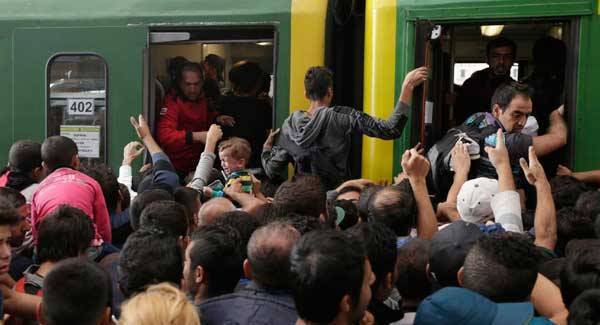
Refugees forced from a train in Hungary scuffled with helmeted riot police and some clung to railway tracks yesterday, as politicians across Europe struggled to respond to public opinion appalled by images of a drowned 3-year-old boy.

Desperate refugees herded onto trains

France and Germany said European countries must be required to accept their shares of refugees, proposing what would potentially be the biggest change to the continent’s asylum rules since the Second World War.

Europe’s worst refugee crisis since the Yugoslav wars of the 1990s has strained the EU’s asylum system to breaking point, dividing its 28 nations and feeding the rise of right-wing populists.

Hundreds of thousands of refugees from wars in the Middle East, along with economic migrants fleeing poverty in Africa and Asia, have braved the Mediterranean Sea and land routes across the Balkans to reach the EU.

Thousands have died at sea and scores have perished on land.

Nearly all first reach the EU’s southern and eastern edges before pressing on for richer and more generous countries further north and west, above all Germany, which has emphasised its moral duty to accept those fleeing genuine peril.

Saying some European countries had failed to “assume their moral burdens”, French president Francois Hollande said he had agreed with German chancellor Angela Merkel on “a permanent and obligatory mechanism” to allocate refugees across the bloc.

“I believe that today what exists is no longer enough. So we will need to go further,” said Hollande.

Merkel said Europe must solve the refugee crisis with “fairness and solidarity”. Germany was prepared to accept more refugees per capita than its neighbours, but others must do their part with “quotas and rules that are fair and take into account what is possible in each country”.

Germany has caused confusion among its neighbours by saying it will accept applications from Syrians regardless of where they enter the EU.

Politicians across the continent acknowledged the impact of images of a three-year-old boy in a red T-shirt face down in the surf of a Turkish beach, which gave a haunting human face to the tragedy of thousands dead at sea.

“He had a name: Alyan Kurdi. Urgent action required, A Europe-wide mobilisation is urgent,” French prime minister Manuel Valls said on Twitter.

The boy’s five-year-old brother Galip and 35-year-old mother Rehan were also among 12 people who died when two boats carrying 23 capsized while trying to reach a Greek island.

Hungary has emerged as the primary entry point for those trying to reach the EU overland across the Balkans, and its right-wing government has become one of the most vocal on the continent opposing large-scale immigration.

Thursday brought a days-long stand-off to a pitch as Hungarian authorities who refused to let migrants board trains for Germany for days finally allowed hundreds onto a train bound for the Austrian frontier, only to halt it at Bicske, a town outside Budapest with an immigration registration centre.

Hundreds of exhausted people had crammed aboard, clinging to doors and squeezing their children through open carriage windows.

When the train was halted, most refused to get off.

Police cleared one carriage, while five more stood at the station in the heat.

Fearing detention, some migrants banged on windows chanting: “No camp! No camp!”

One group pushed back dozens of riot police guarding a stairwell to fight their way back on board.

One family, a man, his wife, and their toddler, made their way along the track next to the train and lay down in protest.

It took a dozen riot police wrestling with the man to get them up off the tracks again.

More in this section

Cookie Policy Privacy Policy Brand Safety FAQ Help Contact Us Terms and Conditions

© Examiner Echo Group Limited