Power struggle adds to Iraq’s woes
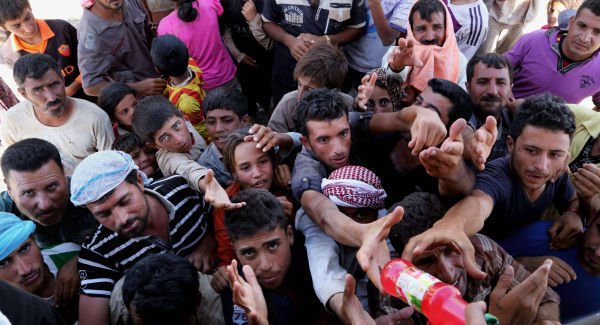
The showdown came as the US increased its role in fighting back Sunni extremists of the Islamic State group threatening the autonomous Kurdish region in the north.
American officials said US intelligence agencies are directly arming the Kurds battling the militants in what would be a shift in Washington’s policy of only working through the central government in Baghdad.
US warplanes carried out strikes on Sunday, hitting a convoy of Sunni militants moving to attack Kurdish forces defending the capital, Irbil. The American airstrikes helped the Kurds achieve one of their first victories after weeks of retreat as peshmerga fighters over the weekend recaptured two towns near Irbil. The Pentagon’s director of operations said the effort will do little to slow Islamic State militants overall.
Haider al-Ibadi, the deputy speaker of parliament from al-Maliki’s Shi’ite Dawa party, was selected by President Fouad Massoum to be the new prime minister and was given 30 days to present a new government to lawmakers for approval.
Al-Maliki has defiantly rejected the nomination. In a speech on Sunday, he accused Massoum of blocking his reappointment as prime minister and carrying out “a coup against the constitution and the political process.”
In another speech broadcast last night, al-Maliki insisted al-Ibadi’s nomination “runs against the constitutional procedures” and he accused the US of siding with political forces “who have violated the constitution.”
“Today, we are facing a grave constitutional breach and we have appealed and we have the proof that we are the largest bloc,” al-Maliki said.
“We assure all the Iraqi people and the political groups that there is no importance or value to this nomination,” he added.
But despite angrily insisting he should be nominated for a third term, al-Maliki has lost some support with the main coalition of Shi’ite parties. His critics say al-Maliki contributed to Iraq’s political crisis by monopolising power and pursuing a sectarian agenda that alienated the country’s Sunni and Kurdish minorities.
The nomination of al-Ibadi came hours after al-Maliki deployed his elite security forces in the streets of Baghdad. Hundreds of his supporters were escorted to a popular rally site by military trucks, raising fears that he might try to use force to stay in power.
Al-Ibadi, the former minister of communications from 2003-04, pledged to form a government to “protect the Iraqi people.” He was nominated after receiving the majority of votes from lawmakers within the Iraqi National Alliance, a coalition of Shi’ite parties.
A peaceful transition is looking increasingly unlikely, given al-Maliki’s reputation for having replaced many senior Sunni officers with less-experienced, more loyal Shi’ite officers.
“One of the major concerns [the US] had in 2010 is the degree to which al-Maliki was trying to coup-proof his military,” said Richard Brennan, an expert on Iraqi special forces at Rand Corporation and former US Department of Defense policymaker. “The US worked hard with the military to make them understand that loyalty had to be to country, not to al-Maliki, but al-Maliki cut the forces to replace competent people with less-competent people loyal to him.”
Prior to al-Ibadi’s appointment, US Secretary of State John Kerry said “there should be no use of force, no introduction of troops or militias into this moment of democracy for Iraq.” Kerry added a new government “is critical in terms of sustaining the stability and calm in Iraq,” and that “our hope is that Mr Maliki will not stir those waters.”
Iranian President Hassan Rouhani, who has expressed fears that Iraq will fragment unless al-Maliki leaves power, expressed his concern about the political crisis in a call with newly elected Turkish President Recep Tayyip Erdogan. “It is important for Iran that a person approved by a majority of the representatives of the people in the Iraqi parliament takes power.”
The US weapons being directly sent to Irbil mostly consist of light arms like AK-47s and ammunition, a Kurdish government official and a senior Pentagon official said.
But the Kurdish official said the US lethal aid is still not enough to battle the militants, even though Kurdish forces were supplemented with similar munitions from Baghdad.
The move to directly arm the Kurds underscores the level of US concern about the Islamic State’s gains — particularly at a time when there is such turmoil within the central government.
Turkey has warned al-Maliki that his actions threaten to deepen a crisis in Iraq and called on him to support Massoum.
CONNECT WITH US TODAY



Be the first to know the latest news and updates