Missing plane may have flown for 5 hours after it disappeared
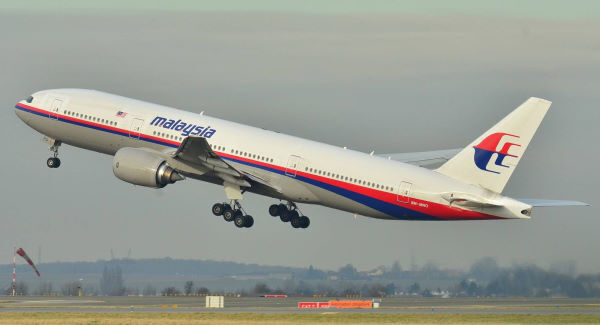
It is believed the plane was sending automated signals to a satellite system long after radar contact was lost. This would mean the jet could have flown more than 1,600km beyond its last confirmed position.
Yesterday US surveillance teams were sent to the Indian Ocean, much further west than the initial searches.
The investigation is focusing more on a suspicion of foul play, as evidence suggests it was diverted hundreds of miles off course, sources familiar with the Malaysian probe said.
A statement issued by satellite operator Inmarsat said: âRoutine, automated signals were registered on the Inmarsat network from Malaysia Airlines flight MH370 during its flight from Kuala Lumpur. This information was provided to our partner SITA, which in turn has shared it with Malaysia Airlines.â
The signals are âpingsâ sent by the plane to confirm it is still there and to allow the network to determine its position.
A third investigative source said inquiries were focusing more on the theory that someone who knew how to fly a plane deliberately diverted the flight hundreds of miles off its scheduled course from Kuala Lumpur to Beijing.
âWhat we can say is we are looking at sabotage, with hijack still on the cards,â said the source, a senior Malaysian police official.
One of the most baffling mysteries in the history of modern aviation remains unsolved after nearly a week.
The latest radar evidence is consistent with the expansion of the search for the aircraft to the west of Malaysia.
There has been no trace of the plane nor any sign of wreckage as the navies and military aircraft of more than a dozen countries scour the seas across Southeast Asia.
Malaysian transport minister Hishammuddin Hussein said he could not confirm the last heading of the plane or if investigators were focusing on sabotage.
âA normal investigation becomes narrower with time ... as new information focuses the search, but this is not a normal investigation,â he told a news conference. âIn this case, the information has forced us to look further and further afield.â
Investigators were still looking at âfour or fiveâ possibilities, including a diversion that was intentional or under duress, or an explosion, he said. Police would search the pilotâs home if necessary and were still investigating all 239 passengers and crew on the plane, he added.
If the jetliner did stray into the Indian Ocean, a vast expanse with depths of more than 7,000 meters (23,000 feet), the task faced by searchers would become dramatically more difficult.
Winds and currents could shift any surface debris tens of nautical miles within hours, dramatically widening the search area with each passing day.
âShips alone are not going to get you that coverage, helicopters are barely going to make a dent in it and only a few countries fly P-3s (long-range search aircraft),â William Marks, spokesman for the US Seventh Fleet, told Reuters.
âSo this massive expanse of water space will be the biggest challenge.â
The US Navy was sending an advanced P-8A Poseidon plane to help search the Strait of Malacca, a busy sealane separating the Malay Peninsula from the Indonesian island of Sumatra. It had already deployed a Navy P-3 Orion aircraft to those waters.
US defence officials told Reuters that the US Navy guided-missile destroyer, USS Kidd, was heading to the Strait of Malacca, answering a request from the Malaysian government.