Pistorius trial hears of ‘bloodcurdling screams’
Taking the stand after the Paralympic and Olympic star pleaded not guilty to murdering his girlfriend, model Reeva Steenkamp, on Valentine’s Day last year, neighbour Michelle Burger testified she was woken in the middle of the night by a woman shouting for help.
“I was still sitting in the bed and I heard her screams,” Burger, who lives 177m (194 yards) from Pistorius’s home in an adjacent housing complex, told the Pretoria High Court.
“She screamed terribly and she yelled for help. Then I also heard a man screaming for help. Three times he yelled for help,” she said, speaking in Afrikaans through an interpreter.
Thinking it was a violent break-in — a possibility in crime-ridden South Africa — Burger said her husband called the private security firm guarding their upmarket Pretoria housing estate before the pair heard more shouts.
“I heard the screams again. It was worse. It was more intense,” said Burger, a Pretoria University economics lecturer.
“She was very scared,” she added, her voice cracking with emotion.
“Just after her screams, I heard four shots. Four gun- shots,” she said. “Bang... bang, bang, bang.”
“It was very traumatic for me. You could hear that it was bloodcurdling screams.” After the final shot, the screams “started fading”, she added later.
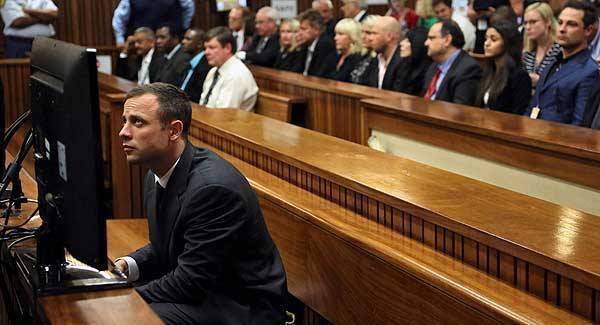
Throughout Burger’s testimony, Pistorius, 27, sat impassively, staring at the floor.
The athlete, who was born without lower legs but reached the 2012 Olympic 400m semi-final using carbon-fibre “blades”, argues that Steenkamp’s killing was a tragic accident after he mistook her for an intruder hiding in the toilet.
Burger steadfastly maintained her testimony despite a probing cross examination by lead defence advocate Barry Roux.
After the first day’s hearing, Pistorius left the court through a media scrum before being bundled into a waiting silver SUV.
Earlier, Pistorius, dressed in dark suit, white shirt, and black tie, stood before Judge Thokozile Masipa to plead ‘not guilty’ to murdering law graduate Steenkamp, a women’s rights campaigner and familiar face on South Africa’s celebrity party scene.
He also pleaded not guilty to several other firearms charges, including one of discharging a pistol under the table of a posh Johannesburg restaurant and another of putting a bullet through the sun-roof of a former girlfriend’s car.
When he entered the courtroom, Steenkamp’s mother, June, followed him with her gaze. Her father, Barry, was not in court after recently suffering a stroke.
Prosecutors are seeking to prove that Pistorius fired four rounds from a 9mm pistol through the door of the toilet in a deliberate attempt to kill whoever was behind it.
Steenkamp was hit three times, in the head, arm, and hip. She was declared dead at the scene.
In his opening address, lawyer Kenny Oldwage, who with Roux forms part of Pistorius’s defence team, sought to portray the state’s allegations as an unwarranted character assassination of a young man deeply in love.
If the state succeeds in convincing Masipa of intent to kill, Pistorius could get life, in all likelihood a minimum of 25 years behind bars.
At his bail hearing last year, Pistorius admitted to culpable homicide, equivalent to manslaughter, which could see him put away for 15 years — or he could leave court a free man, with a suspended sentence.
Coming less than a month after the rape, dis-embowelling and murder of a teenager near Cape Town, the shooting of Steenkamp caused outrage and drew further attention to the high levels of violence against women in South Africa.
The trial before Masipa — juries were abolished by the apartheid government in the 1960s — is set to last a minimum of three weeks but with as many as 107 witnesses waiting to be called, it is almost certain to last far longer.
The proceedings have attracted massive media attention, with hundreds of foreign and domestic media camped outside the court.
The trial is also being broadcast live, a first for South Africa, where, two decades after the end of apartheid, the justice system is often accused of favouring the rich and wealthy, who can afford the best lawyers and forensic experts.
The trial continues today.