Massacre of the innocents
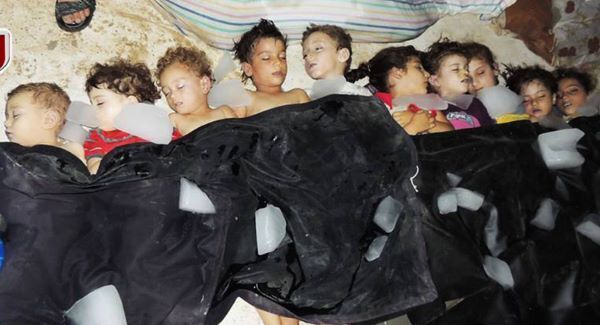
As many as 1,300 people — including dozens of children — were reported to have been killed in the attack by government forces on rebel-held suburbs of the capital Damascus. The country has been in the grip of a civil war for more than two years and about 100,000 people have been killed.
Pictures by citizen journalists circulated on social media sites and websites purported to be from the sites of the attacks in Arbeen and Douma City. Some showed the bodies of many children, some ashen but showing no injuries, and others with foam coming from their mouths. The Associated Press verified some of the images.
Opposition activists cited death tolls ranging from about 500 to 1,300 after shells and rockets fell at 3am local time.
One man, who said he had retrieved victims in the suburb of Erbin, said: “We would go into a house and everything was in its place. Every person was in their place. They were lying where they had been. They looked like they were asleep.
“But they were dead.”
When shelling hit her town of Mouadamiya, south-west of the capital, Farah al-Shami ignored rumours on Facebook that rockets were loaded with chemical agents. She thought her district was too close to a military encampment to be affected.
“And at the same time the UN was here,” the 23-year-old said. “It seemed impossible. But then I started to feel dizzy. I was choking and my eyes were burning
“I rushed to the field clinic nearby. Luckily no one in my family was hurt, but I saw entire families on the floor.”
Doctors described symptoms they believe point to sarin gas, one of the agents Western powers accuse Damascus of having in an undeclared chemical weapons stockpile.
The UN Security Council met last night to discuss its response. However, Russia has vetoed previous Western efforts to impose UN penalties on Syria. The council is not expected to take decisive action.
Russia hastened to back up denials from the administration of President Bashar al-Assad by saying it looked like a rebel “provocation” to discredit him.
Britain voiced the opposite view: “I hope this will wake up some who have supported the Assad regime to realise its murderous and barbaric nature,” said foreign secretary William Hague.
US President Barack Obama has previously said the use of chemical weapons by the Assad regime was a “red-line” issue. However, it was unclear last night what action his administration would take, if any. Up to now, Obama has refused all options of direct US military intervention in the civil war.
Martin Dempsey, chairman of the joint chiefs of staff, said in a letter to a congressman that the Obama administration is opposed to even limited action in Syria because it believes rebels fighting the Assad government would not support US interests if they seized power.

CONNECT WITH US TODAY



Be the first to know the latest news and updates