I tried a professional decluttering service — a month later, is my kitchen still tidy?
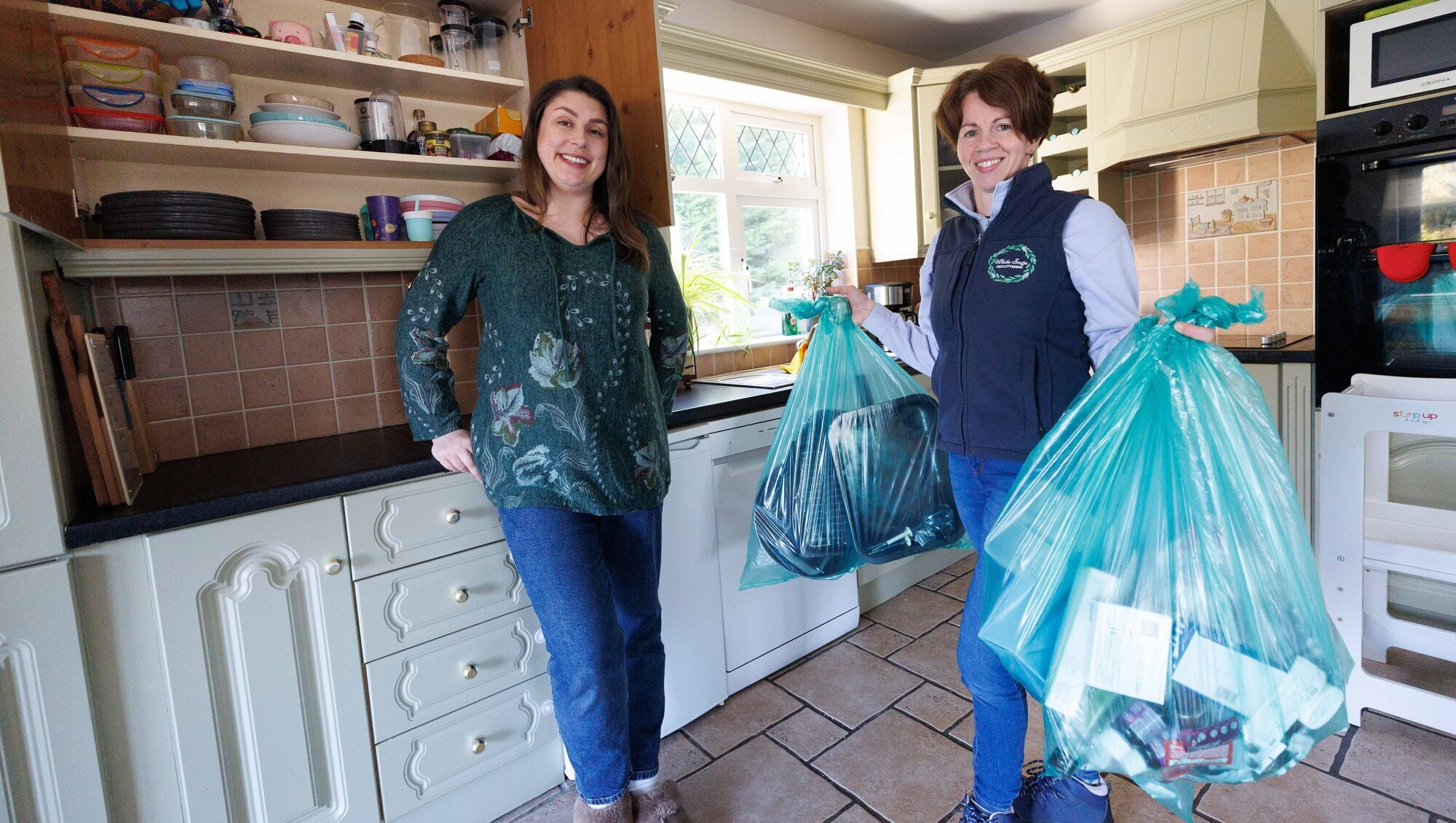
Jess Casey at home in Co Limerick with Anne Marie Kingston of White Sage Decluttering and some of the bags she is taking away for reuse and recycling. Pictures: Eamon Ward
I was recovering from wisdom tooth surgery when I was asked if I’d like to open up my home for a professional decluttering, putting its mess on display in all its glory.
Not exactly a den of tranquility even at the best of times, the house has descended into utter chaos in the time it’s taken to wrench my wisdom teeth out.
It’s not like we ever stop cleaning, although you wouldn’t believe us. In a home with two working parents, and an extremely active toddler who likes to demonstrate his creativity through the art of chaos, daily clean-up takes up all limited free time.
Every night, counters are cleaned, floors are swept and toys are fired back to base to begin again tomorrow.
Associated detritus and miscellaneous plastic shite is rounded up and flung into cupboards, bags, or the corners of rooms. Out of sight, and none of our business.
CLIMATE & SUSTAINABILITY HUB

While for the most part, the surface level resetting seems to work well, it just takes one of us being out of action down to a late work deadline for it to start to tip out of control and the pileup starts to take over.
As I consider the decluttering offer, I look around my surroundings resignedly. In the run-up to
Christmas, the spare room has functioned as an office, launderette, wrapping paper station, and home gym — even if the walking pad and weights are gathering dust.
There have been several attempts made to try and sort this room, along with the rest of our living space. Bags for donations, recycling and rubbish line the walls, their disposal another job on a never-ending list to be tackled on a day when the time can be found.
Embarrassment about the mess aside, it’s clear a bit of help could go a long way.
“Ok, fine. Send in the professionals,” I swollenly lisp, still dentally challenged after surgery.
Enter Anne Marie Kingston of White Sage Decluttering, a professional declutterer and
organiser based in Clonakilty who works countrywide to help people like myself get their homes working and flowing correctly for them.

Anne Marie’s services are so in demand she operates an eight-to-10-week waiting list, leaving me a bit of time to decide where best to tackle during the three hours we will work together.
The night before Anne Marie’s arrival, I planned to do a ‘pre-declutter’ declutter to make sure we don’t find anything too embarrassing... but as with all the best-laid plans, life gets in the way.
The morning of the big clear-out, with Anne Marie just 10 minutes away, I stand in the kitchen,
nervously looking around, terrified we’re going to unearth a fossilised bulb of garlic or a blighted bag of
potatoes, forgotten about and rotting away in the back of a cupboard.
I glance in front of me, noticing a solitary, soggy Cheerio hanging on forlornly to the tiles beside my feet. Everything looks dingy and dirty. ‘What have I got myself into’ I thought, ‘opening up the place to a total stranger’.
As it turns out, I needn’t have worried. As Anne Marie herself says, she arrives at my house a stranger but leaves it a friend.
As a professional declutterer, her focus is on rehoming, recycling and sustainability.
Booked and busy, her typical clients tend mostly to be women in what she describes as a transitional period in their life.
This is pretty wide ranging, including those going into retirement after years of dedicated service, those who are becoming empty nesters after rearing a house full of kids, or those who are going through a relationship breakdown.
“It’s a transitional period in their life, and they’ve been left with decades of clutter,” she explains.
“Maybe 20, 30, 40 years of clutter.”
Her clients all have one thing in common though: “They are 100% ready to let go. They’ve made peace with whatever has happened in their life and they are ready to go. There’s no regret when I come in.”

When she began her business nine years ago in March, clients tended to be more emotional at her arrival, often greeting her coming up the drive with their hanky out.
The decluttering process is not just about tidying a house or keeping it tidy, she reassures me.
“People find it hard to let go, but when I come in they are 100% ready.”
The most common clutter culprits she encounters are clothing, often with the tags still attached, footwear, toys, paperwork and unopened wedding presents.
“I find a lot of wedding presents from people married years and the blankets and the bedsheets are still inside in the hot press or the attic.”
“We came from an era where you’d keep everything, and don’t throw it out.”
But working with clients over covid, she’d often ask them “If you haven’t used this during a worldwide pandemic, when are you going to use it?”
She’s very practical, and crucially, she avoids skips and landfills.

Everything you decide to part with, Anne Marie will take away in her van as she leaves your home — disposing or rehoming it sustainably.
“When I go into the client’s home, it’s me with the client. I’m educating people too, because sometimes people don’t know where to take stuff.”
She believes many people, like myself, want to clear their homes in a sustainable manner but simply lack the time.
“We’re a very busy generation and we’re very time poor,” she explains.
“We don’t have the time to be doing this, this and this. We’re go, go, go between work and trying to run the house. A lot of people would be minding elderly parents or family members, as well as their own children, or there might be kids with special needs. Their time is very precious, and the stuff isn’t going out to the right locations.”
But holding on to things over decades often leaves people stuck with entire rooms full of clutter, she says.
After introductions and pleasantries, it’s not long before we’re getting down to brass tacks. I’ve decided on my kitchen as the area we will tackle during our session, with the room being the one we spend the most time in, while also having the most dysfunctional cupboards.
Since we moved in, they’ve never properly been sorted. Each stage of parenthood leaves its souvenirs, and we have piles of now defunct bottles, beakers and bibs precariously stacked and taking up space among things we use every day.
Opening up the doors and showing her, I’m a bit embarrassed. “Don’t be,” she says, reassuring me it’s a fairly typical reaction from clients.
“They’ll say ‘how has it got to this point?’ but I say ‘life happens’. There could be a baby, or multiple babies. There could be sickness in the house, or sometimes it could just be a busy mam, trying to keep all the balls in the air and there is just no time.”
“Someone might be working five days a week, and then the weekends, they are catching up. There’s just no time, and when they do have time, they just tidy the clutter.”
She often sees people moving their clutter around rather than deal with it: “They’ll move it from here to here, or from one room to another, or then into the garage or the box room. Over time, it snowballs and nothing has left the house.”
“They are not dealing with it hands on. They’ll read every book, all these podcasts but at the end of the day, you just have to handle it and that’s what I do as a professional declutterer.”

Working press by press, shelf by shelf, we begin. There is no Mari Kondo, pull-every-single-item-out-all-at-once approach here.
“You’d feel overwhelmed, so I’d feel overwhelmed,” Anne Marie explains
“We’ll go shelf by shelf, at a nice easy pace.” With this in mind, we begin. “Don’t throw everything out for the sake of it,” she says. “You can keep a maybe pile if you can’t make a decision, so come back in a month and see if you’ve used it.”
The first hurdle we encounter is a set of plates we rarely use. They had come from my own family home, having been purchased in 2010 for a funeral, used once and then put away since.
I’d taken them for my first kitchen but we never use them. They take up so much space, but I’ve never
logically considered rehoming them.
They are among the first items Anne Marie takes for repurposing. She also takes an array of plastic tupperware, two neglected house plants, an air fryer, a teapot, napkins, and a set of cups.
As much as possible will be repurposed. Anne Marie works with a lot of voluntary and charity organisations in West Cork. She is also active among the West Cork free recycling groups.
She also works with local artists, she tells me, as I unearth a tester pot of paint from a cupboard.
We continue our work side by side in a friendly flow state, chatting away occasionally as we sort. Each shelf is given a wash with a hot cloth and soapy water before anything is reorganised.
Knowing the emotional weight certain items hold, she never puts pressure on clients to get rid of anything they are not ready to.
This comes in handy when I discover a box of my son’s old dummies. I start to well up when I see his most cherished one, so beloved it’s been gnawed into oblivion, and chewed right through.
“I have to keep this one,” I tell her. She nods in agreement. For sentimental items like this, she suggests keeping a memory box.

Halfway into our session, Anne Marie starts to make her way over to where we keep our pots and pans.
I go to stop her. “Not these two drawers”, I confidently say. “These are functional, we use everything in them everyday.”
She looks at me with the same calm and level-headed manner you’d imagine a chief negotiator approaches a delusional hijacker.
“What do you have in there,” she asks. “What’s in there that you actually use every day?” The two drawers are full to the brim, and as I start to empty them out onto the kitchen counter I slowly start to lose my bravado. ‘We’ve never used half this shite’, I think, cheeks flushing.
A red plastic lid to god knows what, a rickety saucepan lid, a burnt tray. “All of this can go,” I concede.
Thankfully, there are no told-you-so’s from Anne Marie, a consummate professional.
We also unearth no less than seven expired herbal teas, bought in the hopes they’d either bring on labour or help with pregnancy heartburn.
Anne Marie also makes a few very clever storage suggestions, such as hanging a chopping board on one cupboard door internally with a command hook.
She advises people to group items together in clear boxes — think baking supplies, herbs and spices or bags of pasta — but we make use of what I already have in the kitchen.
With the last drawer finished, Ann Marie loads up her van with several bags and boxes of our clutter.
As she leaves, we embrace like old friends. I feel like I have a new burst of energy, and a new kitchen. It
almost feels like it has an echo.
It’s now a month later, and our kitchen is still clear, organised and functional.
It’s still running as beautifully and organised as the day Anne Marie visited, despite the occasional rogue Cheerio still making the odd appearance.