You can call her what you like, but don’t call her a feminist
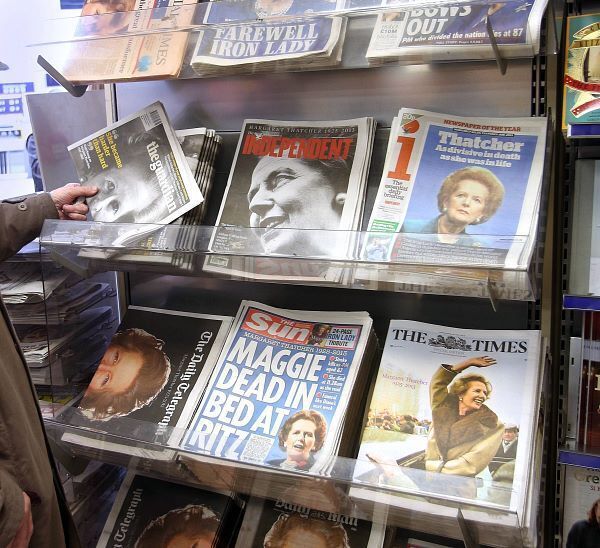
The former British leader, who died on Monday aged 87, rejected the label — “I owe nothing to women’s lib,” she once said — and she leaves a contested legacy for women. For some, she was an inspiration who showed anything was possible. For others, she was an individualist who got to the top and pulled the ladder up behind her.
Meryl Streep, who won an Oscar last year for playing Thatcher in The Iron Lady, said her legacy for women was huge.
“To have given women and girls around the world reason to supplant fantasies of being princesses with a different dream — the real-life option of leading their nation — this was groundbreaking and admirable,” Streep said.
However, Wendy Webster, professor of modern cultural history at the University of Huddersfield, said Thatcher regarded herself as a one-off who owed nothing to feminism.
“She didn’t see her career as having grown out of any kind of movements,” said Webster, author of a feminist analysis, Margaret Thatcher: Not a Man to Match Her.
“She saw herself as a unique individual who had made it through her own talent and her own determination.”
Few would downplay the hurdles Thatcher overcame as a grocer’s daughter from a provincial town making her way in the macho, patrician Conservative Party. Though she was a graduate of Oxford University — in chemistry, then an unusual field for a woman — she had to fight to be selected as a parliamentary candidate, and her victory in a Tory leadership contest in 1975 was a shock.
She wasn’t the first woman to head a modern government, but she was one of the first who was not the daughter or widow of a male leader.
“We should never forget that the odds were stacked against her,” said British prime minister David Cameron. “She was the shopkeeper’s daughter from Grantham who made it all the way to the highest office.”
There had been other female pioneers who ensured that women could go to university, vote, and participate in politics, but Thatcher felt little affiliation to them. Her official biographer, Charles Moore, wrote in 2011 that she “benefited from the emancipation of women without showing the slightest interest in it”.
She was, however, aware that being a woman meant she was treated differently in politics. Her hair, her clothes, her ever-present handbag, all came in for intense scrutiny. In a concession to image politics, Thatcher worked on softening her hairdo and lowering her voice to appear more approachable and authoritative.
She was tough as nails in driving through her policies — dismissing her more flexible colleagues as “wets”. Even so, she sometimes faced condescension from male politicians.
“What more does this housewife want from me? My balls on a plate?” French president Jacques Chirac was caught on microphone saying in 1988. Two years later one of Thatcher’s own ministers had to apologise after calling her a “cow”.
Thatcher deflected such patronising comments with authority — and, despite having a wealthy husband, even turned the “housewife” image into a badge of her thrifty credentials.
“Any woman who understands the problems of running a home will be nearer to understanding the problems of running the country,” she said during the 1979 election campaign.
But Thatcher’s social policies harmed women and families. As education minister in the 1970s, she became known as “Margaret Thatcher, milk snatcher” for removing free milk from schoolchildren.
Her policies revitalised Britain’s economy, but threw thousands of people out of work, and she tried to cut spending on childcare and other forms of social welfare, which she considered an unhealthy crutch.
Thatcher was no fan of affirmative action, and did not nurture or encourage other female colleagues, and appointed just one to any of her cabinets, to the largely ceremonial role of leader of the House of Lords. Baroness Trumpington, a Conservative member of the House of Lords, said Thatcher “treated women like rather unnecessary second-class citizens”.
Today, have things really changed? Thatcher is still the only female leader Britain has had, and the only female leader of a major political party.
Today, 23% of British lawmakers are female, a big increase from 3% when Thatcher was elected prime minister in 1979. But there are only five women in Britain’s 32-member cabinet.

CONNECT WITH US TODAY



Be the first to know the latest news and updates