As the smoke begins to clear, the victims are left with a simple question
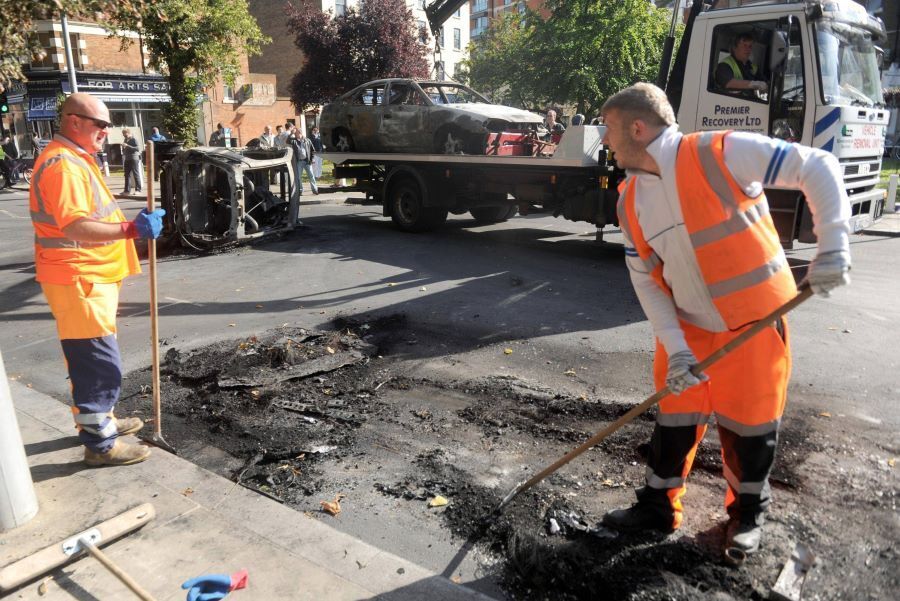
By the time Britain finally retook the streets of its own capital after four nights of chaos and mob rule, lawlessness had fanned out to other cities as the world looked on in horror.
The shooting dead by police of suspected gang member Mark Duggan in the back of a minicab triggered the initial community anger which left parts of Tottenham ablaze last Saturday, but the genuine anger felt at the perceived lack of communication and respect shown by Scotland Yard to his grieving family was soon overtaken by more sinister forces.
The mob has been an interwoven feature of London life throughout its sprawling 2,000-year history, from the 14th century Peasants’ Revolt to Hogarth and Dickens, and right up to more recent eruptions in Notting Hill and Brixton.
But what those social explosions had in common was at least the veneer of a political driving force — even the Gin Riots depicted so violently by Hogarth were triggered by taxation of the drink which had become the crack cocaine of 18th-century London.
This was different because the anarchy was so widespread, so sustained and appeared so lacking in motivation — the only unifying aspiration appeared to be opportunistic greed and a lust for lawlessness.
Indeed, René Descartes summation of the human condition, “I think, therefore I am”, was seemingly replaced by the more base maxim: “I loot, therefore I riot”.
One teenage rioter looting JD Sports in Manchester said: “Of course I can afford to buy the trainers, but why pay good money when you can get stuff for free?”
Previous generations denounced the police they clashed with as “fascists”, or in West Indian parlance, “the Babylon”. It was telling that this generation of rioters uniformally referred to cops as “the feds” — casually aping the language of the Wire, even as they robbed boxsets of the series from HMV along with XBox’s and Wii’s.
When Debenhams in Clapham Junction was overrun, rioters not only used the store’s branded carrier bags to take their haul away in, but also took time to make sure the clothes they were stealing were the right size — try before you loot.
The swiftness of the descent into lawlessness and failure of the police to respond were the things that shocked British civil society most. Faith in the police was already in freefall after the News of the World hacking scandal left Scotland Yard riven in crisis and forced its two senior officers to resign.
The sight of a 50-strong mob trying to set ablaze a crowded restaurant near Lord’s Cricket Ground simply because an orgy of destruction had gripped the rioters, and that they believed they could get away with it because of the curious absence of police, merely compounded middle England’s fears that the pillars of society were collapsing around them.
And the mob did not contain merely the disaffected and those divorced from a consumer society they had no chance of buying into, those arrested included law students, trainee social workers and other professionals.
The randomness of the looters ranged from an 11-year-old girl robbing an off-licence to a disabled, middle-aged man who was found by police locked inside a mobile phone shop in Streatham. He could not escape with the other thieves when the security shutters came crashing back down because he was disabled and riding his shop-mobility scooter as he looted.
The anarchy spared no one — not even those driving it. In Croydon — scene of the single most haunting image of the unrest when a woman jumping from a burning building was illuminated against the flames — a 26-year-old man was shot dead as he clashed with fellow rioters over the goods they just looted.
As 39-year-old Sri-Lankan immigrant Sivaharan Kanbiah surveyed what was left of his ransacked Hackney grocery store said: “You work all your life and in one night they come and destroy it. They did not just steal everything — they tore out the ceiling, they broke up the floor, they ripped out the shelves. I don’t understand such hate.”
Order was only restored when the streets of the capital were flooded with 16,000 police officers — 10,000 more than the previous night and three times more than were on duty during that supposed terrorist target, the royal wedding in April. But that show of force cannot be maintained for long. Especially as the Tory-led coalition refuses to abandon plans to slash £2 billion (€2.3bn) from police budgets over the next three years and cut numbers by 16,000.
Some on the left, such as former Labour mayor of London Ken Livingstone, who hopes to regain control of the city next year, were quick to point to the scale and severity of the government’s massive cuts programme as a key factor behind the unrest. Those on the right insisted a breakdown in family life which saw parents allowing their children to roam the streets like “feral rats” with no fear of a seemingly soft justice system was at the root of the disturbances.
Unemployment among the young is at an all-time high of 21%. Boroughs such as Haringay, where the disorder began in Tottenham, are having their youth services budget cut by 75%. Darker elements seem to have been at play as anarchy was unleashed.
Armoured police vehicles were deployed for the first time in London to push the 150-strong band of looters back from Debenhams in Clapham Junction and officers were given orders to fire plastic bullets if needed — but the police recoiled at crossing that Rubicon.
Met deputy assistant commissioner Steven Kavanagh said: “We are not going to throw away 180 years of policing with the consent of communities quickly. The repercussions and change to the way we police if we took the decision to use [plastic bullets] will be longlasting.”
At the height of the disorder, serious calls were made for the army to be deployed on London’s streets.
Talk of water cannon, plastic bullets and military units brought echoes of the North at the height of the Troubles. Dominic Bryan of Queen’s University’s warned that Belfast had endured troops on its streets for decades because that situation represented a divided society where the state no longer worked. “The symbolism of having to do it on London’s streets tells you — sends a message — about the state of society there too,” he said.
And all the while, the world looked on agog as “Burning Britain” challenged even the financial meltdown for global attention. A German TV channel compared London to Mogadishu, Syria and Iran branded it an “uprising” and one Russian newspaper declared the situation had reached such state of collapse that lions and tigers had been released from zoos and could now be heard roaring on the streets.
But it was not just trainers and mobile phones that were looted in the chaos — it was Britain’s very feeling of security and stability as well.
The only flame London was meant to be exhibiting was the Olympic one representing unity and hope at next year’s Games. But as the smoke began to clear above Riot City and more than 100 families who had been burned out of their homes looked for shelter as others buried their dead, the only question left lingering in the choking air was, why?