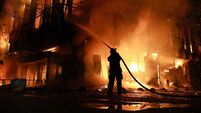
Millions face mounting humanitarian crisis as a tide of bodies covers coastline
Millions of people were facing a fourth night without water, food or heating in near-freezing temperatures in the northeast, devastated by an earthquake and the wave it spawned.
Meanwhile, a third reactor at a nuclear power plant lost its cooling capacity and the fuel rods at another were at least briefly fully exposed, raising fears of a meltdown. The stock market plunged over the likelihood of huge losses by Japanese industries, including big names such as Toyota and Honda.
A Japanese police official said 1,000 washed up bodies were found scattered yesterday across the coastline of Miyagi prefecture.
The discovery raised the official death toll to about 2,800, but the Miyagi police chief has said that more than 10,000 people are estimated to have died in his province alone, which has a population of 2.3 million.
In one town in a neighbouring prefecture, the crematorium was unable to handle the crush of bodies.
“We have already begun cremations, but we can only handle 18 bodies a day. We are overwhelmed and are asking other cites to help us deal with bodies,” said Katsuhiko Abe, an official in Soma.
In Japan, most people opt to cremate their dead and the government took the rare step yesterday of waiving the need for official approval for each cremation.
Friday’s double tragedy has caused unimaginable deprivation for people of this industrialised country — Asia’s richest — which hasn’t seen such hardship since World War II. In many areas there is no running water, no power and four- to five-hour waits for petrol. People are suppressing hunger with instant noodles or rice balls, while dealing with the loss of loved ones and homes.
“People are surviving on little food and water. Things are simply not coming,” said Hajime Sato, a government official in Iwate prefecture, one of the three hardest hit.
He said authorities were receiving just 10% of the supplies they need.
The coast has been hit by hundreds of aftershocks since Friday, the latest one a 6.2 magnitude quake that was followed by a new tsunami scare yesterday. As sirens wailed, soldiers abandoned their search operations and told residents of the devastated shoreline in Soma, the worst hit town in Fukushima prefecture, to run to higher ground.
They barked out orders: “Find high ground! Get out of here!” The warning turned out to be a false alarm.
In Soma, firefighters used handpicks and chainsaws to clear an indescribable jumble of broken timber, plastic sheets, roofs, sludge, twisted cars, tangled powerlines and household goods in their search for bodies. Helicopters buzzed overhead, surveying the destruction.
Ships were flipped over near roads, a kilometre inland. Officials said one-third of the city of 38,000 people was flooded and thousands were missing.
In addition to the more than 2,800 people who have been confirmed dead, more than 1,400 were missing. Another 1,900 were injured.
Japanese officials have refused to speculate on the final death toll, but experts who dealt with the 2004 Asian tsunami offered a dire outlook.
“It’s a miracle really, if it turns out to be less than 10,000 [dead],” said Hery Harjono, a senior geologist with the Indonesian Science Institute, who was closely involved with the 2004 disaster that killed 230,000 people, of which only 184,000 bodies were found.
The Japanese government has sent 100,000 troops to lead the aid effort. It has sent 120,000 blankets, 120,000 bottles of water and 29,000 gallons (110,000 litres) of gasoline, plus food, to the affected areas. However, electricity will take days to restore.
According to public broadcaster NHK, some 430,000 people are living in emergency shelters or with relatives. Another 24,000 people are stranded, it said.