Attacks put Israel under siege at home and abroad
Five Israelis were shot dead at a Likud branch packed with voters and a nearby outdoor bus terminal in the northern Israeli town of Beit Shean. In Kenya, at least two Israelis, six Kenyans and three suicide bombers died in an attack on an Israeli-owned hotel, and two missiles just missed a commercial Israeli airliner after take-off.
The Likud race was widely seen as determining who will lead Israel after the January 28 general election, because the rightist bloc of parties led by Likud has enjoyed commanding leads in the polls over the dovish bloc led by the Labour Party.
As the month-long campaign wound down, polls among the 300,000 Likud party members showed Sharon ahead by more than 20% over the once-favoured Mr Netanyahu, who himself served as prime minister between 1996-1999.
TV projections and early results were expected after polls close at 10pm.
At a news conference, Mr Sharon urged Likud members to vote despite the Beit Shean attack, claimed by the Al Aqsa Martyrs' Brigade militia linked to Palestinian leader Yasser Arafat's Fatah movement.
"We cannot allow the murderers disrupt our lives," he said. "The Palestinian Authority and Arab countries want to intervene in our democratic process."
It was not clear how yesterday's attacks would influence the Likud vote although historically terrorism has tended to make Israelis more hawkish, which could help Mr Netanyahu. Furthermore, Israeli media reported turnout was unusually low a trend which, if it persists, could significantly skew the results.
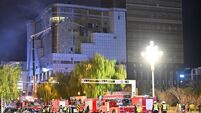
The day's violence began when a green all-terrain vehicle packed with explosives rammed through the gate of the Israeli-owned Paradise Hotel near Mombasa, Kenya, at about 8am.
One man jumped out and blew himself up inside the hotel, while the others detonated the vehicle out front, witnesses said.
Around the same time, two missiles streaked by a jetliner owned by the Arkia charter company as it left the Mombasa airport. Passenger Kerry Levy, 25, said the aircraft's wheels had just lifted off the runway when she felt a rattle that "felt like something fell off the wing." The plane continued on its route to Tel Aviv.
Officials in Kenya said they suspected al-Qaida involvement in the attacks, and Israel said the famed Mossad intelligence agency would investigate. Defence Minister Shaul Mofaz said Israel would track down the attackers.
Hours after the Kenya attacks, five Israelis were killed in the northern Israeli town of Beit Shean when two Palestinian gunmen sprayed a Likud branch packed with voters and an adjoining bus station with gunfire and grenades, witnesses and officials said. The two gunmen were killed.
The gunmen were killed in a protracted firefight with police and armed bystanders. One of the dead gunman wore an explosives belt that did not go off. Despite the shooting, voting continued at Likud branches throughout the country.
The winner will face Labour's ex-general Amram Mitzna, who favours an immediate return to peace talks with the aim of swiftly withdrawing troops and settlers from most of the West Bank and Gaza, territories Israel seized in the 1967 Middle East war. He supports a far-reaching settlement with the Palestinians and says he's willing to withdraw from some areas unilaterally if no deal is possible.
Mr Sharon says all violence must stop before peace talks resume. And while he has surprised many by saying he, too, favours a Palestinian state eventually albeit a restricted one few believe he would meet the Palestinians' demands for a state on all the West Bank and Gaza as well as east Jerusalem.
Since coming to power 21 months ago in the early days of the Palestinian uprising, Mr Sharon has overseen a gradual escalation of military efforts to crush radical Palestinian groups that have waged a terror campaign against Israel.
He sent troops barreling into West Bank cities, destroying much of the Palestinian autonomy government created by the 1990s interim peace accords, removed past peace proposals from the table and refused to deal with Mr Arafat with whom Mr Sharon has had a decades-old and bitter feud.
Mr Netanyahu, who opposes Palestinian independence entirely, says Mr Sharon's efforts to crush the uprising have not been forceful enough. He also calls for expelling Mr Arafat a move Mr Sharon has refrained from ordering.
Mr Netanyahu was once considered practically a shoo-in for a return to the prime minister's position. But he appears to have been outflanked after Labour bolted Mr Sharon's coalition last month. Mr Sharon appointed Mr Netanyahu foreign minister, a position from which he risked appearing disloyal whenever he criticised Mr Sharon. Israel has cancelled its experimental direct election for prime minister which had been in effect for the 1996, 1999 and 2001 elections and the January vote will be for parliament only. The prime minister will be the party leader able to command a majority among the 120 parliament members.
The two years of violence have moved Israelis to the right, and polls suggest that the Likud leader will have the best chances. "Sharon drags around a paltry list of achievements, but the failures don't stick to him," wrote political commentator Ben Caspit in the Maariv newspaper. "On the contrary ... the father of the nation, the ultimate teflon, is sailing calmly toward a second term. Who would have believed it?"
Still, many people remain undecided and polls also show the Israeli public is deeply dissatisfied with the economy plummeting, peace prospects dim, and Israelis appearing more vulnerable to terrorism than ever before.
CONNECT WITH US TODAY



Be the first to know the latest news and updates