Ireland v Israel: Hallgrímsson would accept neutral venue even if it hampers winning prospects
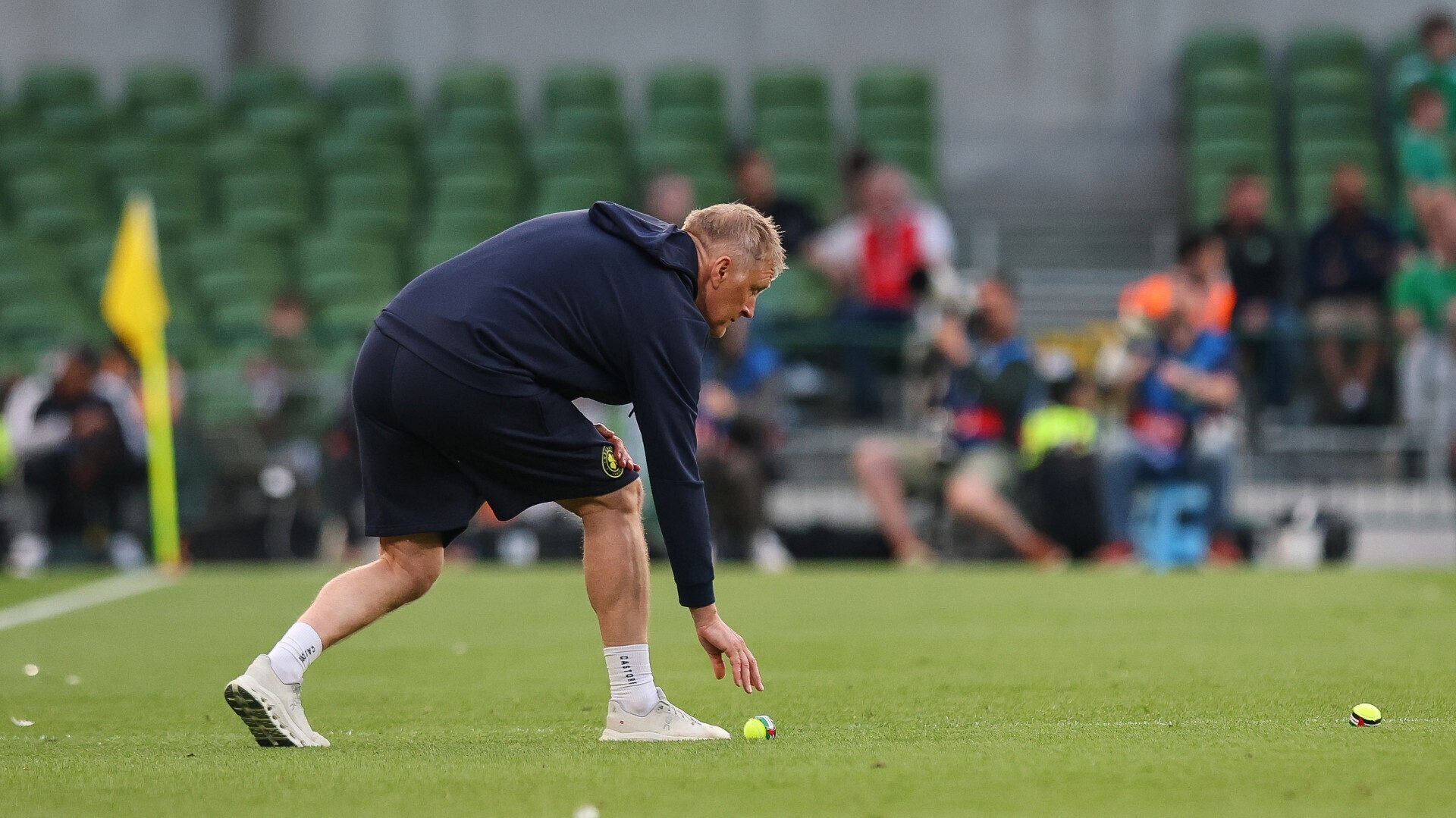
Ireland head coach Heimir Hallgrímsson removes tennis balls that were thrown onto the pitch. Pic: Ryan Byrne/Inpho
Heimir Hallgrímsson says he will accept Ireland conceding home advantage against Israel, even if it hampers their winning prospects.
Heightened pressure on the FAI over the last week – from player attitudes and fan protests – has prompted the hierarchy to consider moving the October 4 fixture out of the country.
Although the Garda Síochána advice of giving the fixture the go-ahead hasn’t changed, there is increasing concern for the safety of players and FAI staff involved in the game.
Fifa and Uefa have applied no sanctions on Israel despite the United Nations finding them guilty on genocide in Gaza and the West Bank. This contrasts with their indefinite suspension of Russia within days of them invading Ukraine.
Ireland manager Hallgrímsson has highlighted those double-standards since his opinion was first sought but as the clamour intensifies, he’s concentrating on the ramifications from a footballing perspective.
“I don’t think we should boycott the game,” affirmed the Icelander.
“Number one, it would cost us relegation to League C of the Uefa Nations League and future national teams will suffer.
“But most of all we are giving them gifts of six points and six-zero in goal-difference.
“Israel will most likely win the Nations League group if we do that because it’s tough not to win the group with that start.
"Then Israel will have easier access to come and play in the finals in Ireland.”
His final sentence was pointed.
As it stands, Ireland will have home advantage for all their Euro ’28 finals once they qualify on the pitch.
If they fail to do so, Ireland are relying on one of Scotland and Wales joining near certainties England in qualifying. Should two of those three fail to emerge from the groups, Ireland could be squeezed out.
That will depend on rankings, a table influenced by how teams fare in the Nations League being held between September and November of this year.
Ireland and Israel are joined in their group by Austria and Kosovo, whom Ireland open against in Pristina on September 24.
Comments by veteran Séamus Coleman expressing his discomfort at the handling of the matter by Uefa and the FAI illustrated the attitude of players towards the games.
Hallgrímsson intimated that a statement on behalf of the players would be forthcoming, on the basis of a resolution being found.
“We are just talking about these things and hopefully the matter will be resolved before the Israel game in September,” said the manager, who confirmed no players have so far declared their objection to playing the matches.
“For me there is no concern, but we would respect that opinion and decision of a player.
“We will tackle that if it comes to that, seeing what happens and how it pans out.”
Given how the topic dominated before, during and since Thursday’s 1-0 win over Qatar, its sure to be a topic of conversation for players during Saturday’s seven-hour flight to Montreal for next Friday’s final game of the season against World Cup co-hosts Canada.
Events may overtake any collective position taken by the players. The FAI on Friday afternoon received a petition from the requisite 10% of its General Assembly calling for an emergency general meeting.
Its sole agenda item is boycotting the two games against Israel, scheduled for neutral territory in Debrecen on 27 and Dublin a week later.
Under FAI rules, summits are called within 60 days but the association’s board will consider the topic sometime next week before responding.
Only legal eagles can adjudicate whether they are necessarily compelled to agree to the request, especially when the grouping that includes Cork City and Bohemians acknowledge the outcome of the motion is non-binding.
Should it proceed, members will be informed of the footballing risks and the financial cost of both boycotting and moving to a neutral country.
“If the decision is made from higher up, then we have to respect that,” noted Hallgrímsson.
“We are the football players and coaches. This is from a political level and those who are in government should take these decisions.
“Not playing in the Aviva would of course be difficult for us because we have been really good here and have had such fantastic support here.
“We would always minimise our chances of winning it if we played in a neutral value or somewhere else.”

CONNECT WITH US TODAY



Be the first to know the latest news and updates