‘Keine fotos! Keine fotos!” From somewhere, the lady in the orange high-vis vest is suddenly moving at a disarming speed. She had not been vis at all until her sharp, adamant warning pierced the quiet.
No photos, no problem my dear frau. These pictures of Hertha Berlin pre-season training I’ve just taken from 25 metres away, through a hedge aren’t close to my heart and weren’t bound for the Germany 2024 Insta montage anyway.
The phone had been taken out almost instinctively because it was the first sight and sound of actual sport at the sprawling Olympiapark since arriving a half hour earlier.
Apart from Hertha’s players shaking off their summer, the stretching and sweating was primarily being left to the landscapers and delivery drivers, the crane operators and flag hanger-upperers.
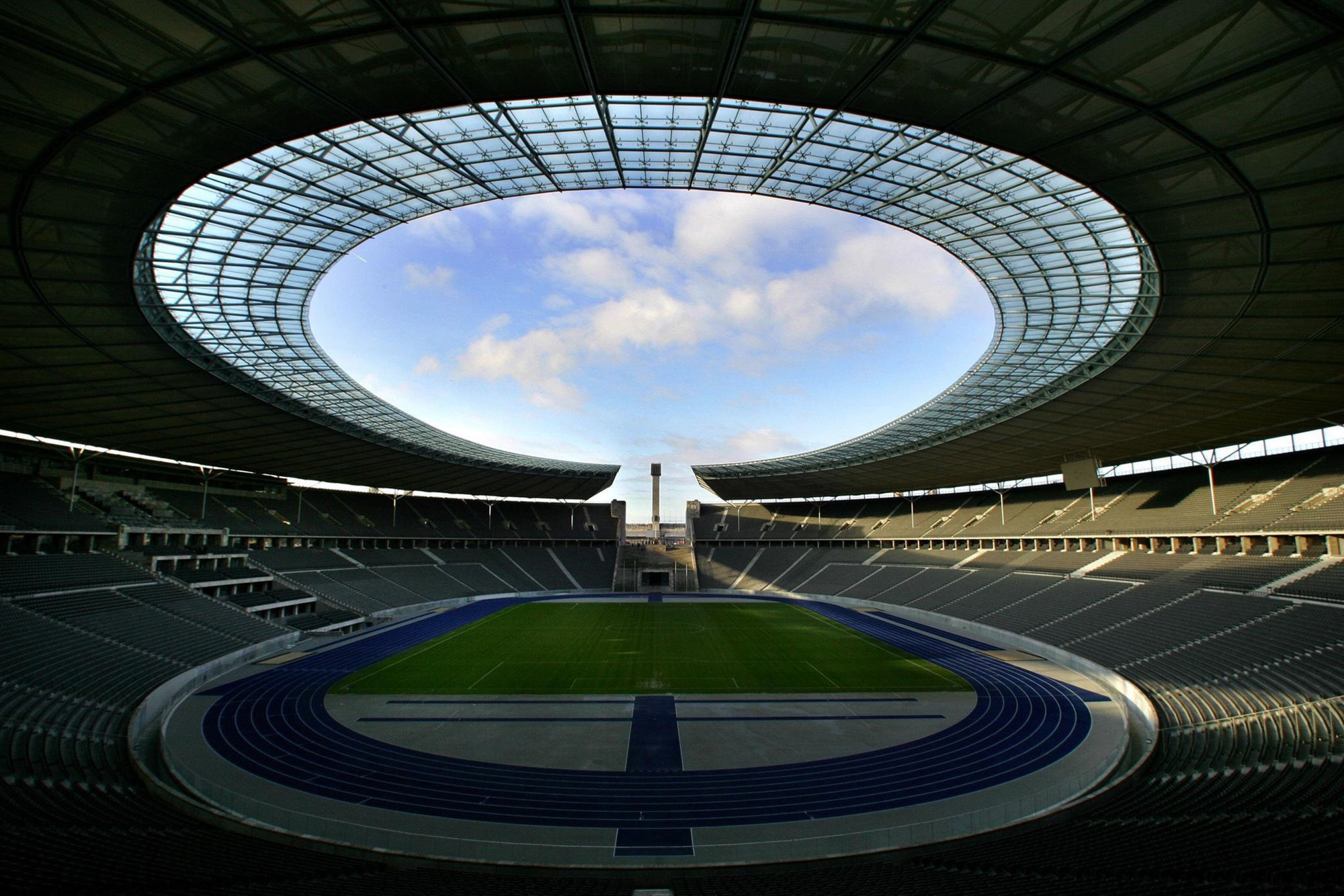
The venue for tomorrow’s Euro 2024 final was doing its own limbering up, an England flag being stretched between two of the Olympiastadion’s iconic pillars. The blue Uefa background on the flags meant the two team logos and the Henri Delaunay Trophy between them really popped off, helped by the weathered limestone facade of the pillars.
The brown-beige stone is kinda doing what it was originally intended to — stand as a symbol of the permanence of Hitler’s Thousand Year Reich.
That’s why we’re out here on a Friday morning before the rest of Berlin have pondered what’s for elevenses. Because the XI from England and Spain are just part of the cast of characters of tomorrow’s decider.
More than most arenas, this beautiful but haunted old house is a character too. A secondary one, sure, but carrying plenty of resonance and impact with it.
The two-story colonnade of 136 pillars and the huge bowl contained within rose in just two years, from 1934 to 1936, in time for that year’s Olympic Games, which the Reichsfuhrer was eager to use to send a booming symbol of Nazi Germany’s greatness out to the world, to boost his message of racial supremacy and antisemitism.
We know how all that generally went but a first helpful reminder comes when you step off the S9 and up out of the S-Bahn station to find yourself on Jesse Owens Allee.
The American track and field specialist racked up four gold medals in front of Hitler to put a bit of a pin in the whole racial supremacy thing, even as Germany dominated the rest of the Games.
The fact that the place survived the nine years that immediately followed those Olympics, when swathes of the city were flattened may have something to do with Allied bombers using it as a landmark for the rest of the city to the east.
After the war, the city carved into four, the British moved in and took over the entire Olympiapark as a military headquarters.
A tournament that has already had two home teams in Germany and Turkey perhaps offers a third on its final day as Gareth Southgate and his players make a beeline for a place that until very recently hosted celebrations for the queen’s birthday on the Maifield lawns, like the stadium, designed by Nazi architect Werner March.
Berlin’s cricket clubs still call Maifield home but for this month have been pushed out. As we walked through yesterday morning, picking up the pace with an extreme thunder storm warning issued, Uefa’s Partner Village and Maifield Garden Club were both hurriedly being expanded for the corporate masses who will descend in two days.
After disastrous experiences at its major finals in Paris and Istanbul in recent years, Aleksander Čeferin and co are eager for a smooth Sunday in the suburbs. But they’ll be equally keen for some iconic drama too.
This is a big occasion and, even with its dark history, the modern Olympiastadion has on its big occasions been a place of blinding light.
Renovated with a roof added in time for the 2006 World Cup, Zinedine Zidane duly blew his own top and walked down the steps and out of the game as Italy triumphed in the final. In 2009, Usain Bolt shattered both the 100m and 200m records at the World Championships. Its most recent decider, the 2015 Champions League gave us two good omens with Alvaro Morata scoring (for Juventus) and the Spanish side (Barcelona) triumphing.
This most politicised Euros is nearing its end, elections across the continent, not to mention conflicts, during the past four weeks ensuring that geopolitics rarely moved far from the surface.
Tomorrow the literal surface is, in its way, political because much as Germany has reckoned with its history over the decades and reckoned with what happened at some of these surviving relics, old evils are finding new minds, the extreme far-right AFD party celebrating historic vote shares.
Lamine Yamal, a bright smiling face for a new Spain, has had us thinking about the passing of time. Watching a 16-year-old make miracles happen will do that.
One thought: If you can rewind the mind and remember Euro ’88, well you’re almost halfway back to the Holocaust. None of this is ancient history, even less so given current events.
So no, no photos. But we must still look at the present, at hulking physical reminders like the Olympiastadion, and see them as warnings from the past.

Cancel anytime
CONNECT WITH US TODAY
Be the first to know the latest news and updates