Factory trailblazers raised bar for women's football on 'Tour de France’
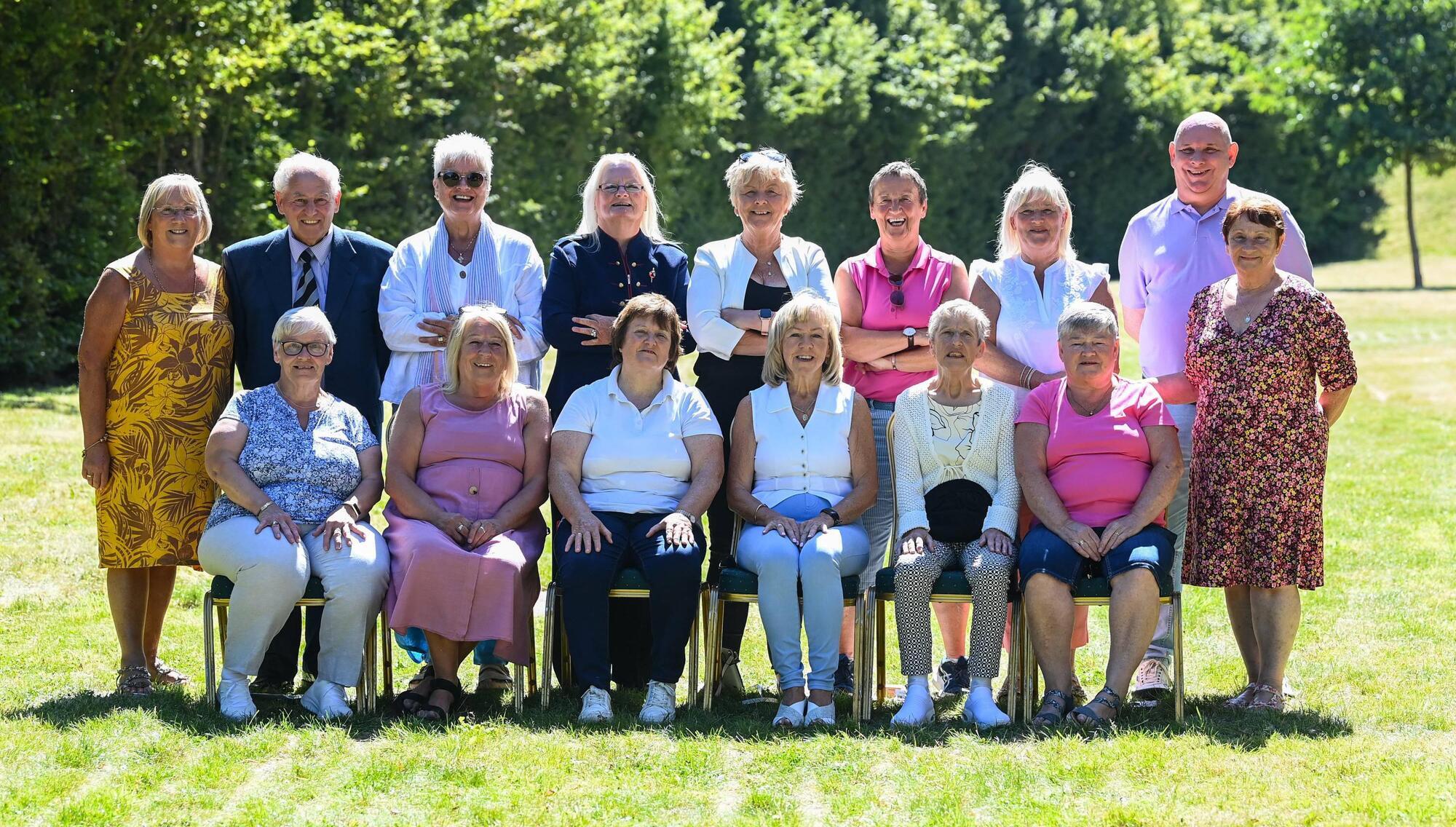
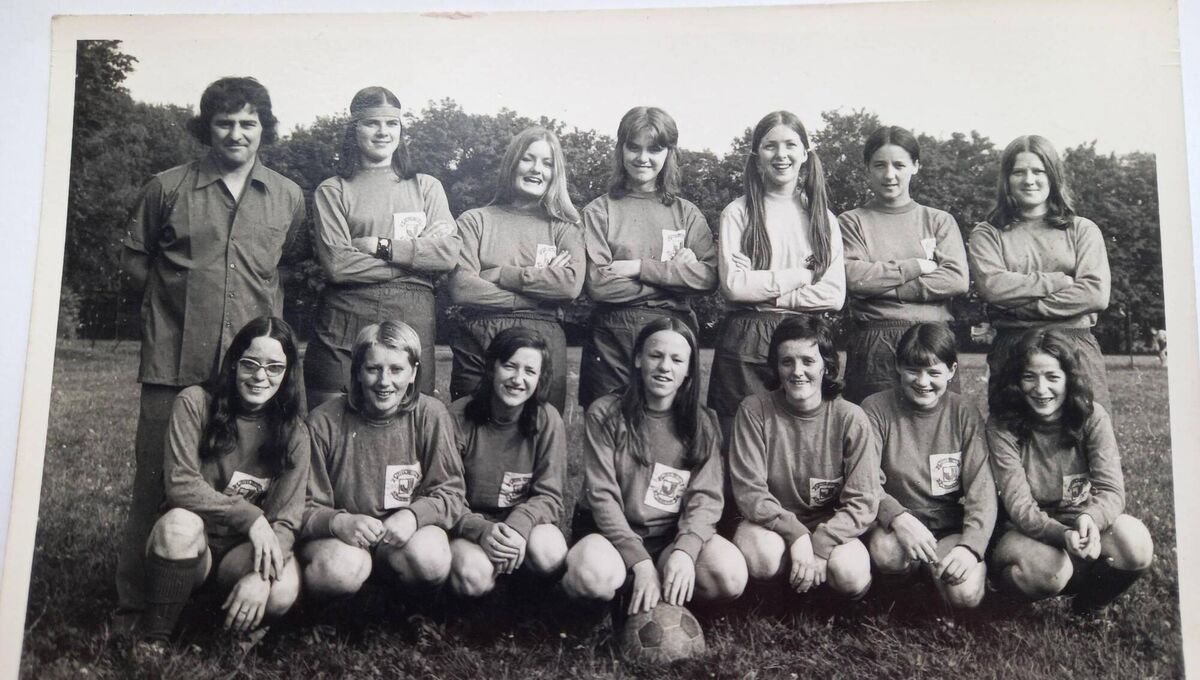
REUNION: Back row, from left, Imelda Noone, Tommy Delaney, Kathleen Ramsbottom, Ann Delaney, Kathleen Caulfield, Margaret O'Connell, Ursula Grace, Joseph Noone and Patrica Noone, with, front row, Connie Jordan, Teresa Walsh, Catherine Rafferty, Linda Gorman, Carol Neary and Teresa Doyle during a reunion event, at the CityNorth Hotel in Meath, to mark the 50th anniversary of the Jeyes team from 1972 who went on a four-game tour of France. Jeyes were a Dublin-based factory women's team who accepted an invitation to travel to France for a mini tour that included taking on Stade de Reims. Photo by Stephen McCarthy/Sportsfile
It was the very first time that Kathleen Caulfield tasted Coca-Cola, or at least that’s how she remembers it as the baby of the Jeyes team that went on a landmark soccer tour in France in the early 1970s.
She grew up playing in the midst of the ‘shilling-a-man’ street games in Cabra West until someone told her that a local girls’ team had finally been set up.
That’s how she got scouted by Jeyes, who made cleaning products in Finglas and were one of the many factory teams that emerged in those embryonic days of Irish women’s football.
But she was only 14 at the time.
How on earth did she persuade her parents to let her travel to France for Jeyes’ unprecedented four-game whistlestop tour against Stade de Rheims in September 1972?
“My father was a stickler. They came up to the house and he looked at every single detail and they swore they’d mind me like a baby, and they did.”
Caulfield wasn’t actually employed by Jeyes. Only three of the touring team were and most of her teammates were still only in their late teens or just into their 20s.
Factory teams recruited far and wide at the time and, to strengthen their touring squad, Jeyes recruited three players (Kay Ramsbottom, Connie Jordan and Ursula Grace) from Evergreen of Kilkenny.
Their epic week-long trip provided more than just a football education.
None of them had ever stepped on a ferry before, not to mind tasted champagne. By the time they got back they’d also, accidentally, tasted horsemeat and spent their final day sightseeing in Paris.
Five of them went on to play for Ireland but most quit football within a few years when work and families demanded more of their time.
But they met again recently, for the first time in 50 years, to swap cherished memories, capture their history and be reminded of just how far ahead of the game their unprecedented 1972 ‘Tour de France’ was.
The garden of a hotel off the M1 reverberated with their unbridled chatter and laughter, not least when Ramsbottom exhorted them to all shout ‘knickers’ to ensure they were smiling for an updated ‘team photo’.
Gareth Maher, the FAI’s Communications Officer, was there to invite them to be guests of honour at Ireland’s World Cup Qualifier against Finland next Thursday.
O’Neill’s also got wind of the reunion and offered to create special replica shirts to wear that night, so they used the occasion to agree a design that will be watermarked with a photo of Pat Noone, their great mentor.
Galway man Pat, a supervisor in Jeyes, coached their women’s team on a pitch adjacent to the factory.
When the Dublin Ladies League and a national cup competition were set up in March 1971 there were already reportedly 60 women’s teams in the capital and also a separate Civil Service league.
UEFA only officially mandated its members to recognise and support female football later that year but its first women’s committee had disbanded by 1978 and its first sanctioned competition didn’t take place until 1982, 10 years after the Jeyes’ tour.
That left the nurturing of the game and international relations up to gems like Noone who had limitless ambition for his players.
Stade de Rheims contested two European club finals in the 1950s and 10 of their players represented France in what was ostensibly the women’s World Cup (for club sides then) in Mexico in 1971.
They were founded and coached by Pierre Geoffroy, a French sportswriter, who was open to the collaboration when Noone contacted him.
For Linda Gorman, who went on to play for Ireland, coach at Home Farm and become the first female Irish manager, the tour was a moment of enlightenment and empowerment.
Their opener, under lights in Reims, drew a 1,500 crowd who booed the visitors throughout.
Jeyes lost 5-0 but eventually finished the series (played in four different and far-flung venues) with two draws and two losses.
What struck Gorman immediately wasn’t the animosity from the terraces or the understandable difference in class, but the respect and support for their opponents, including the quality of their pitch and stadium.
French television covered the tour in its news bulletins and one local newspaper report carried an action photo of Teresa Doyle headlined ‘Cette femme est dangereuse’ (This woman is dangerous).
“That tour set the bar for me in terms of how we, as players, should be treated and I never again lowered it,” Gorman says.
The Jeyes team later morphed into ‘Avengers’, as her great mate Catherine Rafferty, recalls.
They were childhood friends in Finglas and started out playing for Civil Defence after excitedly spotting an ad in the seeking players for a new women’s team in Ballymun.
“People would come over to watch us in places like the 15 Acres (Phoenix Park), initially out of curiosity but then stay because we were quite polished,” Rafferty recalls.
“I remember one game in Ringsend with Avengers, a big crowd down both sidelines. When we finished they spilled onto the pitch. They’d never seen women playing like that before.”
Rafferty’s career was relatively short and she admits to never really telling her eight children or grandchildren about it.
Defender Ann Delaney, who worked in Jeyes, was already married before the tour and her husband Tommy also travelled as part of their small support team.
Delaney played football well into the 1980s and delightedly explained that her 10-year-old granddaughter won ‘Player of the Season’ with her club last year.
“I was a bit of a tomboy then and if Pat Noone had asked us to kick snow off a rope we would. He was an absolute gentleman,” she says.
Jeyes provided special kit bags but their tour was self-funded and a relative unknown called Johnny Logan was enlisted to play at one of their fundraisers in the Drake Inn.
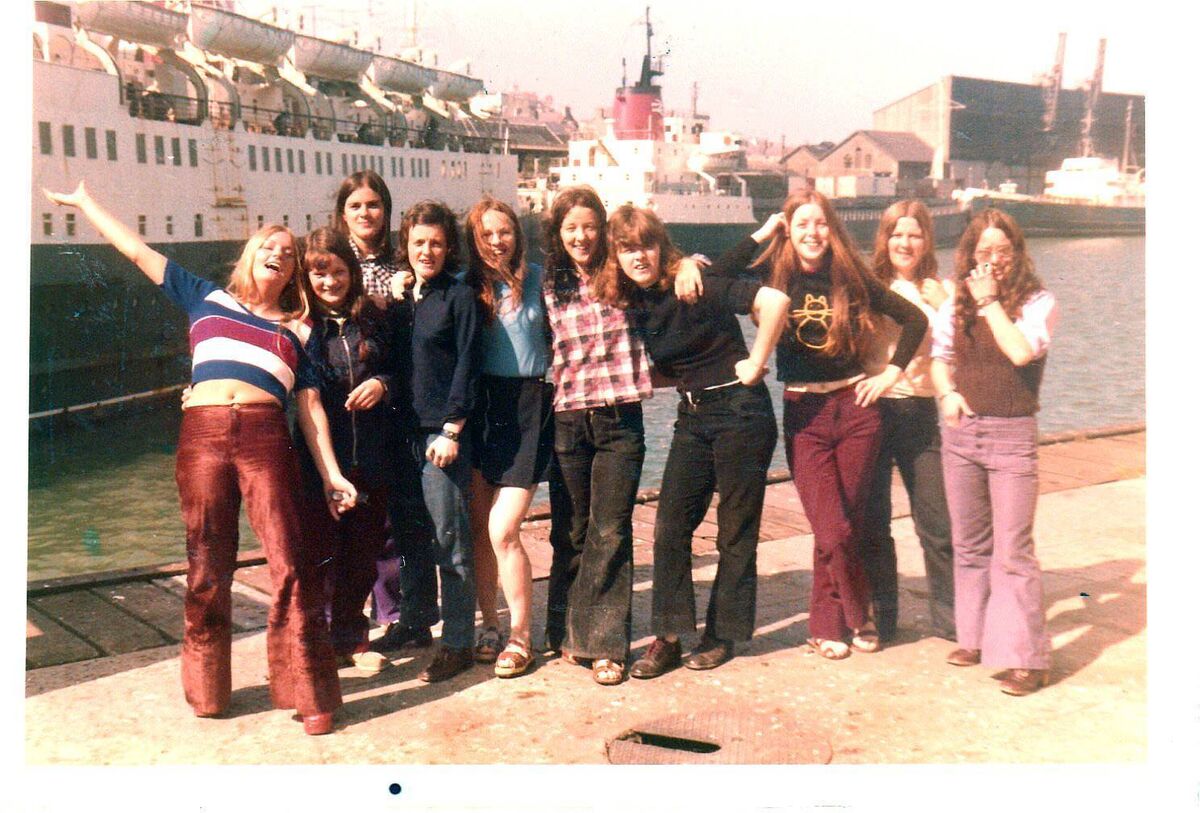
They took the boat from Dublin to Holyhead and a ferry from Dover to Calais and stayed in a hostel in Reims, run by an enclosed order of nuns, though that still didn’t stop some of the wildest from sunbathing on the roof or breaking their curfew.
They were, literally, ahead of their time because the first governing body for Irish women’s football (ILFA) wasn’t set up until the following year.
Only now are they grasping their significance, largely thanks to Meath woman Helena Byrne, a London-based librarian and historian who got the British Society of Sports History to fund their reunion.
Stade de Rheims came to Ireland for a much more extensive tour, against club and representative selections, a year later, which is how they came to sign future superstar Ann O’Brien.
The French club had already offered Ramsbottom (who also represented Ireland at racquetball) a contract which she refused because it was only part-time.
A tall centre-back with a trademark sweatband, she was among four Jeyes players (with Mags O’Connell, Ursula Grace and Linda Gorman) selected for Ireland’s first official international (versus Wales, in Llanelli)) in May 1973 but didn’t take part as she couldn’t get off work.
Ireland played their first four internationals that year, managed by Noone, the first secretary of the ILFA.
It's no coincidence that their third, in October ’73, was a prestigious tie in Parc de Princes.
No English newspaper report has been unearthed yet but there is a two-minute video clip of it in France’s national audio-visual archive.
Ramsbottom only managed to play that day by getting a doctor’s cert for the 10-day trip and, when eyebrows were raised at her impressive tan on return, feigned jaundice.
Only two of Jeyes’ 1972 touring party – Noone and chief organiser Mary Hughes – have since passed away.
Goalkeeper Clare Anderson lives in America and Helen Burke couldn’t make the reunion but everyone else did, including Noone’s three children.
Mags O’Connell is a single-figure golfer these days and Linda Gorman looks fit enough in her late 60s to still tog out but confines herself to a few weekly games of ‘walking football’ where she is still a rarity.
“I play with men, a lot of them ex-League of Ireland. They couldn’t believe that women could play the way I played but I tell them I was actually average compared to some of the women I used to play with. I was just lucky to have good coaches.”
Like many of her past and current teammates she was glued to the recent European Championships and delighted at the reaction they garnered.
“The men I play with watch the Women’s Super League and follow the Irish women’s team. That’s honestly what you hear them talking about. It’s fantastic.”
Older women sometimes complain of becoming invisible to wider society. The history of their team sports is usually buried after decades of unequal support and media coverage but, 50 years on, Jeyes’ female footballers are finally being seen.
Clare Anderson; Helen Burke, Kathleen Caufield, Ann Delaney, Kathleen Ramsbottom; Margaret O’Connell, Carol Neary, Connie Jordan, Teresa Doyle; Linda Gorman, Catherine Rafferty. Reserves: Teresa Walsh and Ursula Grace.

CONNECT WITH US TODAY



Be the first to know the latest news and updates