What's the cost to Ireland of losing the England v Germany match?
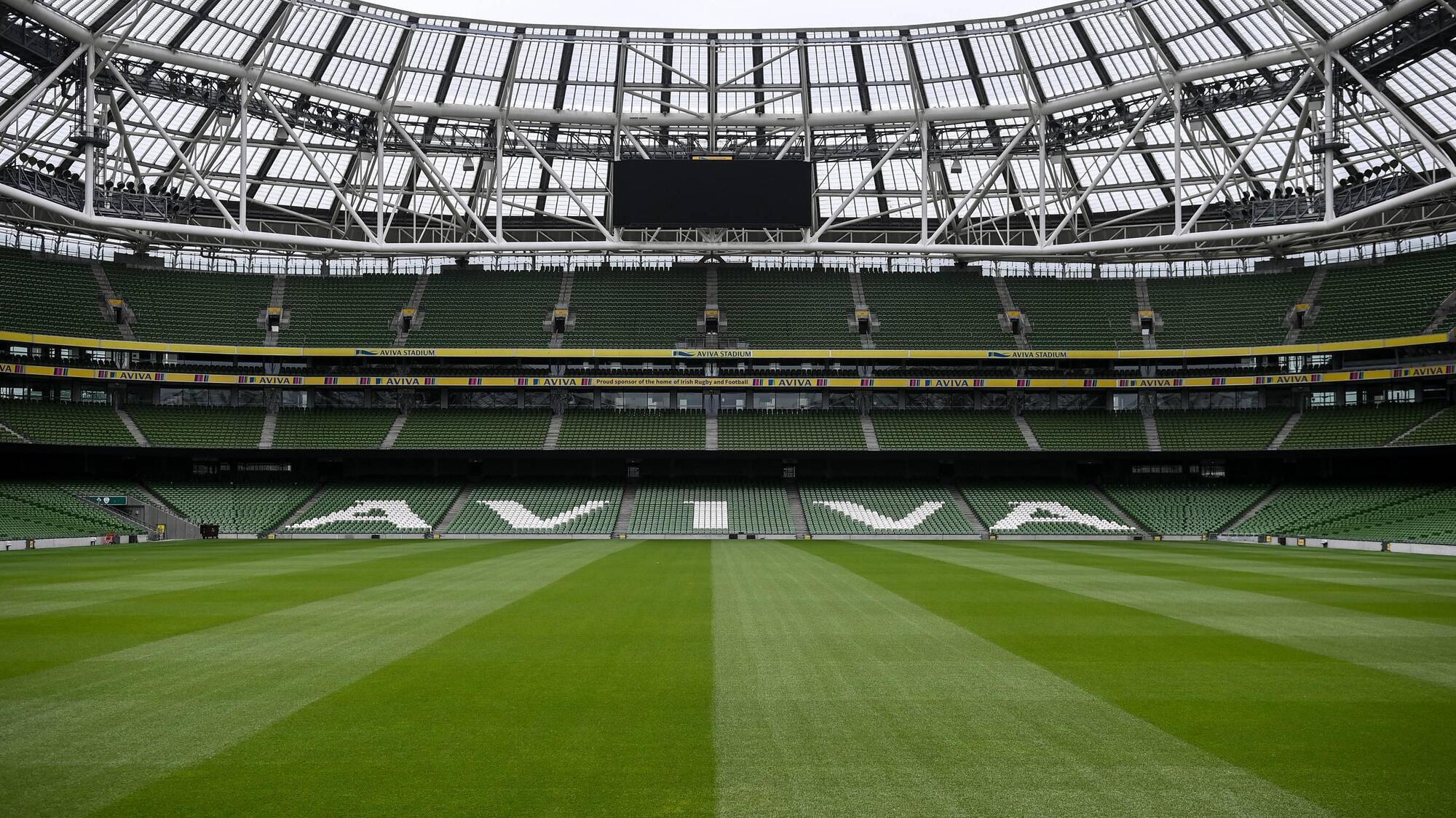
The Aviva Stadium was due to host tomorrow’s Euro 2020 second-round clash between England and Germany. Ireland relinquished its position as a Euro 2020 host due to Covid concerns. Picture: Stephen McCarthy/Sportsfile
TOMORROW at 5pm, up to half a billion football fans will settle down to watch the greatest sporting event that almost took place in Ireland.
England v Germany in Euro 2020’s Round of 16 should have been beamed across the world from Dublin’s Aviva Stadium, putting Ireland at the forefront of global attention and benchmarking the nation as a serious player as a sports host.
Instead, a captive global audience — which will include 50 million English and Germans — will focus on London, with Ireland Inc. losing out on priceless gold star marketing that only sport can achieve.
While the residents around Ballsbridge won’t miss thousands of tanked-up ‘Eng-er-land’ fans causing a racket, the sports business sector is lamenting the opportunity that would have come from hosting our largest ever sporting event.
Even in Covid times with limited attendances, had the four games slated for the Aviva gone ahead, the loss of revenue amounts to €20m in immediate cash impacts, and an “unquantifiable amount” in future spending.
Long-term forecast measurements will be worked out by tourism agencies based on the number of global viewers — in Germany, 25 million watched their team’s win over Hungary, while 20 million watched England v Scotland on BBC.
However, after passing up on the marketing opportunity of a lifetime, the Aviva will be empty and the streets around Irishtown and Ballsbridge will remain as silent as they are leafy.
With the Irish Government unable to commit to criteria required for fan attendances, Uefa withdrew Dublin as a host city in April, and with it, Ireland became the only co-host country of 12 to drop out of the tournament.
It was clear that the Government was paralysed by Covid, and was unwilling to establish benchmark safety measures (with testing and proof of vaccination) to allow a strictly limited audience on matchdays. But this is an ultra-conservative leadership that, even outside of Covid times, is unable to put up a determined fight to win and globally important events and the Euros has gone the same way as the Web Summit — overseas.
So is politics destroying sports and global events through fear, disinterest, or lack of foresight, and what are the impacts of such intransigence?
To assess this subject objectively, I must declare a subjective interest in Uefa Euro 2020 — up to its termination from the tournament roster, I worked as a consultant and special adviser on the project. I was also centrally involved (communications) within the working group in 2016/17, when I was a member of the local organising structure (LOS) working group.
Such close engagement with an exciting and ambitious project for football and for Ireland, alerted my attention to the considerable benefits across all sports had it succeeded. Success in hosting a Euros would certainly have provided a high-bar platform for the successful bidding of future sporting events — imagine a Rugby World Cup bid from a nation that hosted an even bigger competition?
The knock-on effects for political conservatism are not just a setback for football and sport, but for the business of sport and its related industries.
Such decision-making can have chronic effects on the revenues these events bring to the state coffers — not only to the sport itself but across tourism, marketing, and creative sectors.
But given the seemingly, unflinching way this event was handed back to Uefa, it is now important to examine through specific headings if there is any real damage as a consequence, or if there are even consequences at all.
To properly analyse the impacts (or otherwise) of losing the Euros, it will be constructive to examine the loss under the pillars of Political, Business, Sporting, and Marketing.
Political
A former Government minister who was central in involvement around preparing Dublin as a host city for the Euros spoke off the record about the matter — he had agreed to an interview but failed to show the following day.
In our pre-interview conversation, I asked the sitting TD (a member of the ruling coalition) if, due to the conservative nature and the disparate multi-party make-up of the current government, big decision-making (influenced by Nphet) is effectively paralysed?
He said: “Look it’s (Euro 2020) a huge loss, but this was not a priority.”
I told him that our interview would question if Government could have adopted a more flexible approach, with correct planning and testing for attendees and also to consider the reputational impacts for the country as a whole and if he thought that they were any. He agreed that these were “good points to discuss”, but then didn’t.
My bad, I gave him too much food for thought and he declined two phone calls and one text message. I certainly don’t blame him. His reluctance to put his name to such a missed opportunity demonstrates that Government realised the scale of the loss, if only after it had gone.
The clearest demonstration came from Taoiseach Micheal Martin, who couldn’t contain his fury, in the days and weeks after Uefa’s decision to strike Ireland from the roster. Mr Martin was in point-scoring mode when he appeared on RTÉ and decried Uefa for making the “wrong call” and being “out of order”.
One Uefa observer at the time believed this was classic “political deflection” by the Taoiseach, “who had just realised the enormity of the situation after discovering the door open and the stable empty”.
Sporting
There is some sympathy for the FAI — not a phrase you’d have heard too often — who are blameless and essentially powerless in getting the competition over the line.
If anything, the organisation, now under a new and more responsible leadership, turned its sheer disappointment at the inevitable crash into a relatively successful exit strategy. Despite losing out on the event, along with its 25 stakeholders and fellow partners — Department of Tourism, Culture, Arts, Gaeltacht, Sport and Media, Dublin City Council, and Aviva Stadium — its CEO Jonathan Hill succeeded in securing a Europa League final for 2024, a mutually acceptable softener for all.
Observers will point out that Hill has more pressing concerns on his desk, such as ridding the Association of a monstrous €60m debt (which is largely being serviced by Government) and ongoing legacy issues that still lurk in the corridors of Abbotstown.
Hill and his sponsorship team’s primary focus is getting a headline commercial partner over the line and growing new revenue streams, but a Euros would certainly have helped with repairing the federation’s creditability.
Irish football’s reputation as an efficient host to big football events remains intact — it successfully held the Europa League final in May 2011 on the same day the Queen of England came to Dublin — presenting a protocol, logistics, and security nightmare for match organisers, given the short notice by Buckingham Palace.
Its success in delivering the final, without incident, absolutely influenced its achievement in 2014 in securing a slot as co-host to Euro 2020.
The enormous Euro effort was run by LOS project leader Declan Conroy, and included 20+ stakeholder agencies (including An Garda Siochána, DAA, NTA, and Fáilte Ireland). What impressed Uefa about Ireland and the FAI was an ability — despite a large and multifarious body of special interest groups — to achieve such a unified and collegial structure, a rare gift when compared to other host cities.
Business
Had the FAI been given permission by Government to give the green light to Uefa, even with a 25% full stadium, the immediate business impacts would have worked out at around €20m — down from the €106m forecasted pre-Covid. DublinTown, the representative grouping of businesses across the capital, believes that figure, while reduced, is “significant”.
“Definitely there is an impact in terms of tills, even in a restricted tournament where you weren’t going to get 55,000 fans per game,” explained DublinTown CEO Richard Guiney.
“The impact will be quite significant — pre-Covid and with full stadia, we would have brought in around €15-€20m per game, and even with limited attendances of a quarter full Aviva, that would be around €4-5m per match.
“Longer term there will be an impact from an international visibility perspective, where you have a captive (television) audience who then decide that they must visit Dublin. That number is measured by Fáilte Ireland at 12% (on foreign visitors polled who travel to Ireland) — but this is harder to quantify in purely economic terms.”
For a country that entices one in eight tourists through visibility on international TV — the tournament attracted 1.6bn viewers for the 2016 final — the amount in lost future revenues will be sizable.
Marketing and advertising
From a sponsorship perspective, the move will have had an effect on the FAI, which would have been able to use the event to host potential headline partners, and to demonstrate an organisational skillset in putting together a venue for mega-global event.
With the Republic of Ireland failing to qualify — and therefore missing out on two out of three games at ‘home’ — the move will have little effect on current sponsors but they will have had a suite of activations planned for the tournament regardless, without treading on any of Uefa’s valuable partners and tournament associates.
Domestic sponsors will have had no international visibility around the games themselves, but they will have enjoyed much tummy-tickling through the FAI’s own corporate hospitality events planned around the tournament.
For non-rights mischief-makers, the Euros and particularly England’s game with Germany was an opportunity to pump much-needed money back into the sector, badly hampered by Covid. This large cash-rich group of big game hunters are the non-associates but spend an extraordinary amount of money around major events. Paddy Power’s ‘Grealish and Rice’s Heat Map’ (in the form of a snake), which it wallpapered on buildings around Wembley last November, would have been further developed to give Ireland supporters something extra to shout about on Tuesday.
Aldi have already cashed in on Cristiano’s Coke petulance by issuing a water-only bottle, so you can imagine the clever creatives in store for the English duo who opted for the country of their birth instead of the nation which gave them their international starts?
Activations by non-rights holders could have seen a spending splurge of “millions of euro”, according to Charley Stoney, CEO of the Institute of Advertising Practitioners in Ireland.
“It’s hard to quantify but brands will have spent millions of euro through various activations, through point-of-sales, experimentation, outdoor, digital, social, and broadcast,” she explained.
Clever sports advertising requires creative talent, and one of the most prominent in this area is Catriona Campbell, Managing Partner with the Public House agency who questioned if the Government is really that bothered with the consequences of “dropping the ball”.
“The bigger point here is that we lost the Web Summit without doing anything to keep it here, now we’ve lost the Euros and it doesn’t seem we’re that concerned with the consequences,” she explained. “This is a real pity for the (creative and advertising) sector — had it gone ahead it would have given the business a chance to say: ‘We’re back’. Instead, it’s saying: ‘Actually we’re not ready to go yet’ and it has added an extra three to six months onto a really difficult period.”
Campbell’s voice is one of frustration, but a frustration the Government were hoping wouldn’t boil over into bad PR. Sadly, it has almost gone unnoticed.

No obligation. Ts&Cs apply.
CONNECT WITH US TODAY



Be the first to know the latest news and updates