How good guy Gus has revived Mackems
Sunderland started this Premier League season with a self-confessed fan of Italian fascism in charge of team affairs. This month they will end it coached by a Uruguayan who has persuaded supporters to believe in miracles.
In between, they have played out one of the most emotional and unpredictable seasons in the club’s recent history. Fans are suffering from nervous exhaustion.
Stunning performances at Old Trafford, Stamford Bridge and Etihad Stadium have run alongside abject capitulations at home to Fulham, West Ham and Hull. Sunderland are the only Premier League club to have won more points away (17) than at home (15) this season.
Supporters have celebrated their team’s first Wembley cup final in 22 years — and bemoaned perhaps the worst managerial appointment in the club’s history.
Only five games were gone when Sunderland’s head coach Paolo Di Canio, was sacked. He had been in charge for a total of 13 matches. At the end of last season, Di Canio was acclaimed for masterminding a famous away victory at Newcastle. It helped save Sunderland from relegation.
This year, three defeats, a draw and a Capital One Cup victory over Milton Keynes weren’t enough to paper over the chaos he was creating at the Stadium of Light. A measure of it is that of the 14 players signed during his short reign, probably only two will make this weekend’s starting line-up. Club and fans alike still wince at the memory of his 176 days.
In a city with proud socialist traditions, Di Canio’s right wing politics appalled locals. His behaviour towards players created ugly headlines. Former British Foreign Secretary David Milliband resigned from the board. Durham miners demanded they be given back the pit banner they presented to the club.
But Di Canio’s views have long been known and his erratic behaviour well-documented. So what possessed the club’s Irish-American owner and chairman Ellis Short to take him on? Supporters — generally loyal to Short, who attends every home game — whisper this would never have happened when talismanic Irishman, Niall Quinn, was chairman.
Former Sunderland striker Quinn headed up the Drumaville Consortium of Irish businessmen that bought the club in 2006. He left in 2012, but is still revered. No-one from the club has been able to forge such a bond with fans. Short’s decision-making has been less certain since Quinn moved on.
One big mistake was the appointment of international football agent Roberto Di Fanti as the club’s Director of Football last year. Di Fanti was sacked in January. However while in post, he recommended the appointment of Di Canio and set up last summer’s 14 signings.
Di Canio was shown the door in October after players complained to a club executive about the manager’s methods.
There is some pride in a city with great trade union heritage that it was worker power that brought down a tyrant—– even if the workers in question are all multimillionaires. But the embarrassment remains.
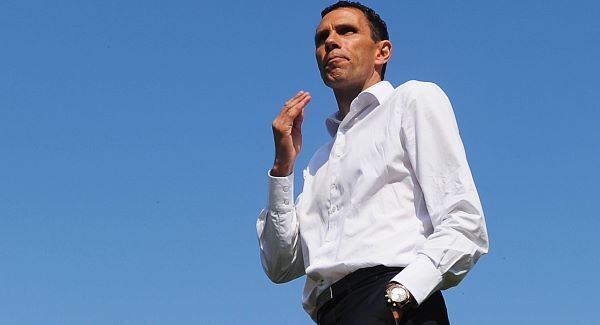
Di Canio’s departure heralded the arrival of former Chelsea and Tottenham midfielder Gus Poyet. Poyet has been well received. Fans see the Uruguayan’s emotional pleas for support as more genuine than his predecessor’s frequent public rants.
The new manager has also given the crowd plenty to shout about. Two wins over Newcastle, including a stunning 3-0 rout on Tyneside, will live long in the memory.
The victory over Manchester United on penalties, at Old Trafford in the Capital One Cup semi final, was another truly emotional evening. Although the cup run eventually ended in defeat to Manchester City, Sunderland’s brave and tactically-astute performance was widely praised. The fans thoroughly enjoyed their day out.
But despite the great highs, Sunderland’s season has also seen terrible lows. Their Wembley final was followed by five straight Premier League defeats. The team has never recovered from a disastrous start to the season, when they didn’t win a league game until the end of October.
Lifelong supporter Michael Graham, who edits the Roker Report blog and has been watching Sunderland since 1986, cannot remember anything like it.
“Sunderland have always done drama better than most,” he said. “I’ve seen 14 relegation scraps in 28 years. But this has been the strangest season I’ve known. I’ve been going to games not having a clue what to expect.
“There have been few, if any, matches where I’ve been able to sit back and relax. We’ve been totally unpredictable. I’m absolutely exhausted.”
Sunderland won promotion to the Premier League exactly seven years ago this week, under the management of the current Ireland national side’s assistant, Roy Keane. At the time, with Keane in charge, Quinn as chairman and backed by Drumaville, ecstatic fans renamed the team Sund-Ireland.
However, the following year Keane walked away. Drumaville sold out in 2009. And in 2012, Quinn left when new owner Short, decided to take a more hands-on role.
Three more high-profile managers — Steve Bruce, current Ireland boss Martin O’Neill and Di Canio — have come and gone. They’ve also spent more than €120m on players, between them.
Last month, Sunderland sank to the bottom of the Premier League. Supporters braced themselves for relegation as an emotional Poyet declared the club needed “a miracle”. But, in keeping with a season of agonies and ecstasies, that miracle duly arrived. Poyet recalled ‘forgotten’ striker Connor Wickham from a loan spell at Leeds. Wickham had scored only once in 33 previous Premier League appearances. The 21-year-old, whose dad hails from Ireland, has now bagged five goals in his last three games.
As their fellow strugglers face more difficult fixtures, Sunderland may only need one win from their three final games to guarantee survival. Michael Graham, like many Sunderland fans, is quietly confident.
“Thirty five points really should be enough,” he said. “Fulham, Cardiff and Norwich would have to do something special [against teams like Chelsea and Manchester City] to beat that. If results go for us this weekend, we could relegate everyone else next week.”
Fans who have bought into Poyet’s miracle and the club’s Dare to Dream slogan, are also looking beyond survival. They hope they may, at last, have found a manager who has the ability to help the club achieve its, and their own, aspirations.
Poyet has Sunderland playing a brand of possession football that is easy on the eye. Players work hard to keep the ball. They play it to feet. They tend not to hit and hope — as they may have done under Keane, Bruce, O’Neill or Di Canio.
The players obviously like Poyet and his tactics. Club captain Lee Cattermole has suddenly become a creative midfielder. His passing is better than ever. And his notorious disciplinary record has improved. Others have similarly blossomed.
It is well-known that Poyet now craves a role far beyond the boundaries of the training ground. He believes the club needs major structural reform and wants the power — more as a manager than a coach — to make significant changes. He also wants a big say in decisions over transfers and assurances that there is money to spend.
There will be plenty for Gus Poyet and Ellis Short to talk about during the summer.
However as Poyet left his last management job, at Brighton, under something of a cloud, he won’t be eager to walk away from his current role. Similarly, Ellis Short wouldn’t want to get rid of a popular coach — or risk the trauma of another search for a replacement.
So seasoned Sunderland-watcher Scott Wilson, chief sports writer at the Northern Echo, believes that when next season kicks-off, the Black Cats will still be a Premier League side — and Poyet will still be at the helm.
“Gus Poyet inherited a chaotic situation at Sunderland and he’s done extremely well bringing key players back in from the cold,” he said. “In the last few weeks Sunderland have achieved results no-one could have predicted. Poyet will be the first to admit that has made mistakes — his January signings were not what the club needed at the time. But there is no doubt the club is heading in the right direction. So although there will be difficult discussions between head coach and chairman in the summer, I think Poyet will still be there.”
Which for Sunderland, after the most unpredictable of seasons, would be a positive result.

CONNECT WITH US TODAY



Be the first to know the latest news and updates