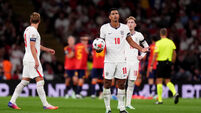
France’s mirror never lies
The man talking to me that day — and still is, but maybe not for long, if President Sarkozy has his way — was one of the highest-ranking members of this administration, who’d backed Raymond Domenech after the Euro 2008 debacle. But you wouldn’t have guessed his backing for the manager with his parting words. “Domenech is poisoning everything,” he said, “but we don’t know how we can get rid of him.”
Several months later, in London, I had a long talk with another influential figure from the Fédération Française de Football. “We won’t be in the last 16 in the World Cup,” he assured me. “Not with Domenech.”
Why on earth, then, if everyone agreed that the ‘impostor’ had to go, did France stick with him until it was too late?
Domenech was chosen to replace Jacques Santini in 2004. As a pure product of the institution, who’d tiptoed his way up the hierarchy by showing unerring instinct in whom to follow, and whom to jettison, he was perceived to be a ‘safe choice’.
True, the Federation had long practiced this rule of ‘promotion from within’, and had been rewarded with two major trophies for its long-term strategy. But whereas it had previously been driven by a desire to build a structure (and a culture) of success from almost nothing, this time, the motivation was to preserve a status quo. Domenech accelerated the catastrophe, but was a fruit rather than the root of the disease.
It is easy, and often convenient, to confuse cause with consequence. Nicolas Anelka’s foul-mouthed outburst, the farcical ‘strike’ that followed, the statement of solidarity forced upon the whole squad by a clique of senior players, Thierry Henry’s surreal meeting with President Sarkozy last Thursday: none of these extraordinary events were predictable, but all of them fitted logically in the unravelling of a system that, not so long ago, had delivered a World Cup and a European title to Les Bleus.
Domenech himself is far too mediocre a man to have precipitated the final crisis by himself; every Ancien Régime has the Louis XVI it deserves when the time for a revolution is ripe, when self-interest becomes paramount to every cog in the wheel that’s come undone.
What we are witnessing is not just the shocking failure of a once-great team; more then anything, it is the final spasm of a dying body, of a whole incompetent system.
But this wouldn’t matter much if the French football team hadn’t become the repository of so many hopes ever since that glorious night of July 1998, when a nation rejoiced at the exploits of Zidane et al.
It was possible to see in the manner of their victory the promise of a new national identity, the proof of how great this country could be if it only shook off the neuroses borne out of its colonial past.
Blacks, whites and Arabs reconciled and triumphant under the tricolour; a heady notion. It didn’t take long, of course, to realise that beating Brazil in a World Cup final and mending a fractured society were not quite the same thing. That dream, though, could still serve as a marker for the future rather than turn out to be a mere delusion. But now? We’re not so sure anymore.
On Wednesday, supporters of Algeria — the overwhelming majority of them French citizens — rioted in a Paris suburb after their team’s elimination from the World Cup.
This incident was hardly reported in the French media. We’ve come to expect this kind of stuff from the racaille (‘scum’) of the banlieue (areas where immigrants reside), to use Sarkozy’s typically delicate phrase. We don’t want to ‘inflame’ a part of the population that 90% of ‘ordinary Frenchmen’ live in fear of, the enemies at the gates of our cities.
LET them rot in their high-rise ghettos, those feral youths who ignore the sense of words like ‘work’, ‘respect’, ‘discipline’ and ‘nation’. That is until they show they can kick a ball well enough to make a career out of it, at which point they can become French, provided they win, of course.
Look at the disgraced team that’s just flown back from South Africa. Most of them are children of the banlieue. Two-thirds have West Indian and African roots. Anelka, Govou, Diaby, Sagna, Diarra, Evra, Cissé. Even their names sound odd to our republican ears. Their behaviour? I tell you, sir — what else would you expect from racailles like these? This is not Jean-Marie Le Pen and his racist National Front sympathisers speaking, this is what I’ve heard time and time again from irreproachable liberals over the last few days. The screen on which we watch Les Bleus play is a mirror. In 1998, we saw a vibrant group of young men in whom we wanted to recognise ourselves; in 2010, a collection of pseudo-stars obsessed with money and VIP lifestyles, rude and shameless.
We’d fallen out of love with a football team after Henry’s double handball; we’re now realising that we’ve fallen out of love with ourselves. And if we thought the players were bad, well, those who’ve looked after them are probably even worse. They are scrambling out of the sinking French FA, shrieking, ‘nothing to do with us!!’ At which point Sarkozy cancels a scheduled meeting with representatives of 130 French NGOs to accommodate the wishes of that Henry. We couldn’t score goals, we can still score — political — points.
Laurent Blanc will need luck when he takes over. So do we all, right now.
Philippe Auclair writes for France Football and is RMC radio’s correspondent in the UK.