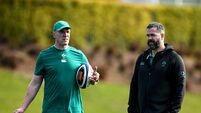
Ireland can kick on with evolving gameplan, insists 'frustrated' Goodman
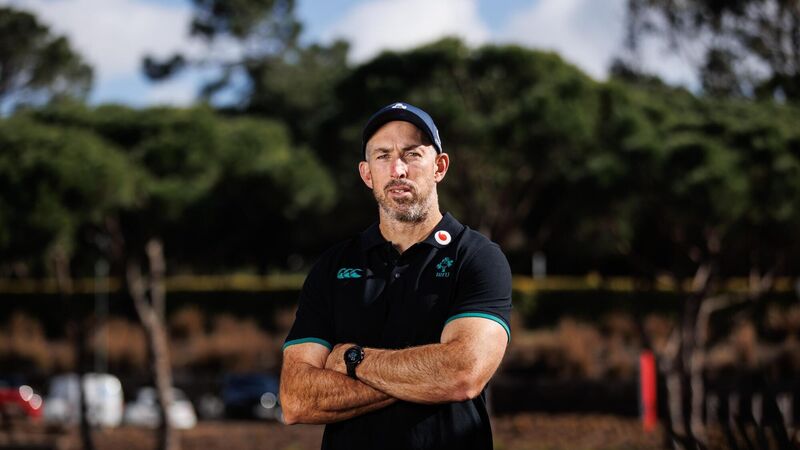
Backs coach Andrew Goodman at Quinta do Lago, Portugal. Pic: INPHO/Ben Brady
Do not complain to Andrew Goodman that rugby is changing for the worse, Ireland’s attack coach couldn't care less. Rather than whingeing about law changes and an evolution towards more kicking and the inevitable rise of scrums off the back of that, Goodman would rather his players focused on better execution of an Irish gameplan, he believes remains capable of defeating the best teams in the world.
Three months on from a sobering defeat to world champions South Africa during an Autumn Nations Series in which Ireland put on a record score against Australia in a 46-19 victory and hammered Japan 41-10 but managed just a try apiece in defeats against superpowers New Zealand and the Springboks, Goodman’s faith is set to receive another stiff examination with an opening-round Guinness Six Nations trip to defending champions France in Paris next Thursday night.
Andy Farrell’s assistant believes the national side is blessed to have four quality fly-halves in Jack Crowley, Sam Prendergast, Harry Byrne and Ciaran Frawley but the team must start converting the chances they have been creating against quality oppositions such as the one Ireland will face at Stade de France.
Speaking a week out from the 2026 championship opener following training at the squad’s soggy training base on Portugal’s storm-ravaged Algarve coast, Goodman outlined where he wants to take Ireland’s attacking evolution and aired his frustration at the criticism surrounding the game’s own direction of travel.
“That's what I showed the boys during this week,” he said. “I've heard a lot of that talk through the last couple of months and it's frustrated me a little bit because I think actually when you look at that game and look at the opportunities we had to put pressure on (South Africa), but didn't execute.
“There was space there for us to take, but we just didn't see it early enough or we didn't trust ourselves to throw the pass or the communication wasn't early enough. Didn't kind of trust it to throw it, so I think there's still a great opportunity in the game.
“That's where we want to go as a team. We want to have a positive outlook on how we can attack the space.”
Goodman cited some mitigation for November’s patchy form, not least a lack of match sharpness for the majority of the players coming off a long British & Irish Lions tour to Australia, of which he was a part of Farrell’s coaching ticket. That deficiency led to inaccuracies and poor decision-making under the sort of immense pressure the Springboks applied in Dublin.
Improved execution is key, but so too is adapting to the new rugby landscape.
“Yeah, kicking is a weapon,” Goodman said. “I think if you look at the Aussie game, it was probably one of the highest games we've had kicking-wise in a long time, but a lot of those kicks were flat kick passes to space.
“Again, we got early success with going back and putting high balls in the back-field and Mack (Hansen) was having a field day getting up and catching those balls.
“So we understand that those moments when you can get a transition back and you're attacking against the unstructured defence, there's a massive opportunity in the game.
“So yes, we are going to work on that skill set. Yes, it's going to be part of the game moving forward. I think if you think of Irish rugby players growing up and the exposure they had to catching overhead, Gaelic and different sports, it's such a massive advantage. We have to use it.
“We want to be the best team in the world at the aerial game and then we want to grow our transitional game as one of the areas we really want to try and evolve. You know, look at the better teams in terms of France and a Bordeaux or someone like that. The way they transition the ball to space straight away, that's part of the evolution we really want to go after.
“So when we do win those balls back in the air, how fast can we be to see the space to execute our passes to get the space and keep the D unstructured or in chaos, if that makes sense. Because if you don't move the ball to space straight away against an international defence, if they've got one opportunity to get the D set, then it's likely you are going to have to go to another kick the way the defence is set these days.”
France, with Antoine Dupont back at scrum-half following the serious knee injury he sustained in the defeat of Ireland at Aviva Stadium 11 months ago, remain both the standard bearers in attack and Goodman sees plenty of ways they can cause problems for the Irish.
“The way they keep the ball alive, having Dupont back obviously, the way he plays around the breakdown and brings the forwards and backs into play.
“Then you've got guys, assuming (fly-half Mathieu) Jalibert is in contention, Thomas Ramos who's been playing a little bit 10 and 15 for Toulouse, those players can make stuff happen out of nothing.
“So, when you think about the turnover ball, how we're going to have to really be controlled in how we finish our sets of positions and take that away from them. I know we can't take that all away from them but how fast we can transition from attack to defence all the time is going to be huge; limiting their counter-attack opportunities when we can as well because that’s obviously a strength of theirs.
“They'll back their set-piece as well, they'll go to their drive a lot so there are some great challenges for us right across the field.”
CONNECT WITH US TODAY



Be the first to know the latest news and updates