These Boks unapologetically represent the best of South Africa which is a tough, tough country
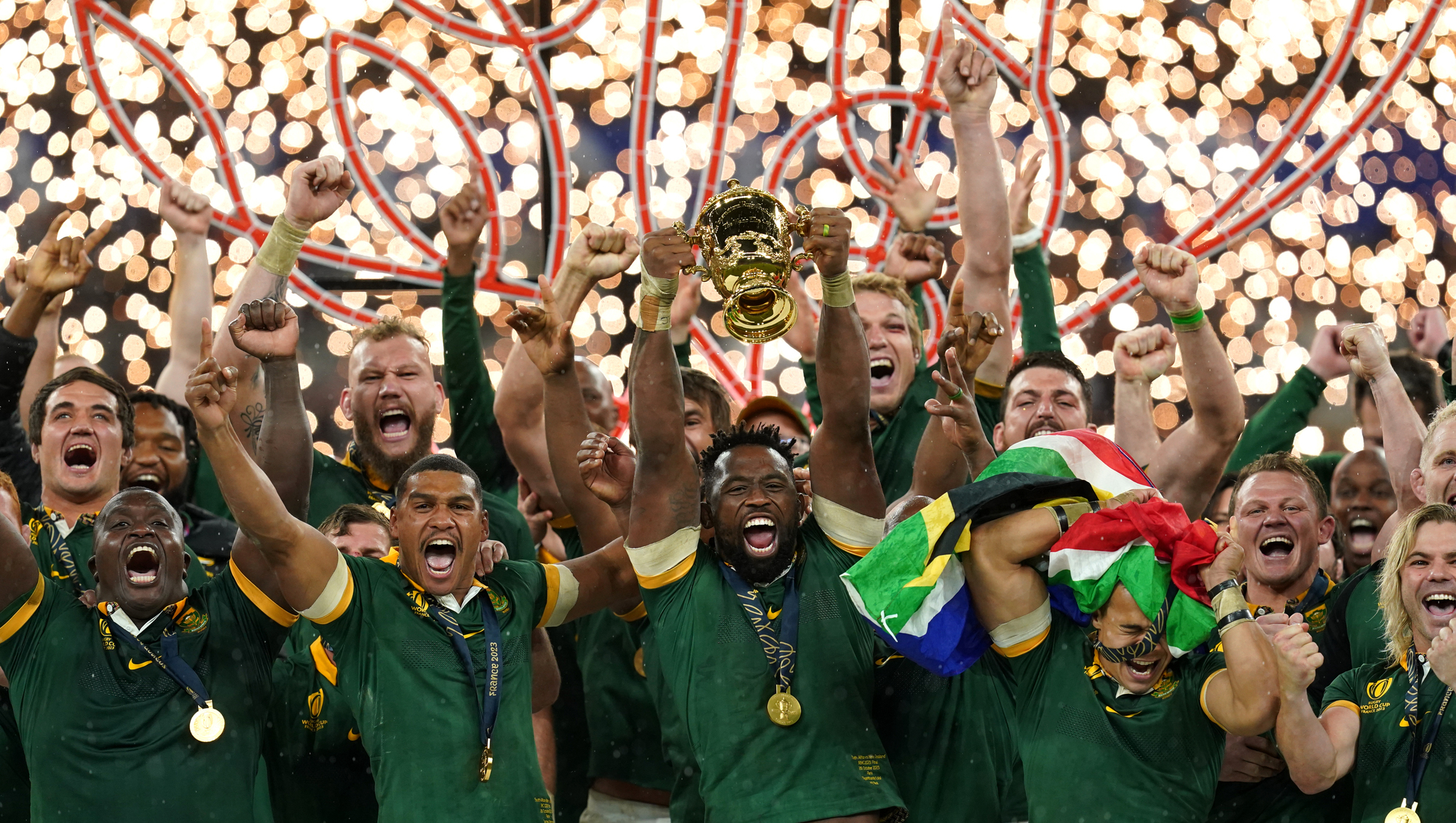
LEADER FOR THE AGES: South Africa's Siya Kolisi lifts the Webb Ellis Cup with team-mates following victory in the Rugby World Cup 2023 final against the All Blacks.
There is no disputing the numbers when it comes to Rugby World Cups – the pinnacle of the sport. The Springboks have no peers.
They proved that with their fourth world title in only their eighth appearance at the tournament, having missed the first two when the country was still banned from international sport.
A 50 per cent success rate at World Cups is remarkable, even in a sport where they are probably only four to six realistic contenders every four years.
The Boks have won 42 of the 50 matches they’ve played in the Rugby World Cup, won each of the four finals they’ve played. They’ve lost two quarterfinals and two semi-finals, where they picked up the bronze medal, for what it’s worth.
Perhaps no title has been harder earned than the 2023 version. The Boks came out of the toughest group, losing to Ireland but also test-driving their 7-1 bench ploy in that game with an eye on the future.
They came within a rolling maul try of winning. That maul was almost certainly illegally stopped when Bundee Aki pulled it down from the side. The Boks knew the result wasn’t terminal and it boosted confidence that in the right conditions, they could risk the 7-1 strategy later in the tournament.
And they did. In the final. Against the All Blacks.
It was a campaign of immensely brave coaching calls, an insatiable will to survive and sheer bloody-mindedness to never give in, whatever the odds.
Springbok director of rugby Rassie Erasmus and head coach Jacques Nienaber were arguably the two most courageous people at France 2023. They made coaching decisions that were baffling to those on the outside, but in their minds were logical choices to secure the outcome they wanted.
Omitting flyhalf Handre Pollard from the initial 33-man squad was a difficult call. They set fitness deadlines and benchmarks and Pollard didn’t meet them by the deadline for choosing the squad.
It was a sign of RasNaber’s ruthlessness. Always the team first and even their hero from 2019 and the man most likely to kick them to glory in France, was not given preferential treatment. “Work on your fitness, stay ready, the call might come,” was the message to Pollard.
The call did come, when hooker Malcolm Marx was injured in the week after the Scotland game, on 14 September. By this stage a month had passed since the Boks finalised their RWC 2023 squad. Pollard was fit and playing again. He was recalled and the rest, as they say, is history.
A flyhalf for a hooker seemed like madness, and in a way it was. It nearly cost them the final, but paradoxically, it won them the final.
Deon Fourie, a flank and brilliant jackal, was elevated to second choice hooker thanks to the early part of his career spent in the job.
The idea was for the only remaining recognised hooker in the squad – Bongi Mbonambi – to play almost every minute in quarters, semis and final. That plan fell apart two minutes into the final, when All Black flank Shannon Frizell cynically took Mbonambi out.
Fourie had to play just about the entire match and was sensational in all departments but one, vital, area – throwing in. The Boks lost five lineouts, all down to Fourie’s struggles with the ball. It gave the All Blacks, down to 14-men, a foothold in the match and nearly cost the Boks when it mattered.
But then the paradox. Pollard was on the field for the critical moments in the knockout stages. He landed the match winning penalties over France and England in the dying minutes from long range. He was there to slot four first half penalties in the final.
Had RasNaber replaced Marx with another hooker, Pollard would not have been there in those crucial moments when the stakes were at their highest. It was as inspiring as it was risky. But fortune favoured the brave.
Pollard did not miss a kick at the entire tournament, landing 12 from 12, including some of the highest pressure, difficult attempts imaginable, for 33 points.
When you consider the Boks won three knockout matches by a combined three points, the enormity of every successful kick was massive.
This was a bold and belligerent campaign by the Boks, who played some startingly good rugby. Their quarterfinal against France, where they scored four tries, was the match of the tournament.
And in every contest they displayed unbreakable character, inspired by the one-in-a-lifetime leader that is Siya Kolisi.
He clawed and fought his way from abject poverty to captain the greatest rugby side in the world. His teammates followed that lead and played with every morsel of energy and commitment to show average South Africans that no matter how desperate things seem, there is always hope.
There was no stronger message, or no greater cause to rally behind than that. These Boks unapologetically represent the best of South Africa which is a tough, tough country.
They showed innovation, courage, commitment, strength, vulnerability and most of all the acceptance and comfort that they’d be unpopular. Winners often are.
They make no apologies for it.
CONNECT WITH US TODAY



Be the first to know the latest news and updates