Champions Cup talking points: What next for Munster's newest stars?
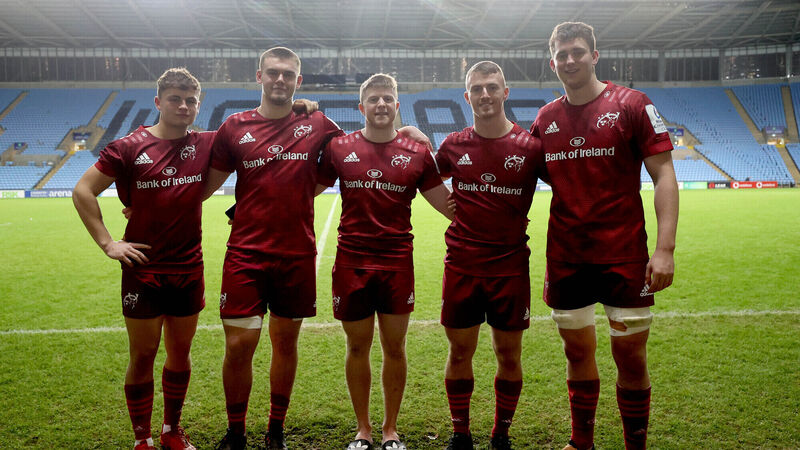
Munster's Tony Butler, Conor Moloney, Patrick Campbell, Jonathan Wren and John Forde celebrate after the win over Wasps. Picture: INPHO/Dan Sheridan
For an academy system that has often come in for flak as Leinster continued to produce Test-ready talent off its admirable schools pipeline, this was a day for its new head to beam with pride.
Ian Costello had prepared this squad, an untested mix of international quality and inexperienced raw talent and moulded them into a team capable of going to an English Premiership side and delivering a bonus-point victory against the odds.
Costello, who returned to his native province after three years as Wasps defence coach this summer, had stepped into the breach with his academy assistants Andi Kyriacou and Greig Oliver in the absence of Johann van Graan and his assistants, all in quarantine and over two weeks of intense, back-to-basics training turned this scratch group of players into a coherent collective that may have ridden its luck at times but had the calmness and presence of mind to execute a stunning European victory.
“The key to that was the last two weeks,” Costello said. “The last two weeks were special. Win, lose or draw today, we put ourselves in such a good position with our preparation by, I suppose, how aligned and connected everybody was in the organisation.
“The way everybody pulled together, we had a lot of wind leading into today and to put in a performance like that, that looked quite cohesive considering the challenges we had, was extraordinary.
“I don’t know how to rank it for you, I just know it was as special as I can remember.”
Munster still have too much firefighting to do with their Covid crisis to get the time or head space to plot how they can now maximise the brilliance shown by their youngsters in Coventry.
But what will happen to all these young guys? Will they just go back to the academy or AIL or will there be a seismic shift in policy and the pathway from promising youngster to getting a crack with the senior team becomes less steep for these players.
It has been noticeable over the years at the U20 World Cup how much senior club game-time players from England, France, South Africa, Australia and New Zealand either had before the tournament or in the immediate aftermath of it.
Having just four clubs/provinces in this country meant less immediate opportunity for the 20-year olds but maybe this is the match that will lead to change, not just in Munster but with the other three as well.
In France and England the attitude has always been if they are good enough they are old enough but with a few exceptions, a lot of emerging players here have to follow a prescribed pathway.
Munster, when the dust settles on the calamity of these few weeks, have a few decisions to make and let’s hope we don’t have to wait a few years to see some of these lads again. They deserve a lot better than that. Sometimes in this country we don’t really appreciate what’s on our doorstep.
JJ Hanrahan was back in Irish rugby’s shop window and he shone.
The Clermont v Ulster tie was an opportunity for him to remind everyone back home of his talent and what Munster, especially, are missing and maybe wonder if it was the wrong call to cut him loose last season.
Despite Hanrahan’s obvious desire to play for his home province, the Kerryman was forced to leave Munster for a second time in the summer with Joey Carbery’s return to fitness and the emergence of Ben Healy limiting his game time.
After making his debut for Munster in 2012, Hanrahan left in 2015 and spent two seasons at Northampton Saints.
He returned home in 2018 and clearly wasn’t expecting to be leaving again so soon this year but at least has found a good home at Clermont, where he is appreciated and valued.
His broken-field running and vision in loose play is a perfect fit. His goal-kicking against Ulster was impressive too with three penalties and two conversions.
It was all a reminder that he is a talented fly-half plying his trade on foreign fields. But as Simon Zebo has proved, there is a path back to Munster from France and at the age of just 28, a third spell back home could not and should not be ruled out.
Leinster’s losses to Saracens in recent times have provided the main talking point when it comes to their relationship with Premiership sides, but they cloud the bigger picture when evaluating the province and their form book in these meetings.
Saturday’s shellacking of a brutal Bath side was very much in keeping with the Irish heavyweight’s experiences stretching back to that 2015-16 season when Leo Cullen’s first term in charge produced some traumatic reversals for a rebuilding side.
That year’s European campaign ended with a 51-10 defeat away to Wasps in the last of the pool rounds, since when Leinster have won 15 of their 17 games against England’s finest. That’s a run that includes a defeat of Saracens in the quarter-final four seasons ago.
Ronan O’Gara once drew considerable heat by questioning the quality of the league across the Irish Sea. Leinster have, to be frank, tormented everyone bar a Saracens side whose successes have subsequently been diluted by domestic salary cap breaches.
A dozen of those 17 games have been won with Leinster claiming at least 30 points. They managed 40 six times, 50 twice and even 60 when using Northampton Saints as a punch bag at the Aviva Stadium this month five years ago.
Exeter will be a tough nut to crack for anyone again this season, but their domestic rivals in this year’s competition have little or nothing in the way of recent European pedigree and a long way to go to prove they can trouble the likes of Leinster in these surrounds.
It’s the small things that matter. As if the wind, rain, greyhound track and sheer bleakness of a Sunday lunchtime kick-off at the Sportsground two weeks out from Christmas was not enough for Stade Francais to contend with, Connacht hooker Shane Delahunt did his utmost to wind up the Parisians. Each time in the opening half when Connacht were awarded a penalty, the farmer from near Birr would head off out and march up the outside of the touchline to where he thought Jack Carty would, or should, send the ball.
Each time he had to walk past the Stade bench who weren’t long taking exception to his antics and tried to get the officials to intervene, but they had no interest in stopping the hooker who marched with the sort of purpose he might do as if he had heard the cattle were out in the top field.
His strapped head was a handy target for Carty as he prepared the kick to touch and by the time the rest of his pack arrived Delahunt had the ball dried and ready to go, while in his wake the Stade officials went beserk.
Stade’s body language was telling all day. Their warm-up was insipid and while an understrength side did have some good periods, they were a beaten docket from the start. Delahunt just helped make their trip to Galway even more miserable.
CONNECT WITH US TODAY



Be the first to know the latest news and updates