If this is Drico's curtain call, it will be an underwhelming end
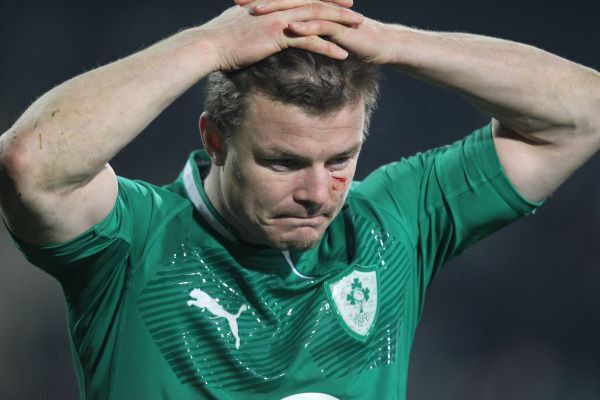
Fourth in the table, one victory from four games and safety from the wooden spoon is not yet guaranteed. It has hardly been a Six Nations to savour for Declan Kidney’s men but tomorrow’s meeting with fifth place Italy is far from a dead rubber, not least because it could be the last time we see Ireland’s greatest ever player take to the field in a green jersey.
If this Six Nations campaign does signal the curtain call for Brian O’Driscoll’s international career it will be a somewhat underwhelming end to his extraordinary tenure in the Irish midfield. His brilliance deserved more.
The shining light of Ireland’s ‘golden generation’ of rugby players, Drico should have enjoyed more than one Grand Slam success since making his international debut in 1999, compared to the three Wales have secured in the same period.
His stint as British and Irish Lions captain in 2005 was prematurely halted by the infamous two-man spear tackle from Tana Umaga and Keven Mealamu which left him with a dislocated shoulder.
But the Dubliner did what he always does, dusted himself off, struggled through the rehabilitation and four years later was the standout player in the 2009 tour of Australia, a tour which Ian McGeechan’s men could and should have won but yet again BOD found himself part of a team which fell short of its capabilities.
Only at provincial level has O’Driscoll seen his team achieve its potential with Leinster prevailing in three of their last four European crusades.
That ruthlessness which Leinster displayed en route to their Heineken Cup triumphs is exactly what Ireland have lacked in recent seasons. To borrow Brent Pope’s favourite idiom, this Irish squad have too often “given a sucker an even break.”
November’s 46-24 victory over the Pumas, 2010’s 24-8 dismantling of Grand Slam chasing England and a handful of big score lines against Italy stand out as the few occasions Ireland have turned the screw when in control of a game.
What unfolded in the Aviva Stadium against Les Bleus last weekend is what Irish fans have become more accustomed to seeing. The stats back up the dominance Ireland enjoyed; 54% possession, 58% of the game played in the French half, more ball won in opposition half, greater ruck clearance.
Kidney’s men learned their lesson from the English game in Round 2 and played the conditions better than the French. Conor Murray produced the best kicking display from an Irish scrum-half for some time as Ireland repeatedly forced the French to play from their own territory.
Rory Best’s darts were back to their best after a wobble in Murrayfield and the Irish maul was the most potent attacking weapon on display.
Yet for all their control, they managed just one try and the indiscipline which has marred otherwise decent performances for so long came back to haunt them as they coughed up almost twice as many penalties as Philippe Saint-André’s men and had Michalak been more accurate with the boot they could have fallen to a third straight defeat.
Unlike the defeats to England and Scotland after which you could point to poor decision-making, sloppy errors or tactical miscalculation, Ireland didn’t seem to do a whole lot wrong against France which made the failure to win as puzzling and it was frustrating.
Just as they did in Paris last year Ireland threw away a winning position against Les Bleus by failing to score after the interval. This inability to deliver from winning positions comes down to mentality.
But the only team Ireland have consistently backed themselves against is Italy. The Azzurri have never beaten Ireland in the Six Nations and the last time the two sides met on St. Patrick’s Day in 2007 Ireland celebrated a 51-24 win.
Tomorrow’s opposition should not be written off however. For some time now Italy have been considered the emerging force of northern hemisphere rugby but their days as the 'plucky underdog' are over.
A convincing victory over pre-tournament favourites France in Round 1 seemed to take their edge off for the Scottish and Welsh encounters but Jacques Brunel’s charges were back to their combative best against England.
Treviso provided further evidence of the strength of Italian rugby with a 34-10 defeat of Munster in the PRO12, despite contributing ten players to the Italian starting XV for their clash with Wales the same weekend.
Under Brunel Italy have become more tactically astute and more difficult to open up, committing fewer players to the breakdown, providing greater width to their defence, a system which kept England try-less in Twickenham.
The positivity of Ireland’s initial team announcement on Thursday was considerably diluted by the news that Jonathan Sexton will miss the game due to a fresh foot injury picked up in training.
The setback means Ireland aren’t quite at 100% but it offers Paddy Jackson the perfect opportunity to back up an impressive showing against France.
After a nervy Test debut against Scotland, the Ulsterman would have been anxious ahead of the French Test but having acquitted himself well in the Aviva last weekend he now has the chance to prove his consistency and with Fergus McFadden ruled out through injury there is no safety net of a back up kicker.
In a rare slice of good fortune on the injury front, the majority of Ireland’s walking wounded have recovered in time for the final showdown of the 2013 Six Nations. Having orchestrated Ireland’s impressive lineout performance against France, Donnacha Ryan’s inclusion is a boost.
Craig Gilroy returns to the wing after his groin strain meaning Luke Fitzgerald must once again be content with a place on the bench. Both Luke Marshall and O’Driscoll have recovered sufficiently from concussions suffered against France to start tomorrow.
In fact concussion was just one of the injuries sustained by O’Driscoll in a performance that seemed to embody everything he is about. The 5ft 10in centre also suffered a dead leg and a tear on the inside of the ear but as ever he struggled on.
Fourteen years after his international debut O’Driscoll’s dedication shows no sign of waning. No other player in modern rugby consistently picks himself off the floor to keep playing when his body is clearly at breaking point.
If this is to be his Irish swansong, the other twenty-two men in the dressing room owe it to their former skipper to produce the level of commitment and endeavour that has characterised Brian O’Driscoll’s career.
Prediction: Ireland to win: 21-13