Maurice Brosnan on the Armagh team that Kieran McGeeney built
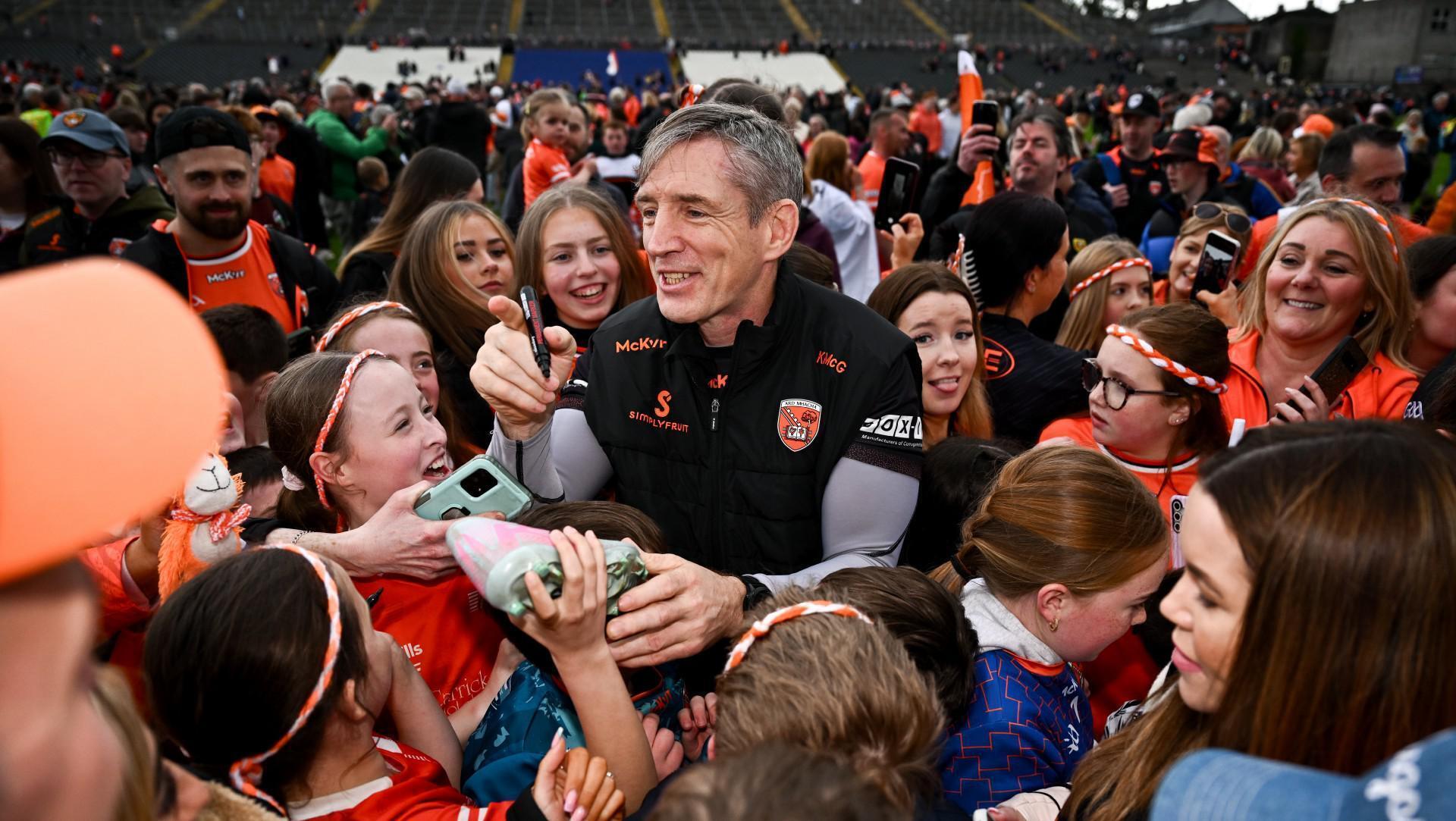
OUR-MAN: Armagh manager Kieran McGeeney with supporters after the Ulster GAA Football Senior Championship semi-final. Pic: Ben McShane/Sportsfile.
In the beginning, there was boundless enthusiasm, an impressionable panel and zero intolerance for shortcomings. The reality of Armagh’s thinking, where it stood and where it needed to go, was illuminated by a dreamlike pre-match prediction.
The Athletic Grounds was in poor nick, so Armagh headed across the border to Inniskeen for training on the Thursday night before facing Ulster champions Donegal. Stefan Campbell was sharing a car that included a rookie Andrew Murnin, who was days away from his championship debut.
They passed the journey by offering their predictions on the game until it came to Murnin: “I can’t see any other result. Armagh by eight plus.” Cue an awkward silence before they all spontaneously erupted in laughter. Did they believe then what they know now? Not a chance.
“It wasn’t exactly, ‘Oh! We can’t win this game, or we don’t have full belief that we could win,” says Stefan Campbell.
“But it was just in the company of somebody a wee bit naïve. It was more where we knew we were as a group. We thought we could win a game on our day but were we contenders?
“Geezer kept rhyming certain words off to get us to believe. All-Irelands were mentioned in terms of where we needed to get to but as a group, we knew deep down. Geezer knew deep down. Don’t forget, we couldn’t win a game in Ulster until 2019 against Down.”
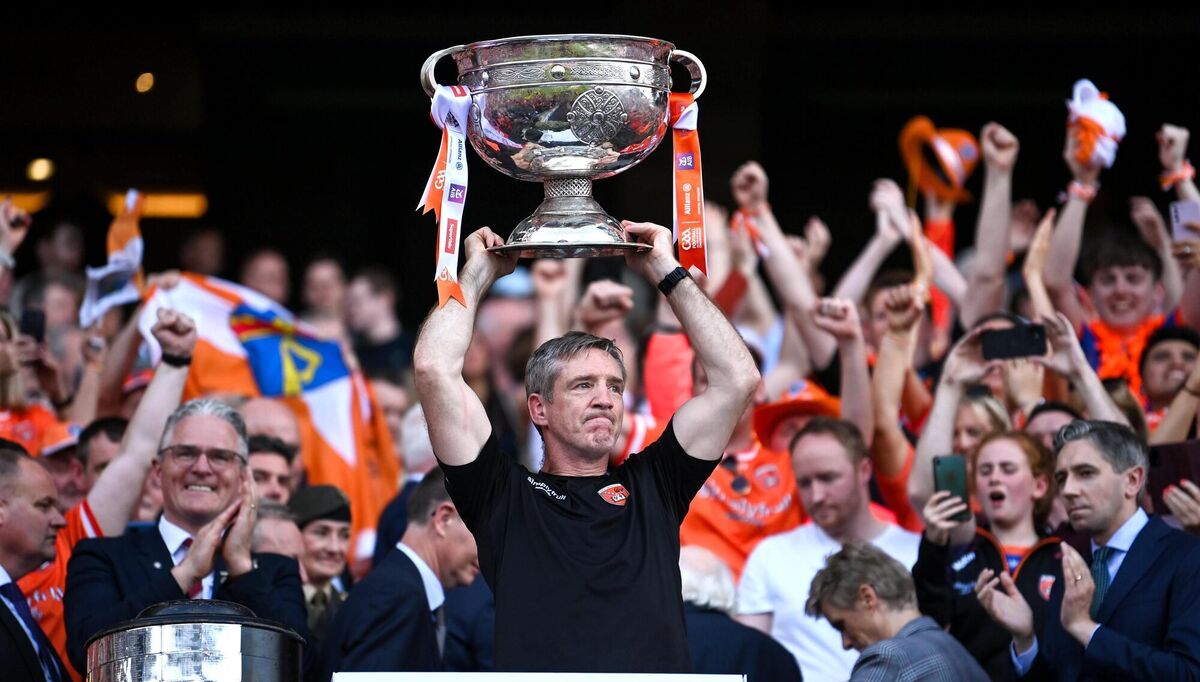
Look at their horizon now. 2024 All-Ireland champions. A fourth successive Ulster decider. The numbers dictate that the longest-serving Gaelic football manager has navigated 56 championship games using a tight group of 81 players. His record stands at: 33 wins, 21 defeats (including penalty shoot-outs) and 2 draws. That extraordinary span includes a remarkable eight games that went to extra-time. So far.
McGeeney’s fear before that 2015 championship opener was the gulf. Not in ability, but exposure. They needed to be routinely exposed to higher levels of intensity in order to survive. His only way to prepare for the cauldron that championship would bring was to throw his players into it repeatedly. But at the start, that proved challenging. In his mind, that was infuriating.
Take 2016. A three-point defeat to Laois was ruled null and void after they brought on a seventh substitute, one more than the permitted six. A replay was eventually ordered two weeks later. Laois edged that rematch by a point. This was the first of many run-ins with officialdom. Post-match, he stressed that they had no say in the refixture and would hate to see anybody lose a game they had won on the pitch. He also made sure to mention that match officials had been the ones who erred originally.
“Obviously all the boys were out on the Sunday night after that Laois game and on the Monday,” says Campbell, with a belated licence to laugh about it now.
“Sure, it was supposed to be the end of the season. I actually wasn’t, the missus and I were in McDonald’s. So, he phones me and is like, ‘Wherever you are, stop drinking! Set the tank down. This game is going to be replayed. Come on!’ I was there, ‘Calm down. I’m only having a Maccas here.’ He was worried. ‘I don’t know how I’ll get a team. All the boys are out; they aren’t answering my calls.’ Gavin McPartland had actually just flown out to the Euros in France. But we got the troops together eventually.”
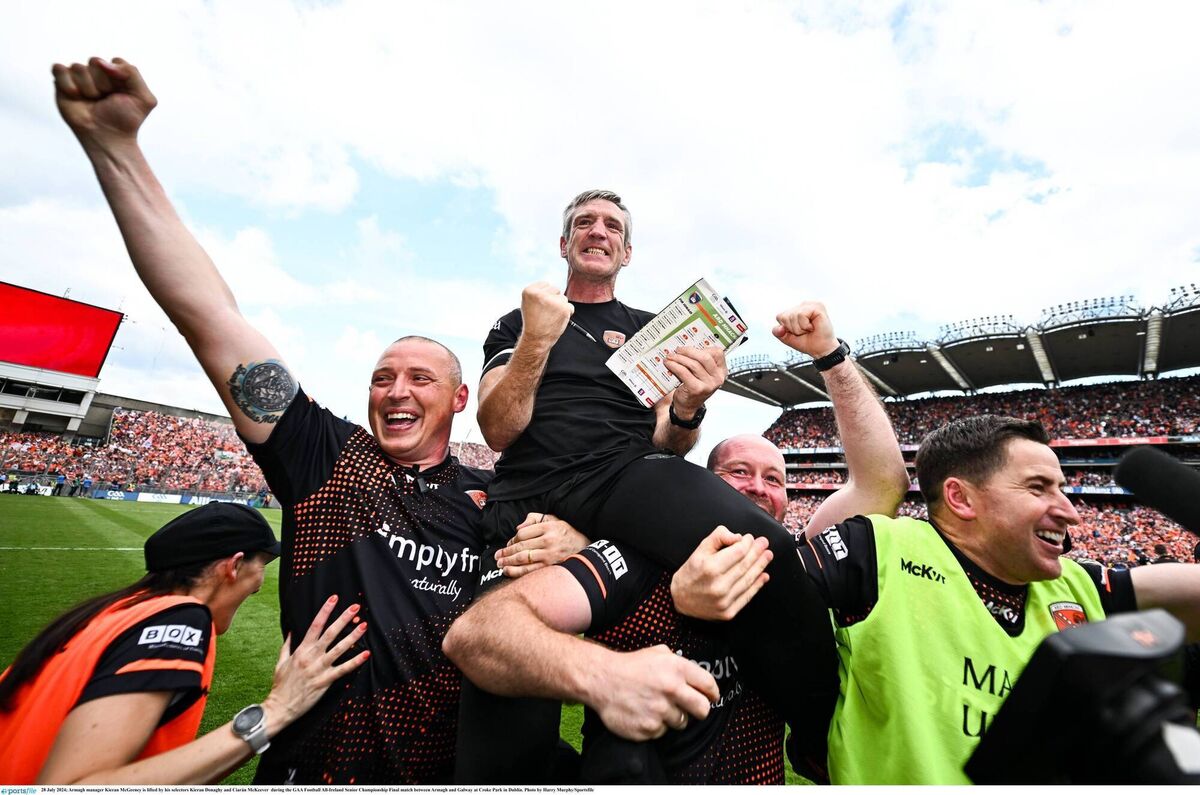
In the aftermath of the 2024 Sam Maguire triumph, McGeeney steered a wide berth of most sit-down interviews. His classic glare appeared at the Olympics or in fleeting flashes, but there was never going to be a tell-all tale. This is a singular man who led his county to the summit as captain for their first ever All-Ireland and did the same as manager for their second. An obsessive who gathered his fellow coaches in a side room of the victorious dressing room after they lifted the cup to urge them that he needed them all to return for a tilt at back-to-back.
His sole longform outlet was a podcast with Consistently Above Average, hosted by Andrew McGahon. Their primary focus was Brazilian Jiu-Jitsu and the crucible of martial arts.
In the course of that conversation, McGeeney revealed the pursuit appealed to him because of the extremities involved in winning and losing, how it can be intertwined person’s identity. It is not like team sports in that sense. There is an opportunity to carry the responsibility. He related to it.
“It is seen, rightly or wrongly, as whether you are the better person. I always had an interest in that, the mental preparation. It’s like the defence forces. There is a wee bit more riding on it than normal.”
He spoke about travelling to York to train with famed Brazilian jiu-jitsu practitioner Marcelo Garcia. How he had questioned some practitioners after travelling to the session on the tube with them. Why come to training to really push yourself for two hours twice a day if you can’t stand for ten minutes to let someone of advanced age sit down on the busy tube? It struck a chord.
“How you approach things and how you think away from the mat is as important as how you think on it” Gradually, that ethos was instilled in his county. It was preached with religious fervour. Make the man beside you look like an All-Star. We, not me. The strength emanates the collective.
“It takes 35 to 40 lads to win an All-Ireland or to be anywhere successful,” says Ciaran O’Hanlon, who retired at the end of last year. “Because if you don't have that competitiveness in training or competition from inside, you want to get to where you want to.
“That was Geezer’s biggest challenge in the early days, getting everyone on board. In a county setup, everyone wants game time, but the harsh reality is 15 players take to the field and a few subs come on, but the fellas outside of that are so important for where a team wants to go.
“I think that was a struggle, getting the group to see how everyone can play a part. It was a culture more than anything.” That old chestnut, culture. To them, it wasn’t just a buzzword. They created a monument they could point to.
“I can’t remember what year, but we came up with a culture code which we lived and breathed. For me, that is when the penny dropped for a lot of fellas. It pushed us on another level. Even up to 2017, we were a yo-yo team. Kieran was massive on playing the best teams as much as possible.
“The culture code was everything. The leadership group and management came together to write out the behaviours on and off the field. It has evolved from the first one actually. It gave us something to chase. Something in black and white to live by and to enforce. If players weren’t doing that, they were challenged and asked by their peers why aren’t they doing what we agreed to do.”
Before the near-miss heartbreak, there was unadulterated torture. Tyrone hammered them by 18 points in the 2017 All-Ireland quarter-final. Campbell points to that as a key moment for the squad. He took a year away.
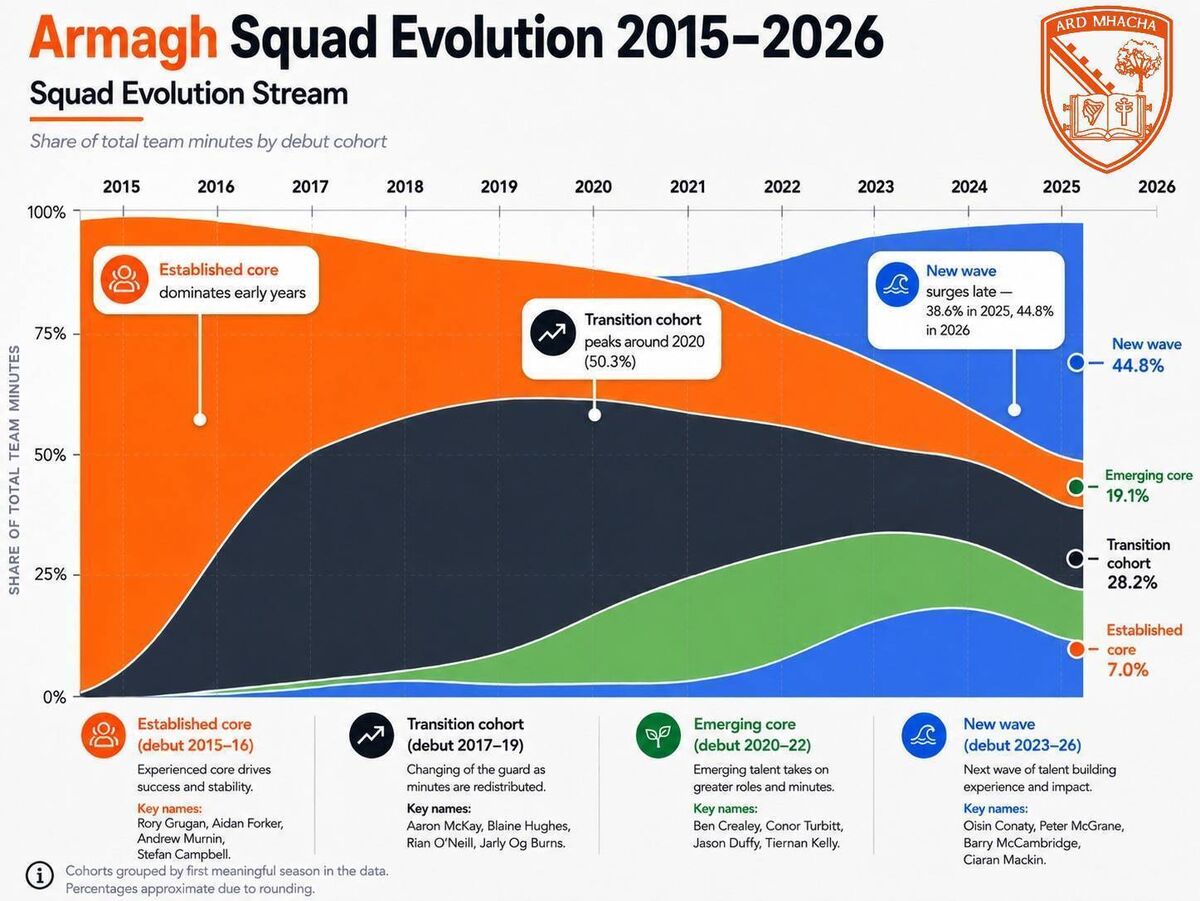
Ciaran McKeever retired and embarked on his pathway to McGeeney’s coaching ticket. Andy Mallon, Tony Kernan, and Micheal McKenna started to filter out, and the likes of Paddy Burns, Ross McQuillan, and Connaire Mackin began to step up.
They are reaping the rewards of a similar regime now, long-term investments in Oisin Conaty, Darragh McMullan, or Tomas McCormack making up for the raft of departures endured during the recent off-season.
The tactical evolution was unfolding at the same time. First, it was with the number one. The decision to include Paul Courtney in goals against Cavan for the 2016 Ulster SFC proved controversial. This was an outfielder in goals who didn’t even wear gloves.
“I fractured my spine in a training game going for a high ball,” explains former Armagh goalkeeper, Patrick Morrison.
“That is why Paul ended up in goals. But he played in goals for his club the odd time and he did underage too.
“Rather than bring someone new in, we decided to transition Paul in. He did so well in training and challenge matches. Between Geezer and himself, they talked about coming out the field and helping the attack.”
Despite the criticism that followed, Armagh won 17 of 24 kickouts that day. Their retention in 24 games under the new rules is a remarkable 66%. This season, it is 70%.
Ultimately, the lesson of the searing Donegal loss bled into subsequent campaigns. They were too loose with possession, allowing teams to hit them on the counter repeatedly.
“We kicked so much ball away,” says Campbell. “When we did the post-mortem of that game in the winter, we came up with a scoring system. We can’t give X amount of ball away. Those games were like yo-yo tennis for us. Teams were scoring so much for turnovers. That was huge for us going forward.”
Their evolution came from the top down. McGeeney met Kieran Donaghy after their narrow loss to Mayo in 2019 and unveiled the vision. Everything they did stemmed from a deep dive into their issue and wide search for solutions.
Develop more unity? Instil a buddy system, with senior players assigned a plus one or at times a plus two. Conversion an issue? Create a 36-shot drill, with players to shoot off left and right from set positions and keep a score for internal competition. Compounding errors with multiple successive turnovers? Develop a traffic light system, red a signal to slow it down and make sure of the next score.
While out with injury, Morrison took a prospect under his wing by the name of Blaine Hughes. They worked with goalkeeper coach Ciaran McKinney, who is still plugging away there today.
Eagle-eyed observers will spot McKinney behind Hughes’ goal in Clones on Sunday. Morrison is currently coaching Leitrim and does the same. Like a good pioneer, they land on bold strategies and don’t care how it looks to anyone else.
“You are like a golf caddy,” says Morrison. “It’s just an extra set of eyes, help them along or read the game as well. If there is a kickout routine or a certain press, we can help identify it. They might want to ask was that my best option and I can see, yeah or no, there was a free man the other side.”
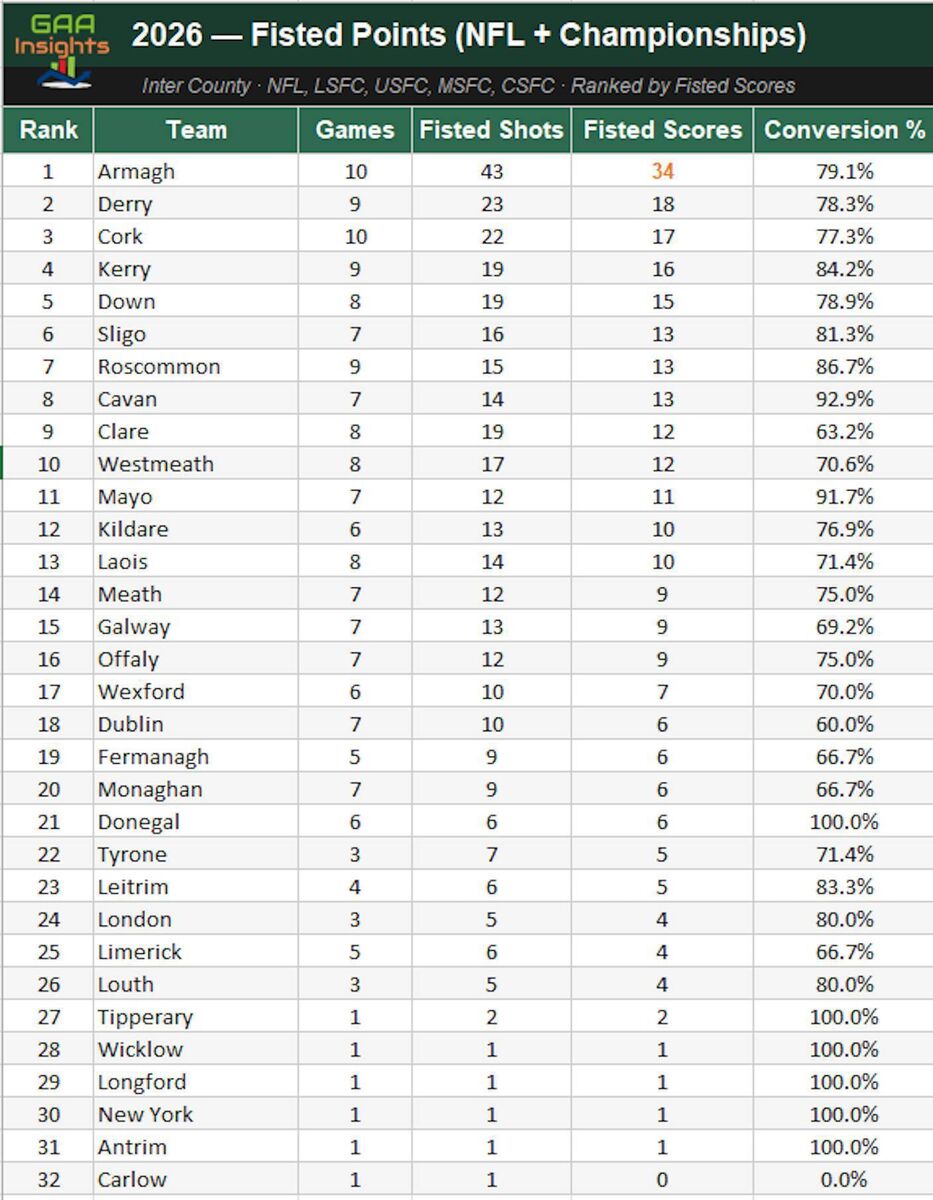
Such conviction is a reason that the current side don’t care about the optics of their fisted points. This year they have scored a staggering 34 scores like this, one less than Derry and Cork combined, who rank second and third.
The validation that comes when their exhaustive prep pays off is immense. Their video analysis before the 2024 All-Ireland final focused on Conor Gleeson’s tendency to stay on his line and Matthew Tierney’s physical significance on kickouts. Campbell squared the ball across the square for Aaron McKay’s goal, Connaire Mackin was picked and met Tierney reproachfully on the sideline to produce a visceral feeling across the board: what we planned is working.
Campbell openly acknowledges breaks that can go for or against a team as well. The penalty margins on one side. On the other, Tom O’Sullivan’s missed goal chance in 2024 and a dropped shot that ended in a goal.
“Those penalties against Galway, Derry, Monaghan, losing the Division 2 final by a point, you are just building a certain type of character. We have said this before; I don’t know how we would have reacted if we won that Ulster final in 2024. Would that be the monkey off the back? How would we have celebrated? I wonder would that have been enough. I was 32, 33. So was Grugan or Forker. Now Geezer probably would have humbled us in the middle of that week.” That, it turns out, is another speciality.
“Geezer, obviously, he can get heavy. He can get agitated. He can get easily irritated. It is not a case of bringing boys in and running them. He just relentlessly goes after standards. Let’s say we had a big win and an in-house game or skills session the next day, one ball drops that should have gone to chest. He will literally race down the stand of the Athletic Grounds, pull the session.
“Accuse the boys of being soft, that one win went to our heads and that kind of stuff. If boys are taking too much out of the ball when a pass is on down the line, he will run down and stop the session. Explain yourself. You are getting ahead of yourself. Too cocky. That refocuses you, back to first touch, head up, supporting. It is a standards and energy thing. If he sees a bit of complacency creep in, he drives standards to the max.”
That devotion is returned in abundance. After a knee injury in a club game in 2022, O’Hanlon was told that he would never play football again. The first phone call came from McGeeney. There was nothing to worry about from a financial perspective. McGeeney’s wife, Maura, is the team physio and invested herself heavily in getting him back.
“He just said no to the idea there’d be no football again. No. You will be back on the pitch. For me, the only way to pay that back was by showing loyalty. My role in the last few years, I didn’t play much but you impact wherever you can. I was showing some of the younger lads, Darragh McMullan, Petey McGrane, Dan Magee. Make your mark somewhere even if it isn’t on the pitch.”
O’Hanlon is 31 years of age now. His last championship game was in 2021 against Monaghan. He was one of numerous players to walk away at the end of last season with an official function organised by the county to thank them for their service.
He watched the reconfigured squad begin to find their feet early on. At times, they looked stretched. In their loss to Mayo last March, Armagh made just two substitutions. One of them was in the 67th minute.
“You just didn’t know what way it was going to go. I didn’t expect a phone call to come back in for training or anything like that,” he laughs, before turning serious.
“I’ll tell you what though, if the phone rang and he said, ‘I need you for a few weeks here.’ I would have done it hands down. No need to think about it.”

CONNECT WITH US TODAY



Be the first to know the latest news and updates