Peter Jackson: Officials turn a blind eye in miserable end to Ireland’s reign
“In the ring, you know the punches will come from one opponent,” he told me way back then. “But on the rugby field, you’re gonna get hit by 15 opponents and they’re coming at you like crazy from all angles. And a lotta the time you don’t see them coming ‘cos you can’t.”
Ireland, then in the final countdown to the 2003 World Cup, had flown him in from his home near Milan for the day to give their squad a rough idea of what it takes to be a world-beater in a punishing trade.
The middleweight — whose fights against Thomas ‘The Hitman’ Hearns have long become the stuff of boxing legend — flew back out shaking his head in bemused admiration of those ready for simultaneous exposure to multiple hitmen doubling up as human monstrosities.
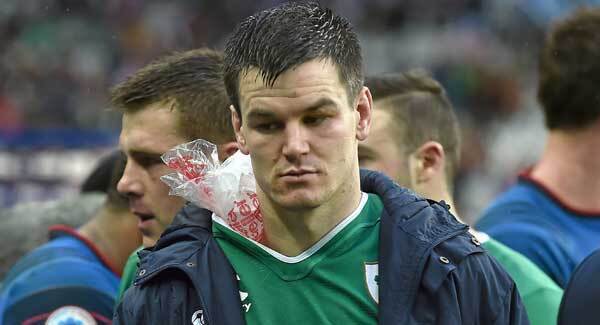
Had Hagler been watching, the mind boggles at his wincing reaction to the gruesome sight of Johnny Sexton being flattened by a blow every bit as monstruous as the size of the second row forward who administered it — Yoann Maestri, a big unit of 19 stone.
His unsuspecting victim must have felt he had been pole-axed by Hagler, Hearns, Roberto Duran, and Sugar Ray Leonard all rolled into one assault. Sexton, learning his craft as an 18-year-old schoolboy when Hagler addressed his compatriots on that sunny September day, will know this morning exactly what he meant.
Having found that out the hard way a long time ago, Europe’s supreme fly-half is entitled to consider his long-term health and ask how many more batterings he can take in the name of sport?
Had Maestri’s crime been committed on the streets of Paris, the Toulouse lock could have been charged with common assault. Shamefully, the game of rugby allowed him to get away scot-free as if it had never happened.
No red card, no yellow, not a word of warning, no wagging finger, not even a mealy-mouthed ‘play the game, Yoann, old boy’. Nothing.
And that, if anything, was a greater disgrace than the assault itself. How could a batch of officials equipped with a battery of TV cameras stand by and do nothing? They let it go, as if it was still somehow a grotesque part of the game as it used to be in the bad old days of the often lawless 70s, splattered with all manner of notorious incidents, not least the one at Murrayfield when the boxer-paratrooper Gerard Cholley, did his bit for the entente coridale by laying out four Scottish players in the same match.
Those who run the sport are never slow to talk a good game on protecting players from head injuries but when push comes to shove, as it did in all its crudity at the Stade de France, they do nothing to punish the offender.
The 48-hour citing process leaves room for retrospective justice. Maestri should have been given a straight red and any formal charge will amount to a tacit admission from the Six Nations organisers that he should have gone there and then.
If Jaco Peyper allowed him to get away with that, the South African was hardly going to bin Maxime Mermoz for anything as trivial as a deliberate knock-on, nor any one of eight Irish forwards bullocked by the French eight into repeated scrum offences before Maxime Medard applied the matador’s finish.
A more miserable end to Ireland’s reign would have been impossible to imagine.
Bullish Jones not afraid to shoot from the lip
The Six Nations is rapidly turning into The Eddie Jones Show, a bi-weekly production of knockabout stuff guaranteed to keep the tournament entertained in a manner that hasn’t always been the case on the pitch.
Since winning their solitary Grand Slam of the last 20 years, England have gone through a succession of coaches so terrified of saying anything remotely likely to give the opposition a crumb of motivational comfort, that they said nothing beyond repeating parrot-fashion their “respect” for the other lot.
Jones is not one to seek refuge behind such politically-correct baloney. So he spoke before the Roman excursion in wonderfully explicit language, demanding England “smack” Italy, that they had to be “absolutely brutal up front so there’s no Italian left standing at the end of the game”. An Englishman talking like that would have been derided for his arrogance.
Jones gets away with it because he’s a fair dinkum Aussie and because his team respond by playing as good a game as the one he talks.
His rallying call may have been almost tantamount to inciting Mount Vesuvius into blowing its top, as though the Roman legions were about to experience another Pompeii. If a few Azzurri were still standing at the end, by then Jones’ Red Rose brigade had reduced them to just another old relic in a city full of them.
England’s players are not immune to his caustic wit. “There’s a rumour going round that James Haskell’s got bad hands,” he said of his No 7. “It’s not true. He’s got terrible hands…”
Good grounds for Cotter’s growing grumpiness
In the wake of another hard-luck story, Vern Cotter deviated from his customary ‘it-is-what-it-is’ verdict to confess to growing grumpiness. No wonder.
Scotland played their full part in the match of the tournament hitherto and had nothing to show for it.
They had good cause for complaint. Replays of Gareth Davies’ opening try showed the Wales scrum half in an off-side position when he turned Jamie Roberts’ knock-down into a long-distance solo strike, provoking more questions about the use of technology.
In the final reckoning that made all the difference, leaving the Scots nursing a ninth straight championship defeat, their worst sequence since a hat-trick of wooden spoons in the early 50s. Greig Laidlaw wore the anguished look of a man who can’t understand why the rugby gods keep doing the dirty on the Scots, especially in Cardiff. Thom Evans suffered a near-fatal injury there eight years ago when a bewitching Shane Williams stole the match for Wales and now Stuart Hogg’s become a double victim. Sent off after 23 minutes on his last visit for taking Dan Biggar out in mid-air, the Scottish Lion barely lasted any longer. Returning with the look of a man hell-bent on redemption, he caused Wales problems before fate played another dirty trick on him, rendering him lame within half an hour.
Talented tyros making a mark
Two rounds down, three to go and further proof the Six Nations is becoming no place for old men. A few gnarled veterans, like Scotland wing Sean Lamont (35) and Irish lock Mike McCarthy (34), cling on, but the young ones are bursting through on all fronts.
Maro Itoje is a politics student who writes poetry as a diversion from competing against the cauliflowered inhabitants of the second row. England unleashed him on Italy yesterday at the age of 21, 15 minutes after making Paul Hill their youngest Test prop at 20.
France, winning in spite of themselves, capped a 20-year-old front row forward, Camille Chat, just as Scotland had done in the opening round with their 20-year-old prop, Zander Fagerson.
Behind them are a number of 21-year-olds – Scotland lock Jonny Gray, England wing Anthony Watson, France flanker Yacouba Camara – and a veritable host of 22-year-olds headed by Robbie Henshaw.
Most illuminating piece of punditry
“I’m expecting the Irish half backs to be very important.” When were they ever anything less?