Glass half full for battling Ireland
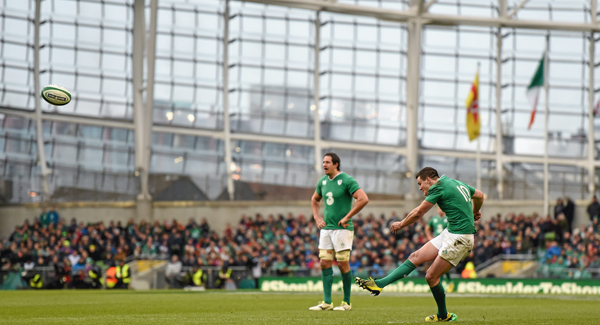
Honours between the two teams were even at the Aviva Stadium and that was perhaps as it should have been, though it was Ireland’s head coach who will have slept easier on his depleted team’s performance.
For this was not how the scriptwriters had envisaged an encounter between two sides supposedly on very different trajectories. Denied the services of several hundred Test caps worth of experience through injury and retirement, Ireland were on their uppers, their lack of strength in depth cruelly exposed by a rampant Argentina side in their most recent outing, last October’s humbling 43-20 World Cup quarter-final defeat.
Wales, on the other hand, were getting bodies back after an injury-ravaged World Cup, and had the continuity, power and physical oneupmanship to blow away the Irish in the same manner Argentina had.
Yet, given the amount of pessimism circulating in Irish rugby circles of late, reports of the national team’s demise appear to have been greatly exaggerated and it was a glum-faced Gatland who was left to ponder “two trophies gone from the cabinet” after week one, the draw, he said, “a fair reflection” of the contest.
No Grand Slam nor Triple Crown for either side this year, but Ireland’s glass, like its trophy cabinet, is half full, a third championship in a row still a possibility, with the cavalry now in sight in the form of the returning Sean O’Brien, Rob Kearney and, potentially, Mike Ross and Cian Healy, ahead of Saturday’s rapid resumption against France in Paris.
Their stand-ins and other less-experienced starters had weathered the storm in Dublin, none less than debutant CJ Stander, who appeared to the manor born inside the Aviva Stadium yesterday afternoon rather than the farm he was sprung from in George, South Africa. The Munster back-rower, capped at the first opportunity having qualified through his three-year residency, got the nod to cover his provincial skipper Peter O’Mahony and, having belted out the words to Amhrán na bhFiann, he went on to get his lines right once the game began, leading the charge in an impressive back row alongside Jamie Heaslip and Tommy O’Donnell.
That trio turned the tables on Welsh Lions Warburton, Tipuric and Faletau during a blistering opening 30 minutes in which the home side took a 13-0 lead through a Conor Murray try and Johnny Sexton’s conversion and two penalties. That was not supposed to happen, either.
Murray’s try on 27 minutes actually marked the point in which Wales, who had lost fly-half Dan Biggar to an ankle injury six minutes earlier, came to life and mistakes began to creep into Ireland’s game.
In the final 10 minutes of the opening half, back-up out-half Rhys Priestland nailed a penalty and converted Taulupe Faletau’s try after the Welsh scrum had turned the screw on the Irish pack, winning four penalties at the coalface, with tighthead Nathan White struggling to get on the right side of referee Jerome Garces.
It was 13-10 at half-time, and the second half played out as a curious sort of an arm wrestle, both sides willing to play with some adventure, yet neither able to crack the other’s defensive codes.
Priestland landed two further penalties to edge Wales in front, requiring Sexton to step up to the plate and get his side back on track six minutes from time, his penalty Ireland’s first score since his 27th-minute conversion.
It was enough to ensure Schmidt’s team go to Paris with hope restored rather than shattered and he was cautiously optimistic, given the way his depleted resources survived this challenge.
However, the short turnaround to a France side markedly different from the one Ireland dismissed at the World Cup represents another huge leap for his rookies, he was at pains to point out.
“Look, it’s comforting, because you’re not quite sure how you’re going to go,” Schmidt said of his inexperienced players. “It is a new level, some of them have dipped their toe in and obviously CJ hadn’t, but he acquitted himself so well that he led. That’s the challenge for those people, to come in and step up straightaway, because there’s no opportunity, particularly in the Six Nations, to get close without being launched into it.
“So, there’s some encouraging things, but the feeling in the changing room afterwards was a little bit deflated and little bit cognisant that we have to go forward, we have to improve further. That’s going to be a challenge, because I actually did think we performed really well today. That first 30 minutes, there’s a lot of times when we have had a really good experienced core available and not put a first 30 minutes together as well as that. There’s a hint of positivity there, now let’s consolidate that.”
S Zebo; A Trimble, J Payne, R Henshaw, K Earls (D Kearney, 72); J Sexton (I Madigan, 75), C Murray; J McGrath, R Best – captain (S Cronin, 75), N White (T Furlong, 64); M McCarthy (D Ryan, 64), D Toner; CJ Stander, T O’Donnell (R Ruddock, 49), J Heaslip.
J Cronin, K Marmion.
Liam Williams; G North, J Davies, J Roberts, T James; D Biggar (R Priestland, 21), G Davies (Lloyd Williams, 72); R Evans (G Jenkins, 53), S Baldwin (K Owens, 64), S Lee (T Francis, 58); L Charteris (B Davies, 62), A W Jones; S Warburton – captain (D Lydiate, 72), J Tipuric, T Faletau.
A Cuthbert.
Jerome Garces (France)