Digging in for the long haul

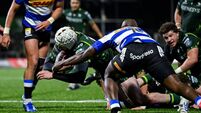
WHEN THEY reflect on yesterday’s performance in Cardiff, Munster will derive satisfaction from winning a game away from home without ever reaching the heights that secured the Heineken Cup less than 50 yards away in the Millennium Stadium.

Not only does this victory equal Leicester’s achievement of winning 11 consecutive games in this tournament, including a record six away victories, it also saw them dispose of a Cardiff challenge at the fourth time of asking.

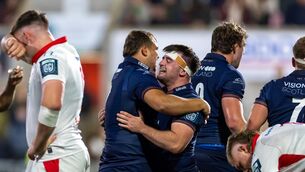
Elsewhere at the weekend, Leinster atoned for disappointment against Edinburgh with a performance of character in disposing of Agen on Saturday. Alas for Ulster, their quest to reach the quarter-finals for the first time since 1999 looks a lost cause now. To have any hope of success in this competition you must be able to grind out wins on the road. This seems to be beyond Ulster at present.

In contrast, Munster sit with a four-point advantage over closest rivals Leicester in Pool Four, having achieved two away wins already this season. While they never reached the heights that secured their excellent win against Leicester at Welford Road in October, they didn’t have to.

When Anthony Horgan cried off hours before kick-off, Munster were denied a fifth player from their starting lineup against Biarritz in last May’s final. With Barry Murphy and Mick O’Driscoll also unavailable, Munster’s resources were stretched to the limit. Yet as always in the face of adversity, they showed sufficient composure under pressure to absorb everything Cardiff threw at them.

Cardiff knew that to survive in this competition a win was a must. It was no surprise, therefore, that they hit Munster with everything in the opening 15 minutes and created enough difficulties for Paul O’Connell’s men to race into a six-point lead. The difference between Munster and the majority of teams in this tournament is their level of experience that allows them absorb pressure without pressing the panic button. It also helps on days like this when you possess a place-kicker of Ronan O’Gara’s quality. His immaculate return of six from six in difficult underfoot conditions was critical and tore the heart out of the home team.

Even when losing Federico Pucciariello to the sin bin for alleged use of the knee, Munster raised their game and outscored Cardiff with an O’Gara penalty during that ten-minute period.

When the Blues lost Martyn Williams, Munster seized the moment, lifted the tempo and went for the jugular. As we have seen on so many occasions, Munster sacrificed a kickable penalty opportunity to opt for a line-out in the corner. In such circumstances, with the opposition pack reduced to seven forwards, you could put your house on Munster to score. They didn’t disappoint, with Denis Leamy doing the necessary.

Munster could have inflicted further damage during that period when an attacking five-metre scrum propelled Cardiff with such force that Leamy lost control of the ball at the base of the scrum, and a definite try-scoring opportunity went a-begging. That said, on the basis of the early Cardiff pressure Munster were more than happy to reach the break with a seven-point lead.

Fighting for their lives, Cardiff bossed the physical exchanges for major portions of the second half but, crucially, lacked the creativity behind the scrum to score the vital try. In this respect, Munster’s defence was clinical and decisive. Normally on days like this it is the Munster lineout that separates them from the opposition. On this occasion Cardiff were outstanding out of touch and shaded Munster overall. In the prevailing conditions, handling was always going to be difficult and Munster were guilty of a number of unforced errors.

It was inevitable, therefore, that the scrum would play a vital role. Munster dominated throughout and John Hayes was outstanding — first when opposed by Lions Test loose-head Gethin Jenkins and then his replacement, Wales international John Yapp.

The other decisive factor was the workrate of both Alan Quinlan and Leamy, who made countless offensive tackles, negating the influence of former All Black Xavier Rush.

The other key decisive performances were in the back three from both Shaun Payne and Tomas O’Leary. Aware that O’Leary, primarily a scrum-half, was only included at the 11th hour, Cardiff out-half Nick Robinson tested his nerve under the high ball. O’Leary passed with flying colours. Likewise, Darragh Hurley, introduced for the last 20 minutes when the game was in the balance, made a significant contribution on his Heineken Cup debut. The Munster production line for prop forwards rolls on.

Munster can now look forward to the return fixture in Thomond Park next Saturday with the certainty that they will play better and the knowledge that scrapping for a victory in such circumstances will stand to them in the long term.

Meanwhile Michael Cheika and Leinster can take immense satisfaction from their bonus point victory over Agen on Saturday, which re-ignites their quest for qualification to the knockout stage. The victory elevates them to top of their pool and in many respects was a triumph over adversity.

Forced to start without the influential Felipe Contepomi and their first and second choice tight head props, there was further cause for concern when captain Brian O’Driscoll was ill during the week. It was clear from an early stage that he was uncomfortable, which resulted in him playing the majority of the game on the wing. In those circumstances, to score three tries and be as effective as ever at the breakdown was truly inspirational.

In the first half, Leinster defied the logic that territory and possession wins games. With their scrum under pressure and only one lineout throw in 40 minutes, they were forced to live off their wits. For the second week in a row they got down and dirty. The commitment of the forwards at the breakdown and in defence laid the foundation for this win.

To reach the break with a seven-point lead was a testimony to their grit and determination. That said, Agen were clueless behind the scrum and failed to provide any meaningful opportunities for the flying Rupeni Caucaunibuca.

Once again, Keith Gleeson was excellent on the ground and forced numerous turnovers when Leinster were starved of possession. In the second period with more opportunities out of touch where Malcolm O Kelly excelled, Leinster showed just how dangerous they could be with Denis Hickie and Shane Horgan making massive inroads against the French defence.

Both these teams have each lost once in this pool and next week’s return fixture at the Stade Armandie now assumes an even greater importance. For now, however, Michael Cheika can be pleased with a job well done.

x

More in this section

Sport

Newsletter

Sign up to our daily sports bulletin, delivered straight to your inbox at 5pm. Subscribers also receive an exclusive email from our sports desk editors every Friday evening looking forward to the weekend's sporting action.

Cookie Policy Privacy Policy Brand Safety FAQ Help Contact Us Terms and Conditions

© Examiner Echo Group Limited