'Your focus is on that 12-15m strip of ground. When the weather isn’t playing ball, you’re micro-managing it'
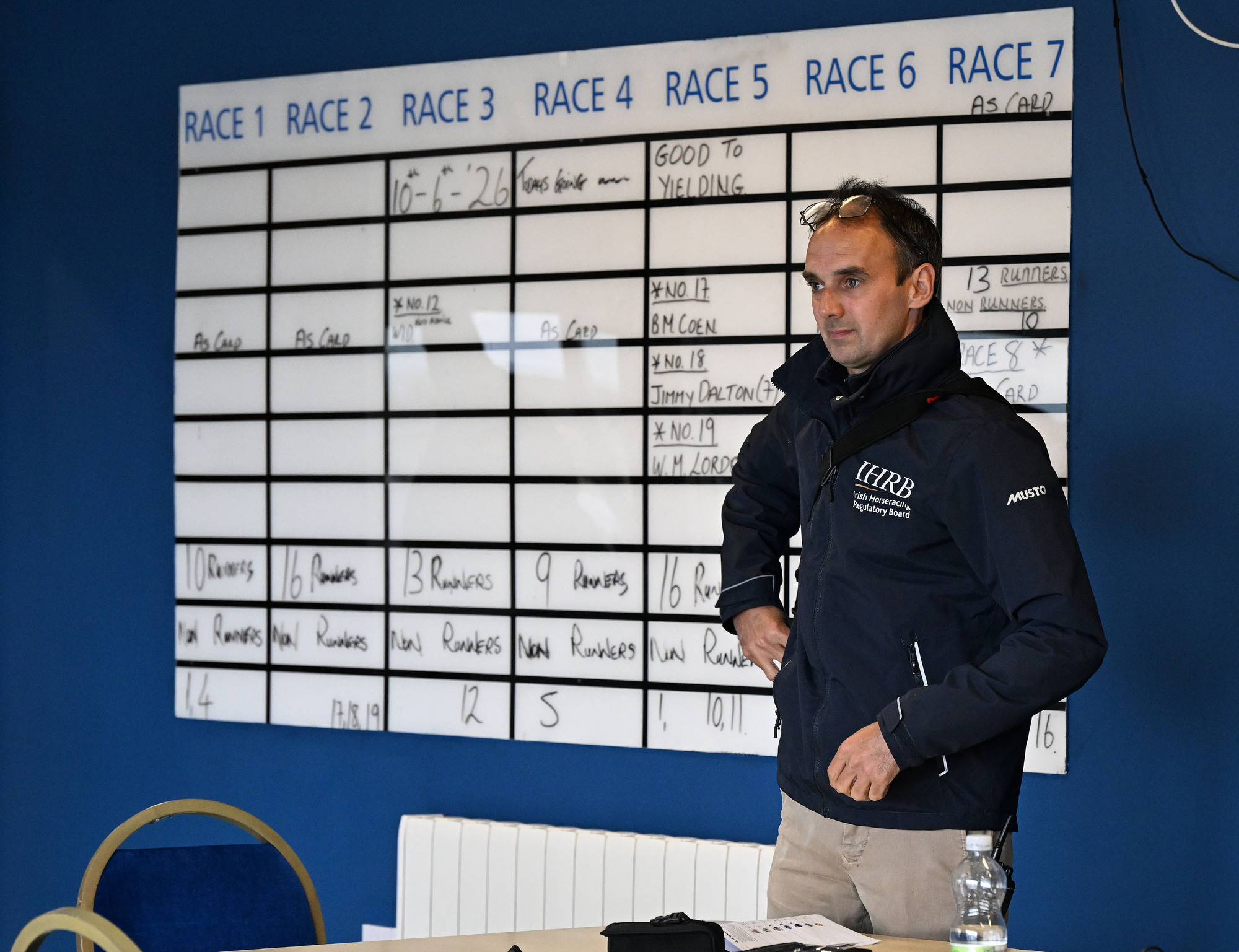
Shane Ryder, the IHRB Clerk Of Course Pic: Healy Racing
Shane Ryder, the recently appointed clerk of the course at Galway racetrack is speaking a few days before the maiden festival in his new role and not long after the All-Ireland football semi-final between Dublin and Kerry dominated by the equine equivalent of square balls, dodgy penalties and unawarded goals.
Like many from East Galway, Ryder has been immersed in horses since childhood, spending summers riding out on the Curragh. After school he took a degree in equine science at Limerick University, rode as an amateur for six years and then returned to his family home to fulfil a long-standing ambition to train. He’d been digging in the training trenches for two decades when an interesting prospect for a career pivot came his way last year and he was appointed clerk of the course at Ballinrobe, Roscommon, Limerick and Galway.
“This opportunity came at a good time for me,” he reflects. “I’m 48 and wasn’t planning to ride out horses for the rest of my life. It’s hard to get good staff when you’re a small trainer and I knew I was going to get to a point maybe two or three years down the road when I’d realise that I didn’t want to be doing that anymore.”
The vital role the clerk plays in the operation of the racing industry is unseen and mostly unappreciated, although recent shenanigans in Britain have led to increasing scrutiny. Watering policy in the run up to the Epsom Derby meeting, the inconsistency and draw bias on the straight course at Royal Ascot, and the cancellation of fixtures at Cheltenham and Haydock because of track subsidence have directed social media’s angry searchlights uncomfortably towards the clerks.
Ryder remains unfazed, his focus solely on things within his control. “My main role and my primary concern are the safety and welfare of participants, both horse and rider,” he says. “It’s a little different in Britain in that the clerks work for the racecourses; in Ireland we work for the IHRB and we’re the direct link from there to the racecourse. For me it’s all about producing a kind racing line on any given day and any decision I make is made with that in mind. In the weeks before the festival, I’m always watching the weather. You’d be on weather apps all the time but with the settled weather this year the lads in Galway will know that it’s not going to come naturally and that they’ll need to water the track.
"Racing is a dangerous activity. Our job is to minimise the risk, everywhere and anywhere we can. It’s impossible to eliminate risk entirely, but if I see a tweak that could reduce it even by a tiny fraction, we won’t hesitate to do it.
"I won’t be lying awake at night wondering how many were in attendance or how many pints were served. All my focus will be on the parade ring and racetrack.”
While a television weather forecast showing a big dark cloud over Connacht is useful information if you are planning a day at the beach in Barna, it’s of little value if your only concern is a track ten furlongs round and 40m wide in Ballybrit. Detailed granularity on local rainfall and windspeeds is needed when deciding on how many millilitres of water to add, and when and where to add it - crucial issues for the smooth and safe running of a race meeting. For Ryder, precise and regular communication is essential.
“We liaise with the courses in the run up to a meeting,” he explains, “and I’m in touch with the foremen on my four tracks. I have built a good relationship with the teams, we have a good communication, but no two tracks are the same, they are all unique. The sod is different; some take the rain and dry out at different rates. There are over 400 race meetings in Ireland every year on 26 courses and every time they race, they are effectively on a new strip of ground. Your focus is on that 12 or 15m strip of ground on that day. When the weather isn’t playing ball, you’re micro-managing it.”
By ten past five on Monday, when the white flag is raised for the opening race of the 2026 Galway festival, the first movement in Shane Ryder’s Galway symphony will have been played. A combination of nature, intricate planning, his team’s judgement and an irrigation system will have done their work and the ground ‘will have been called.’ But his week has only just begun.
“When it comes to Galway week itself, it’s not so much the weather that will keep me up, it will be the responsibility,” explains Ryder, as he outlines the scale of his challenge. “Thousands of people will have worked towards this week, trainers have targeted races for months, maybe even since last year. Owners have invested huge amounts, and you just want to give everyone the best possible conditions for a good week’s racing.
"I think my experience as a trainer helps. I understand where the lads are coming from and from being a trainer, I understand the anticipation that owners and trainers have when they arrive at the races. I understand the months of work it takes to get a horse ready, especially for the Galway festival and I understand what they expect to find when they are walking the track.”
Ryder believes that approachability and personal integrity are crucial traits for a good clerk of the course. He never declines a call from a trainer even if he suspects that he might hear the roar of a hair dryer from the other end of the line. He is equally emphatic that if something goes wrong that he stands in front of the problem and owns the responsibility to get it right next time. The Galway festival rolls all these variables into a single hectic week.
“What goes on down in Galway no-one can comprehend,” he smiles. “I was a trainer for years and didn’t comprehend it. The unique thing about Galway that makes my job a little harder is that we are going to have national hunt and flat racing all on the same line. Good ground for the flat lads doesn’t equal good ground for the jump lads, so that can be challenging, trying to keep both codes happy. On Tuesday we have a chase and the race immediately after that is on the flat. Nobody understands that a fence has to be removed after race three before race four can happen. It’s a giant machine and I’m only a very small cog.”
A ‘small cog’ that will arrive at the track, three hours before the first race is off each day. First, he’ll walk the course to ensure the going description still matches his earlier call. Then he will check that the medical and veterinary supports are in place and that everybody that is needed to run a safe race meeting is present on site. He’ll spend the rest of the day on closed circuit radio with scores of the team members resolving problems big and small as they arise, while at the same time marshalling horses, jockeys and trainers into position so that the meeting runs to time.
“When the week is done, if everything has gone well and everybody has got home in one piece, I’ll take pride and great comfort in that,” he concludes.
“Some of the owners and trainers might be going home frustrated that things haven’t gone right but at least they will know that I know that we got it wrong and will try put it right the next day. If you are open, honest and doing your best, then you’re winning. The jockeys would know this too, that we aren’t working against each other, that we are all pulling in the same direction.”