The brutal week of baffled Bob Baffert
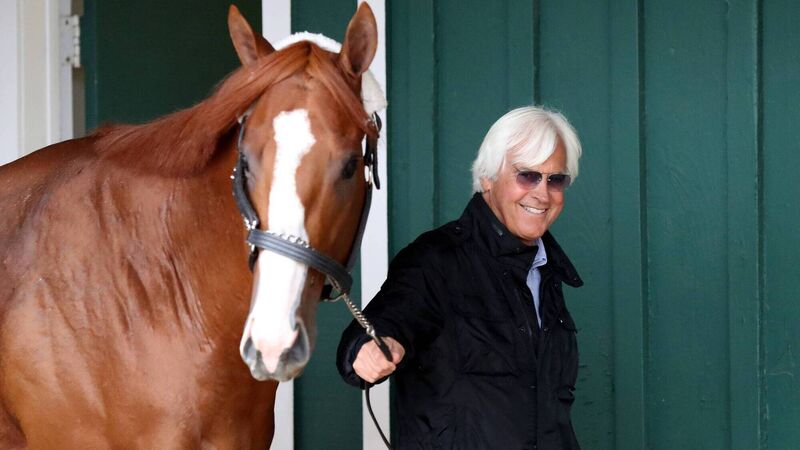
GLORY DAYS: Bob Baffert with Justify ahead of the 2018 Preakness Stakes, a race he won en route to landing the American triple crown. Justify’s reputation was tainted when it emerged after his track career had ended and a $60m (€49.6m) stud syndication was secured, that he had failed a drug test following victory in a spring trial. Picture: Rob Carr/Getty Images
Sunday
Bob Baffert is baffled. Not just everyday, run of the mill type baffled, but totally and utterly mystified, perplexed and discombobulated.
America’s leading racehorse trainer is so upset that he has called an impromptu press conference at his barn at Churchill Downs racecourse so that he can share his anguish with the world. A week has passed since his three-year-old colt, Medina Spirit, gamely won the Kentucky Derby at the same track.
Baffert starts proceedings with an inconsequential logistics update regarding the movement of the horse to Pimlico in Baltimore, where he is due to contest the Preakness Stakes, the second leg of the fabled triple crown.
He says that horse will probably arrive somewhere between three or four in the morning. None of the journalists are interested.
They’ve all been around Baffert long enough to know that the average ground speed of a horse transporter is not the reason behind their sudden Sunday morning summons, not why the ‘Hall of Fame’ trainer unexpectedly rerouted eastwards from his journey home to Santa Anita, California at such short notice. He is here to assert his sizeable influence on a developing and darkening narrative.
He gets to the nub of the problem.
“Yesterday, on my way to the airport I got a call with some horrible news,” he says, gravely. “We have been served by the Kentucky Horseracing Commission with the news that our Derby horse, Medina Spirit, had tested positive for 21 picograms of betamethasone. I can confirm that Medina Spirit has never been treated with betamethasone. Yesterday I got the biggest gut punch in racing for something that I didn’t do.”
He spits pure contempt onto the words ’21 picograms,’ his body language infers that this is a pharmaceutical quantity so insignificant that it is an insult to a man of his standing even to be called to account for its presence in his horse’s bloodstream.
He could of course have chosen to phrase it differently but didn’t. He could have said “over twice the previous legal limit of the substance permitted and 21 picograms more than is currently allowed”.
“I was totally shocked when I heard this news,” he continues. “I am the most scrutinised trainer. And I am OK with that. The last thing I want to do is something that would jeopardise the greatest sport.
This is a pretty serious accusation. We’re going to get to the bottom of it. We didn’t do it.
Baffled Bob then outlines the time-wasting hoops he must now jump through to prove his innocence and how darn puzzled he is that this stuff just keeps on happening to him.
Later that day the Kentucky racing authorities finally catch up with his media storm and his newly-established ‘in-house’ investigation into the outrage. “We’ll take it from here, Bob,” they almost say.
His horses are immediately banned from racing at Churchill Downs pending the outcome of their official inquiry. Word then leaks down from Baltimore; the officials at Pimlico are seeking a legal avenue to cancel his Preakness invitation too.
Monday
Two Baffert trained colts, American Pharoah (2015) and Justify (2018) have won the triple crown recently, an unusual cluster of success. No horse had achieved the feat since Affirmed was steered to glory by a teenage Steve Cauthen back in 1978, seven years after the first of Bob Baffert’s 30 recorded career excursions with banned substances. Five of these cases have occurred within the last 12 months and even the reputation of the great Justify was tainted when it emerged after his track career had ended and a $60m (€49.6m) stud syndication was secured, that he had failed a drug test following victory in a spring trial.
On Monday, battling Bob Baffert continued his media campaign, taking his bafflement to Fox News, a channel now famously amenable to powerful people needing a broadcast platform for subjective versions of their own specific truths. There was no hint of a ‘mea culpa’. No Act of Contrition, no hunt for penance and redemption — just more victimhood with some added toxic speculation thrown in.
He told Fox: “There’s so many ways these horses can get contaminated and when they’re testing at these really ridiculously low levels … we live in a different world now. It was like a cancel culture kind of thing.”
He later developed his “different world” theory in another soft focus interview on an equally sympathetic radio station. “Churchill Downs came out with a really harsh statement,” he lamented. “I was shocked by it. They violated my due process. Usually when you get a positive, it’s supposed to be confidential and they wait for your split (‘B’ sample) to come back and it usually takes a few weeks.
Twenty-one picograms, we call it contaminate levels. They’re testing at these really low levels the last few years. It’s been a problem in racing.
It had seemed to slip his mind that it was he who had made the news of his failed test public before any official had time to say a word.
Tuesday
Betamethasone is an anti-inflammatory steroid medication designed to mask pain in animals. If used nefariously in racehorses it could cause them to run hard through a niggle or injury, postponing any adverse physical consequences until later. Like a root canal patient, still under the pleasant numbness of the dentist’s needle, sinking his new front teeth into a hard slab of toffee before the novocaine wears off. It wouldn’t feel like such a good idea a few hours later.
Baffert’s stridency in the previous couple of days looked a bad idea too by the time Tuesday rolled around. It has emerged, despite all his deflections and excuses, the cancel culture, the harsh officialdom at Churchill Downs, the absence of consistent governance in horseracing, the ludicrously small amount of the drug found, the transparency of his self-declared no-stone-unturned inquiry, that he may have (unwittingly, of course) been responsible for the violation after all. This news induced a new shyness in the puzzled ‘victim’ and he left it to his lawyer to issue the clarification this time.
The horse had been treated for a ‘rash on his hips’ with an approved therapeutic cream called Otamax, which does contain betamethasone. “I had him checked out by my veterinarian who recommended the use of an anti-fungal ointment called Otomax,” the statement read. “The veterinary recommendation was to apply this ointment daily to give the horse relief, help heal the dermatitis and prevent it from spreading. Medina Spirit was treated with Otomax once a day up until the day before the Kentucky Derby.”
The product specification advises that it’s use ceases 14 days before a race.
This admission removed any lingering defence against disqualification if the split sample confirms the positive test and effectively separates his owners from their $2m (€1.65m) first prize. But Tuesday ended with a little better news for Baffert.
The authorities at Pimlico had chickened out under his aggressive threats of litigation. Medina Spirit would be allowed go to the wire in Baltimore.
Wednesday
There was once a time in North America when horse racing was second in sporting popularity only to baseball.

These days there is a widely held view that the sport is facing an existential crisis caused by an abundance of fatalities, drug abuse, medieval employment practices, and an absence of consistent governance. By far the biggest problem is the absence of central control and the delegation of oversight to State level, where they tend to make their own rules.
An independently commissioned report for the American Jockey Club five years ago concluded that “within the industry, it is well known that the systems in place are not conducive to catching cheaters. Violators knowingly leverage the absence of national compliance… and are well-versed in doping methods, industry gaps in compliance and cognisant that there are minimal risks in being caught doping or abusing their horses”.
Legislative steps are being taken to close this gap. The Horseracing Safety and Integrity Act is due to go into law in 2022 and will create an independent nationwide regulation body that will operate under the supervision of the United States Anti Doping Agency, USADA.
All this might be too late to save Bob Baffert’s career and reputation. Cracks in the edifice had already appeared by Wednesday. Several of his prominent clients let their disappointment be known and Spendthrift farms, co-owners of last season’s Derby and Breeders Cup winner, Authentic, have decided to move their horses elsewhere.
“Bob gave us the thrill of a lifetime last year,” said their spokesperson. “but given the circumstances, the best thing for the time being is to step back.”
Saturday
Bob Baffert has selflessly decided not to fly to Baltimore for tomorrow night’s race, fearing his presence at Pimlico would be a distraction to the horses, the owners, and to the sport he loves so much.
Medina Spirit is 7-4 favourite for the Preakness with his other runner, Concert Tour, next best at 5-2. Or, as the oddsmakers might put it, if you ‘dutch’ them both, Baffert is roughly 4-6 to win the second classic.
Nothing baffling about that at all.

Subscribe to access all of the Irish Examiner.
Try unlimited access from only €1.50 a week
Already a subscriber? Sign in