Battle royal that developed into greatest race ever run
Born in 1918 and a son of South Kerry, O’Sullevan sidestepped any risk of a Kenmare accent by decamping to the English public school system at a young age where he settled on the plummy, if less musical, tones that built him an illustrious career at the BBC.
And it was on this very day 40 years ago that Peter spun his unique vocal magic around what is still routinely described as the greatest Flat race ever run when Grundy and Bustino engaged in a furious midsummer gunfight under Ascot’s blazing sun.
The King George VI and Queen Elizabeth Diamond Stakes that year had as many sub-plots as Game of Thrones but his effortless immediacy in marrying the complex strands together while building to an elegantly precise crescendo was perfect for the dramatic canvass being painted on the track beneath him. Both he, and the race, began serenely enough.
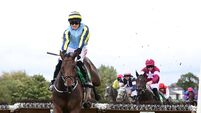
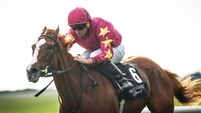
This afternoon’s King George doesn’t nearly contain the same dramatic possibilities. Golden Horn is starting to look like the real deal and if he can add victory in today’s contest to his Derby and Eclipse, we are moving into Mill Reef territory and a probable rating in the high 130’s. Sometimes legend comes dropping slow.
Back in 1975 the gratification was more instant, there was an immediate sense that history had been made on conclusion of that pulverising battle of courage, tactics, talent, jockeyship, luck, grit, perseverance and determination. Two equine generations had eyeballed and a story was made that had far more longevity than either of the protagonists involved.
Grundy, the dual Derby winning three-year-old trained by Peter Walwyn put his reputation on the line against the finest older horses of the time. Dick Hern’s St Leger winner Bustino, who had recently smashed the Epsom course record in the Coronation Cup, was joined in opposition by the Eclipse and Arc winner, Star Appeal and the peerless Dahlia, still regarded as one of the finest mares to ever grace a racetrack and that day sought a hat-trick in the race.
Hern had concluded that the best way to beat Walwyn’s tough little colt was to crack his stamina, brought two decent pacemakers to test his theory and after a couple of furlongs they settled into their tactic. O’Sullevan began to wind up the intensity.
If central casting had sought stereotypes for the sort of ‘chap’ who trained horses in deepest Berkshire in the second half of the last century then Peter Walwyn MBE and Major Dick Hern would have done nicely. Both ex-Army, privately educated and beautifully connected, Grundy’s handler Walwyn is still heartily dishing out his patented politically incorrect wisdom in Lambourn well into his eighties.
Hern, who passed away in 2002, was less controversial, but was a brilliantly innovative horseman who before Bustino had transformed Brigadier Gerrard all the way from plain bred obscurity to immortality a few years earlier.
Bustino came to him when he was bought at the sales by his long-time patron Lady Beaverbrook for twenty-one thousand guineas. A stoutly bred, slow maturing bay, his lineage was almost as august as that of his owner, tracing back to Larkspur and Alycidon among others.
Grundy, on the other hand, was as exotic as the band that topped the charts on race day, although thankfully he was prettier and more athletic than the Bay City Rollers. Owned by the Italian Dr Carlo Vittadini, he only cost half the price of Bustino, probably because his flashy chestnut coat, three white socks, flaxen mane and a blaze down his face the width of the nearby M4 motorway. This was not a fashionable look.
But after half a mile of the King George it was apparent that being pretty counted for nothing in a duel in the sun. The commentator deliberately raised the temperature another decibel.
O’Sullevan spent 50 years describing races for viewers of BBC television. If those five decades of compelling commentaries could be distilled into a single second it would be the phrasing of the word ‘blistering’ at that time, in that place.
Its timing would also have been music to the ears of Dick Hern whose cunning plan required a blistering, or even suicidal, pace for as long as his pacemakers could sustain it.
Although Grundy’s dam, Word From Lundy, had won over two miles the speed he’d shown as a champion two year old and later as a dual Derby and Irish Guineas winner convinced Hern he couldn’t stay a true run mile and half, so he entered three pacemakers but when Riboson cracked a cannon bone near to the race, he had to go to war with just two.
Time would argue that this proved to be of the more impactful non-runners in racing and time could well be right. Peter Walwyn certainly thought so.
“Bustino had won the previous year’s Leger,” he later recalled, “so they knew he stayed and Dick Hern put in Kinglet and Highest for him. There was a third, but he was injured and that probably cost Bustino the race because the other two went as fast as they could but could only take him to the half-mile marker.” Meanwhile, the commentary increased the tempo.
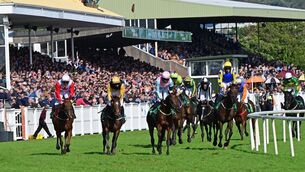
It wasn’t just the pacemakers that were done in at the half mile pole; the other runners were too which left only two main protagonists to continue the spine tingling epic finish. It hadn’t rained in South East England for weeks on end; the ground was still firm despite extensive watering and remarkably hey had got to the turn in at five furlong pace. O’Sullevan recognised the decisive move.
Bustino’s jockey, Joe Mercer had noticed the pacemakers waver, pressed the turbo button and kicked on by about four lengths. For an unending second there was no response from Grundy ridden by the then twenty-three year old champion Pat Eddery. Then gradually, painfully the younger horse began to grind down the gap.
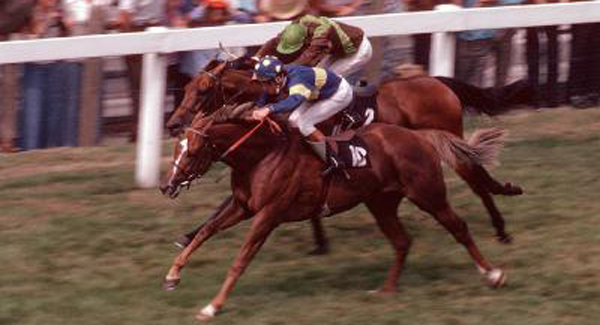
Eddery threw the kitchen sink at Grundy, hitting him nine times in the straight, while Mercer, realising his horse could not physically try any harder, put his whip down. They were level at the furlong pole, Grundy by half a length a hundred yards out, Bustino fought back, still refusing the unconditional surrender his relentless foe demanded. O’Sullevan’s hit peak pitch, delivery and volume.
They pulled up rocking with exhaustion, the course record two and half seconds in their rear view mirrors. The stunned Grandstands almost silently reflected on what they’d just seen. Grundy had prevailed by a neck.
The race may have broken both of them. Bustino was never seen on a racecourse again and Grundy was retired when he flopped badly a month later at York.
Whatever fare Golden Horn serves up at Ascot today, it is unlikely to match this still fresh 40-year-old feast. And even if they do it probably won’t seem like it. Peter O’Sullevan won’t be calling the horses.