Ciara Mageean: 'It is a very strange thing to be 34 and face the fact of your mortality'
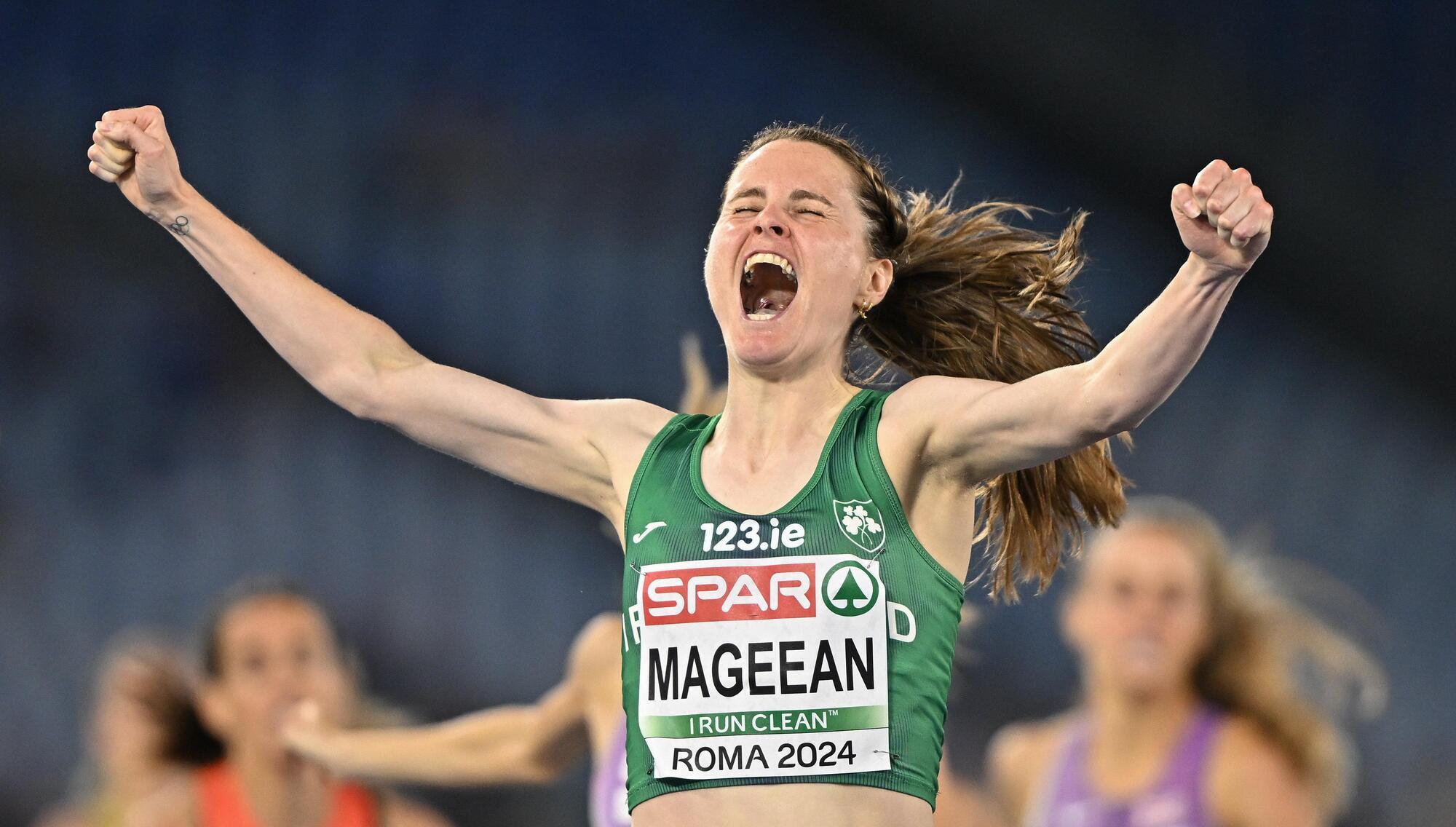
Ireland's Ciara Mageean celebrates winning the women's 1500m final during day three of the 2024 European Athletics Championships. Pic: Sam Barnes/Sportsfile.
While sifting through the wreckage of the Paris Olympics, which Ciara Mageean was forced to withdraw from at the 11th hour due to injury, she found herself sitting in the home of British psychiatrist Steve Peters.
Peters’ most famous work surrounds The Chimp Paradox, a model that breaks the mind into parts. There’s the rational, logical human. There’s the computer that stores memories and runs its autopilot system. Then there’s the chimp, or limbic system, which governs emotional impulses.
After they’d covered various topics in Mageean’s life, Peters shared one of his findings: “Your chimp thinks that everything should be fair.” That ideal has been a central pillar in Mageean’s life throughout her 34 years. But she knows it’s also not the reality.
“I feel like life should be fair, that there shouldn’t be millionaires and really poor people – as Communist as that sounds,” she says with a laugh. “People shouldn’t be dying of starvation."
“But that's life,” Peters told her. “Life just isn't fair.” Her athletics career taught her as much, Mageean’s dazzling talent coming with a fragility that so often kept her ability shackled, and that’s before we get to races she likely lost to dopers.
Still, Mageean has long believed that things happen for a reason. There was that great, volcanic eruption of joy when she won the European 1500m title in 2024 – how all the hurt before made the moment even sweeter.
Read More
Within weeks, of course, running ripped her heart out again as she withdrew from the Paris Games. But less than a year later, that deep, genuine pain was made to feel almost trivial. Stage four bowel cancer, which has a five-year survival rate of 10-15 percent.
“Whenever I was given the diagnosis I wondered, ‘Why me?’” she says. “And then I was like, ‘Well, why not me?’”
Two of her classmates in primary school died as children. Mageean has known many others who departed long before it felt anything like their time. So when she thinks about cancer, she takes “a bit of strength” from the notion that life just isn’t fair. As for her belief that things happen for a reason? That’s harder to apply here.
“I don't believe that cancer happens for a reason, unfortunately. Or maybe I was meant to share my story. Maybe I was meant to raise awareness of it. I hope I survive this and I don't die young and if I do, I hope the legacy that I leave is something. But yeah, it’s a horrible thing to be going through.”
Last week, Irish athletics got another jolt of stomach-churning news after 2012 Olympian Ciarán Ó Lionáird was found dead in Vancouver, Canada, aged just 38.
“He was always such a character,” says Mageean, who was emerging at senior level when Ó Lionáird was at his peak. “He was always in trendy clothes, really quirky, and he was such a phenomenal athlete. My heart goes out for all Ciarán’s friends and family. I was completely devastated for them.”
Over the past week, Mageean has been inundated with goodwill while making public appearances to promote her book, My Greatest Race – a powerful, uplifting story that she wrote with Clíona Foley. It flicks back and forth between her life, her career and her cancer story, the latter ever-present but not dominant or definitive.
A listener’s text to the Brendan O’Connor show on RTÉ Radio 1 made Mageean cry. So did the words of longtime Irish Runner Magazine editor Frank Greally at a book launch on Tuesday. Mageean is deeply appreciative of the empathy coming her way, though she isn’t one to indulge much sympathy.
That was clear in RTÉ’s Uncharted with Ray Goggins. Filmed in January, between courses of chemotherapy, it saw Mageean take on immense physical challenges in Costa Rica.
“I was like, ‘Lads, I don't want it to be taken easy on me, I don't want somebody pussy-footing around me.’ It's awkward and uncomfortable whenever somebody comes to me and is like, ‘Oh my God, are you OK?’ But if people come towards me with love and being caring, it's only ever from a place of goodness and kindness.
“A little part of me feels guilty that just because I have the platform through sport, I'm getting such a rush of all these things. I'm so aware that there's people out there going through the same battle but their profiles and networks are a lot smaller.
"But I do hope they're getting this from the people around them. One of the reasons I wanted to share what I'm going through is for somebody else going through [it], maybe they can resonate with it and try to get that little bit of strength.”
Mageean completed her latest round of chemo in late May. More will undoubtedly follow. She’s both hopeful that she will live for many, many years while realistic enough to know she might not. But she’s carrying on – as always. Head down, straight ahead, whatever it is that’s coming.
“It is a very strange thing to be 34 and face the fact of your mortality being a lot more prominent on the horizon. It's a tough thing, but it comes to us all and you just don't know when.
“I'm not scared to die. I just don't want it to happen anytime soon.”
As for the unfairness of life? Eight times during our chat, Mageean uses the word lucky. To describe the friends and family she has. To have been able to push her body to such heights and to have brought so many along for the ride. Not once does she use the word unlucky.
“I feel really fortunate and maybe that'll be my legacy,” she says. “It's one of the reasons I wanted to write the book – that legacy of hope and joy in the face of any sort of adversity. Yeah, I hope that's something that lives on long after the time that I cease to be here.”
CONNECT WITH US TODAY



Be the first to know the latest news and updates