Bronze relief for Doyle and Lynch at end of Olympic cycle
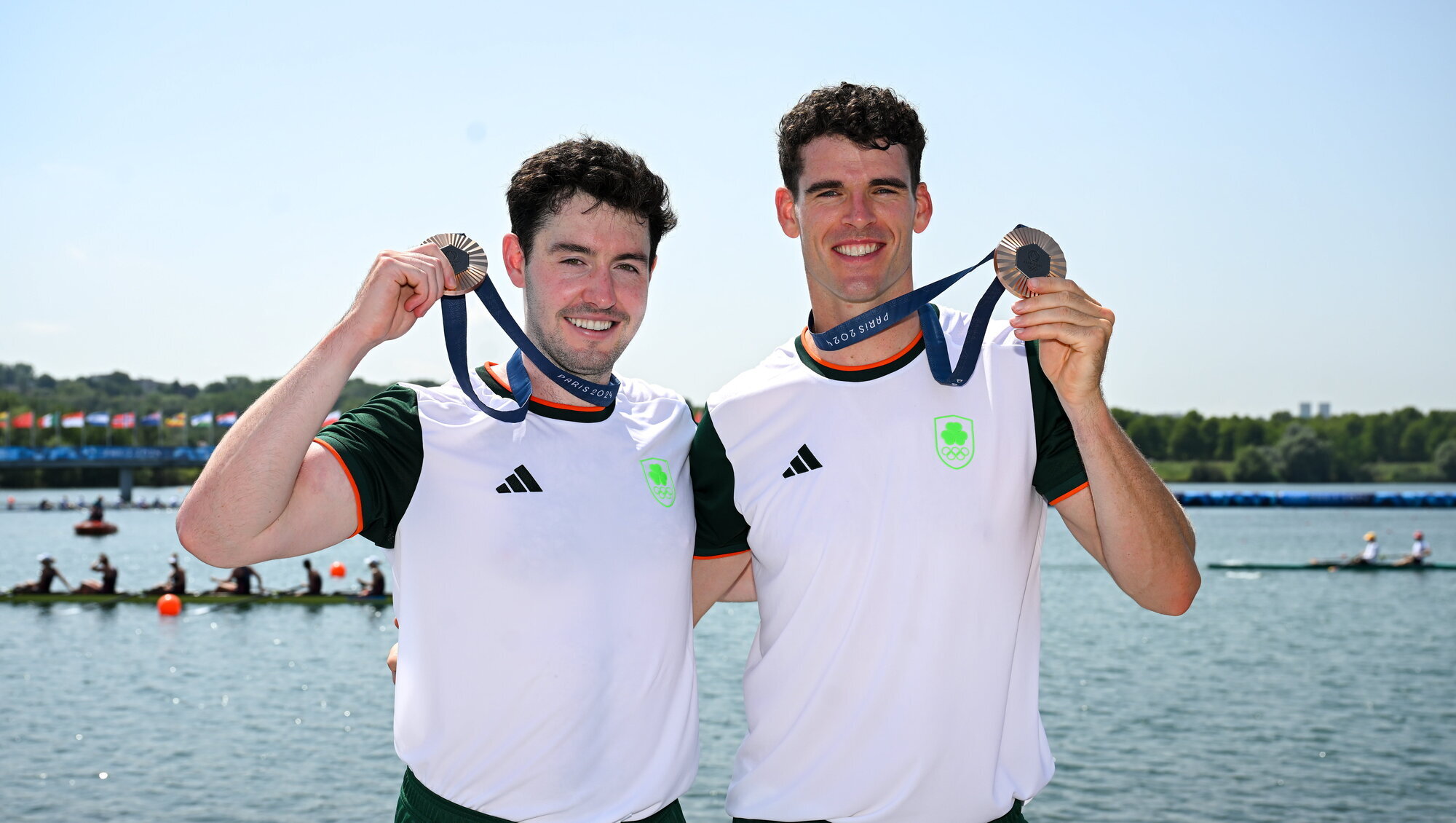
BRONZE: Philip Doyle, right, and Daire Lynch celebrate with their bronze medals after the men's double sculls A final at Vaires-sur-Marne Nautical Stadium. Picture: Stephen McCarthy/Sportsfile
The answers were polite but the air of disappointment, the sense of a shot that hit the crossbar, clung to every word and syllable. This was a crew that had come to these Olympic Games with a rarified expectation and, while they had made the podium, this was not the step they wanted to take.
“The silver is really special, of course,” said Melvin Twellar of the Netherlands after Thursday’s final of the men’s double sculls. “It's starting to settle in more and more that this is really special. Not everyone can say they have two Olympic silver medals in this really hard boat field.”

The Dutch are reigning double sculls World champions, they had finished second in Tokyo three years ago behind a French crew, and Twellar had gone on record before Paris to tell everyone that the aim for himself and Stef Broenink was to “take revenge” for that near-but-no-cigar effort at the delayed Games.
All of which raises the question: how do we measure success?
You hear mention of ‘bad’ silvers and ‘good’ bronzes’ down the years. Medals are the most visible and cherished symbol of rank and accomplishment, but they are coloured more again by individual and national backgrounds, and by form. The Dutch were considered unbeatable until earlier this week. Their mood was understandable.
Ireland were considered their closest challenger. Philip Doyle and Daire Lynch had been tipped for that silver pre-Games, their phenomenal runs in the heat and semi-final had upgraded their status to potential gold and, in the end, they managed to hold of the USA to claim a bronze. That’s a lot to digest on completion of an Olympic final and cycle.
The first thing to say is that it stands as an achievement of enormous proportions. This was the first male heavyweight Olympic medal of any hue for Ireland. That’s a point all the more significant given the lightweight ranks are being done away with in Los Angeles in 2028. It’s also only Ireland’s fourth Olympic medal in rowing ever.
Every medal is painstakingly earned. Athletes eke out marginal gains on a daily basis like Andy Dufresne with his rock hammer and the cell wall. Doyle balanced his latest push with medical duties in Cork, Lynch gave up a career and a life in New York with a marketing start-up only 15 months ago.
Lynch was sick all week through this regatta, Doyle has had a neck issue all year that seized up coming down the stretch and made his grip slip on the handle just as they seemed set to challenge the Dutch for second spot. So, while the rest of us could hail a bronze medal without reservation or carp, they were entitled to see it initially in shades of grey.
“I nearly dropped the flipping oar with 50 metres to go, so I think a little bit maybe was just relief. But I think when we won the semi, when we won the heat, there's that great feeling of adrenaline as you're coming in. You know, ‘you've got it in the bag’, whereas there, you know, you're, you're looking around and you realise… “I think during the week, you try and get something from each race. You build off it, you build off it. Whereas today, it was just a release almost. It was kind of a wave of positive and negative and relief and disappointment. Sometimes you just have to contain that within yourselves and look back and just say, like, give it all.”
The thing with expectations, of course, is that everyone has their own.
Enache Florian and Andrei Sebastian Cornea were only a minor part of the conversation through most of the week. They had hurtled to the front in their semi-final, faded, and then only made it through to the A final when the Serbian crew basically stopped rowing. But they led here from pillar to post.
The Irish saw them go out and expected to see them retreat to the pack, but they never did. Doyle knows Florian well. They have rowed against each other the last five years, won some and lost others, and the Down doctor’s affection for the gold medal winner was obvious. They were “on another planet,” he said at one point.
They certainly weren’t mapped earlier this year when Cornea was still racing in a quadruple sculls in a World Cup. This was an entirely new Romanian crew from the one that won the ‘B’ final in the 2023 World Championships in Belgrade, which the Dutch won, and in which the Irish came third.
It was March before they sat in the same boat.
Doyle explained the depth of the Romanian system, how they had picked out their top two male athletes and decided that this double sculls was the best means of extracting everything from them. They were bang on. Romania had 1.46 seconds to spare on the Dutch and 2.59 on the Irish.
They had beaten the world champions, and the crew expected to push them most.
“I don't care who is the world champion, who is the silver medallist,” said Florian. “I have respect for all the crews that compete against me. I told them before. If they want to beat me, they must die. I want to tell you that everything you have to do, no matter what, they will judge you. Just prove them all fucking wrong.” Everyone has their own expectations.