Disaster and triumph, Wilkins experienced it all on the Olympic seas
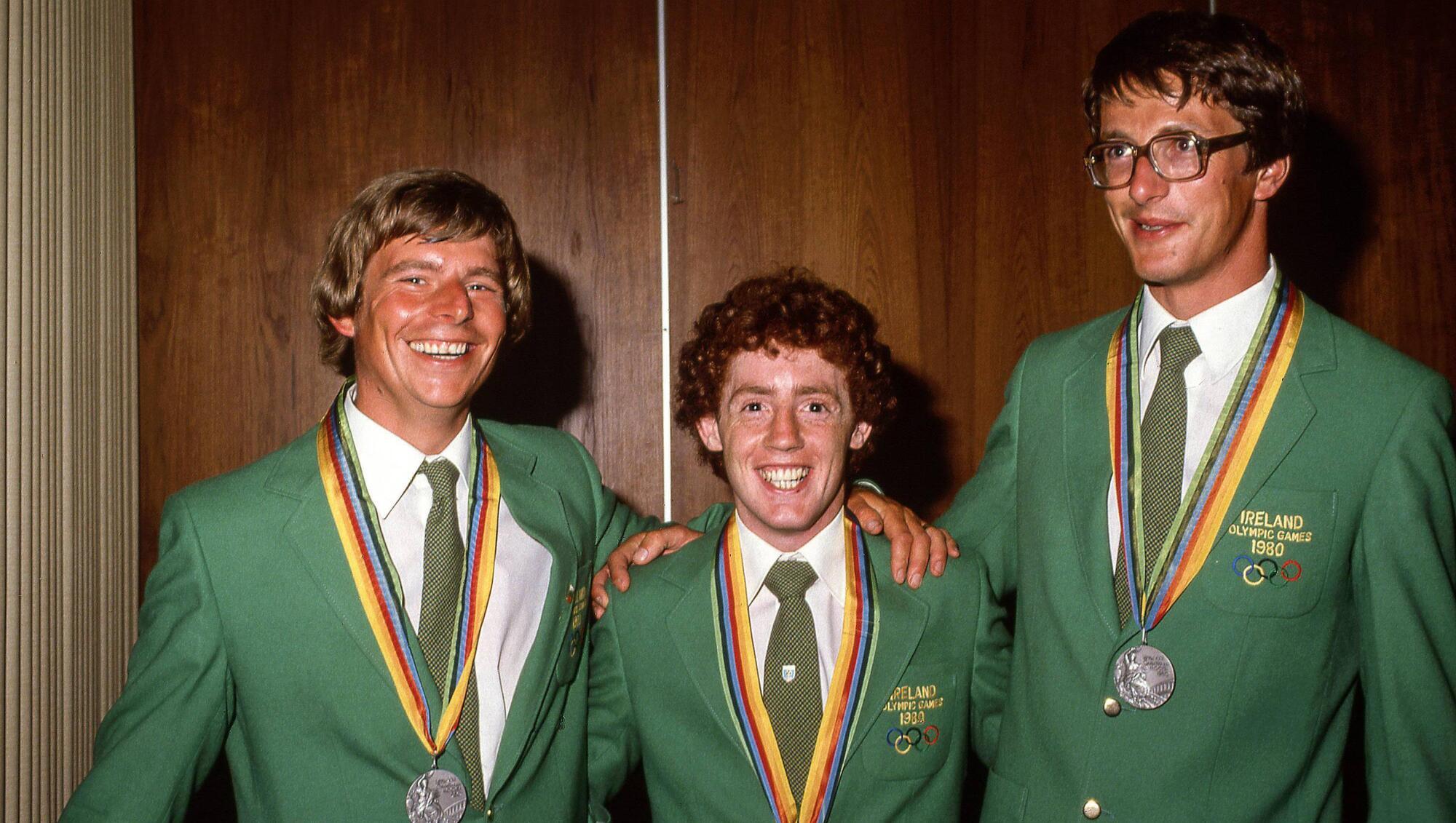
4 August 1980; Flyweight bronze medallist Hugh Russell, centre, with Flying Dutchman silver medal crew David Wilkins, left, and James Wilkinson at the Irish Olympic team homecoming in Dublin Airport from the 1980 Summer Olympics held in Moscow, Soviet Union. Photo by Ray McManus/Sportsfile
Annalise Murphy didn’t just captivate a nation as she sailed the waters off the coast of Weymouth in 2012. Then 22 years old, the vast sweep of the Dubliner’s Olympic experience, from the enormous swells of hope to the crashing despair of finishing just outside the medals, served as a bracing introduction to one of sport’s crueller codes.
She had won the first four races in the Laser Radial class, still held the overall lead through eight of the ten runs, and found herself in the gold medal position at one stage of the last, definitive race. Murphy drifted in and out of silver and bronze too but ultimately lost out after some small but significant tactical errors.
A silver in Rio four years later, in the second of her third Games, would wash away the tears shed that day in early August on England’s south coast. Those toils and triumphs, and the fact that her medal was a centrepiece bookended by other Olympic experiences of differing hues make it a replica of Ireland’s only other podium place when it comes to the open seas.
*****
David Wilkins is one of only three Irish athletes to compete in the Olympics five times. Derek Burnett and Rob Heffernan are the others. Terry McHugh stands alone at the summit of that mountain with six between his efforts in the javelin and bobsleigh. Like them all, Wilkins’ silver in 1980 is just one captivating chapter in the spine of a bigger story.
If there’s a thread linking his and Murphy’s experiences, and so many more sailors, then it is the vagaries that can sink the best’s best-laid plans. Hannah Mills, Britain’s multi-medallist in the women’s 470 class and current Olympic champion, once boiled this down to brass tacks by observing that there could be no wind or it could be 25 knots.
“You never know what you’re going to get,” she said.
That goes for so much more than the weather.
Wilkins has been there and earned the soaked t-shirt. So, while he claimed that silver along with Jamie Wilkinson 44 years ago, he can just as easily look back and fill you in on the disasters and the minor details that foiled podium pushes in his first Games in 1972 and then in his second last 16 years later.
In ’72 he sailed in the Tempest class with Sean Whitaker when they led one race only to be stalled by some broken gear. Worse followed on the second-last day when they were becalmed near to the line having rounded the last mark at the front and had to sit more or less helpless as the fleet passed them by.
“The boat that was 26th around the last mark won the race and actually won the gold medal. We finished about 13th or 14th that day. If the race had finished at the last mark we would have gone into the last race guaranteed a medal, possibly the silver, and with a chance of the gold, but these things happen.”
Maybe, but some things would make you curse like, well, a sailor.
Wilkins and Peter Kennedy were shooting away from the pack in one race in the blindingly quick Flying Dutchman class in Pusan in ’88 when they came to a complete halt. They searched the boat high and low for an answer and eventually found a piece of plastic covered in tar that had attached itself to the centreboard under the hull.
They had to capsize themselves to get it off.
The other impediment in ’88 was even bigger, an enormous container ship that somehow strayed through the course when the Irish were one of four crews in prime position. Wilkins still has footage of it on his smart phone from an RTÉ documentary that was aired before the Beijing Games in 2008.
“And the annoying thing is if the bugger had just slowed down a bit we would have been fine because he wasn’t going much faster than us.”
*****
The Olympics is riddled with what ifs and the Dubliner tells these stories with an air of something close to stoicism. You probably don’t spend his amount of time in a boat without coming to peace with the frivolousness of elements that may as well be dictated by ancient gods like Poseidon or Neptune or Aeolus given the capricious nature of the seas and the winds.
Even his medal is fitted with sliding-door moment.
Partnered by Wilkinson, they were well-placed to win the first race in the Flying Dutchman at the Pirita Yachting Centre in Estonia’s capital of Tallinn when the Hungarians flew off on what’s called a ‘flyer’ and caught a lucky wind. Another race was scuppered when the rudder was tangled in plastic and then popped out of its seating later on.
With one result to be discarded it left them with what the Irish Times reported as a “millstone” around their necks for the rest of the regatta. The words may well have been those of Wilkins himself who dictated daily dispatches to Moscow where the paper’s correspondent and the rest of the Irish press corps were concentrated.
They actually had room to manoeuvre by the end, all but guaranteeing the silver with a race to spare. Getting to the starting line had been a closer run thing with Wilkins replacing his crew Rory Staunton with Wilkinson less than a year beforehand. They also took on a new boat that was fitted with a new centreboard just over a month before the Games.
Wilkins and Wilkinson had to shave 2 millimeters off that centreboard to get it within guidelines. A much harder job than it sounds. It took almost the length of the World Championships to pare it down but when it did the boat flew like the wind. With Wilkinson fitting in equally well, they went to the USSR knowing they had a shot.

Tallinn itself was a blast. The 1976 Games in Montreal, and the sailing in Kingston, Ontario, had been marked by oppressive levels of security after the terrorist horrors in Munich. The Soviets, for all the totalitarian and bureaucratic realities that came with State Communism, took note with regular entertainments and Estonia itself was less austere than Moscow.
When it was all over and the silver had been bagged Wilkins sat in his hotel room with a vodka in hand and gave his latest take to an Irish media that, after 16 years without a medallist, was also digesting the bronze that Belfast’s Hugh Russell had guaranteed in the ring at the Olimpiski Sports Complex that same day.
Among the few quotes to make it back to the printing presses at home was Wilkins’ remark that the achievement was due reward not so much for himself but for what he termed his long-suffering family. Much the same point is made when asked today if there is any one secret to making it to five Games.
He has no hesitation in shading his exploits with context. Talented as he was in a global sense, the act of qualifying for a Games was less tempestuous then than now. If you were good enough to better your own countrymen and had the time to take off work – which he didn’t for LA in 1984 – then you were invariably good to go.
If that’s changed since then other things stay the same.
“The Brits did some analysis to find out the level of fitness and the energy consumption out on the water seven days in a row and they worked out it was the equivalent of running three-quarters of a marathon each time because you are on water at about ten in the morning and you come off about five or six in the evening.
“That’s the level of fitness you need so I always trained very hard. I had been through events where I hadn’t been particularly fit and the windier it is the harder it is. You come off a bit tired after the first day but if you’re not fit you don’t recover. The next day you might be at 90% and by the fifth or six day you might be at 40%. So you had to be fit.
“There’s not many sports when you do that so many days in a row.”
And few people who did it at the highest level five times over a span of 20 years.


CONNECT WITH US TODAY



Be the first to know the latest news and updates