Ireland's next medal factory? Rowers must manage growing expectation
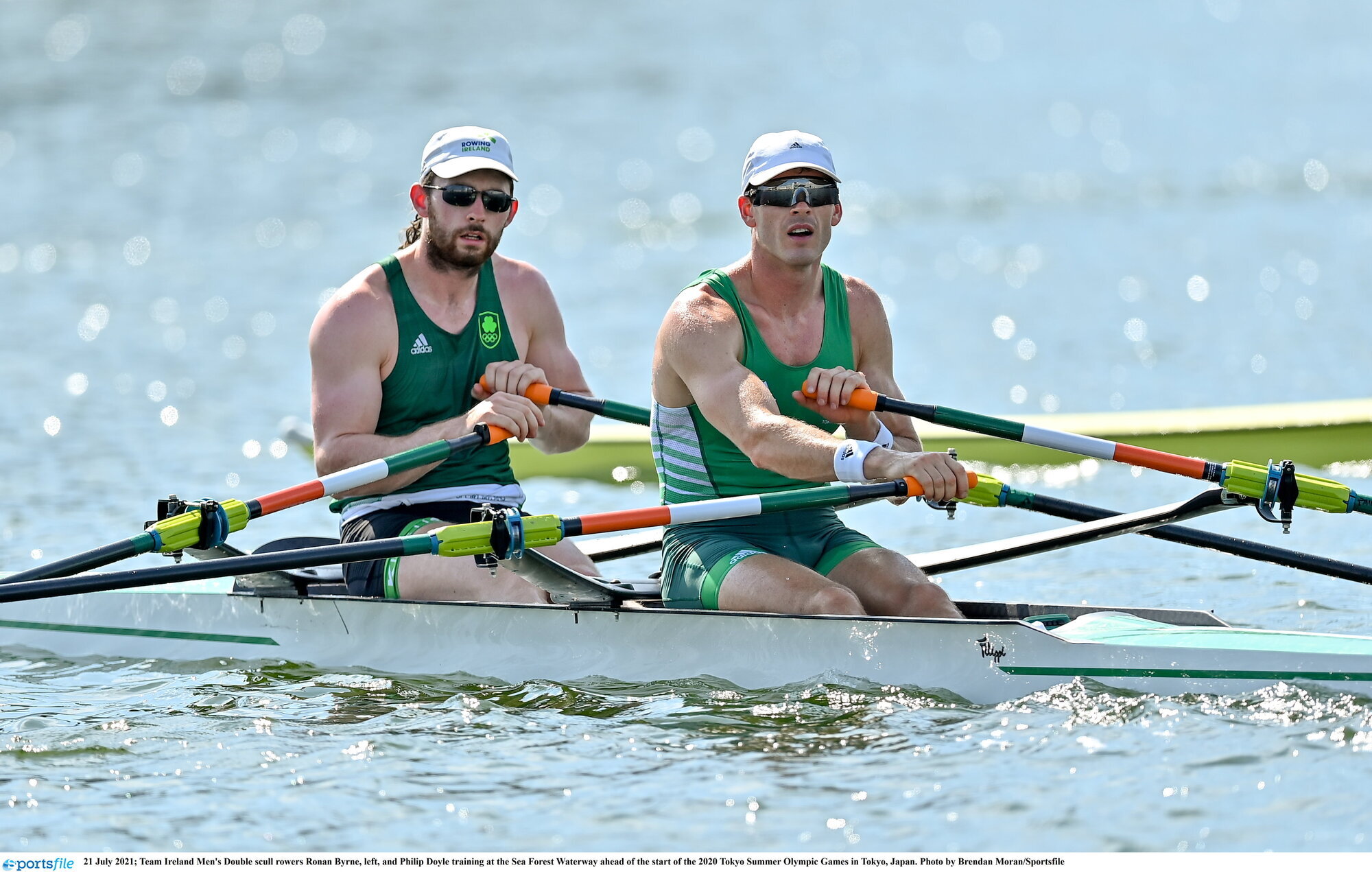
Ronan Byrne and Philip Doyle training at the Sea Forest Waterway in Tokyo. The pair will open the Irish rowing team’s account in their heats in the early hours Thursday night/ Friday morning. Picture: Brendan Moran/Sportsfile
Everyone rides into the Olympic Games on their own emotional wave. The months of May and June were wallpapered with news of various Irish athletes sealing their spots for Tokyo. For them, the summer has been one long adrenalin rush.
Philip Doyle and Ronan Byrne have had to wait much longer to follow up on that same high.
It’s not that the pair have been guaranteed their places since qualifying the men’s doubles boat with a silver at the World Championships in Linz in August of 2019. No, there have been plenty of hurdles to overcome before picking up their team kit and accreditations.
Doyle returned to medicine when the pandemic kicked in, leaving Byrne and Daire Lynch to earn a bronze medal at the delayed Europeans last October, but internal trials earlier this year reaffirmed the pecking order as it had been pre-Covid.
“That feeling is so special and I’ve been sort of living off everyone else hearing they have qualified so it’s been strange,” said Doyle. “Myself and Ronan have known we were working towards this specific goal and that when the Games would be on we would be there.
“I admire anyone who didn’t have that and the way they pushed on without having that qualification spot and it’s great to see Ireland with such a huge team. Obviously so many people kept that motivation and drive during the time off.”
Go back to London in 2012 and Sanita Puspure was Ireland’s only representative on the water at Dorney Lake. Now she is one of 13 competing for a nation that, as Conor McGregor might put it, isn’t here to compete so much as take over.
The hope is that the rowers can assume boxing’s mantle as Ireland’s Olympic medal factory with Puspure and the lightweight men’s double pairing of Paul O’Donovan and Fintan McCarthy merely the most prominent of podium contenders as opposed to the only ones.
Doyle and Byrne are among the other crews in with a decent shout of making headlines. The pair disappointed at the European Championships in Italy in April, in what was the former’s first action in 20 months, but a silver followed at a World Cup event in Lucerne.
“Myself and Ronan are a very individual partnership. It takes a while for us to click and for the Europeans we just didn’t have that click that we are so used to because of the time apart. The same thing happened in 2019 where we actually came 10th in the Europeans and we went on to finish second at the World Cup.”
He can see that progress is being made. Doyle speaks of that bit of “magic” that can happen when the boat and its occupants are in perfect harmony on the water and he felt it come more than go during that medal-winning effort in Switzerland.
Encouraging.
The Irish Olympic team has spent weeks training together in Banyoles, Spain, each crew measuring itself against their own competition times and against their male and female colleagues on the water around them. The wholesale take seems to be that everyone is faster now than in 2019.
That internal competition has manifested itself come game time too, Lydia Heaphey’s silver in the lightweight women’s single sculls on day one of World Cup II back in May serving as a clarion call for everyone else to follow suit. Plenty did.
That momentum can work again in Tokyo.
Puspure, Doyle, and Byrne can’t win a medal when they open the Irish rowing team’s account in their heats at the Sea Forest Waterway shortly after midnight on Friday Irish time, but they will be mindful that all eyes are on them.
Not just those of their colleagues, but back home as well.
Byrne understands that their own silver in Linz two years ago puts more pressure on his boat to deliver more than most of Team Ireland’s contingent here but he will tell you too that some of his friends didn’t even realise he was going to the Olympics until earlier this summer.
Pressure? What pressure?
“At the end of the day, bringing something home for the Irish people would be great but it’s us on the start line and it’s us coming home as the team, training as the team, working together as the team,” he explained.
“We have to manage our own expectations before we look to see what’s happening outside of the sport.
CONNECT WITH US TODAY



Be the first to know the latest news and updates