Norman’s nightmare marked end of an era
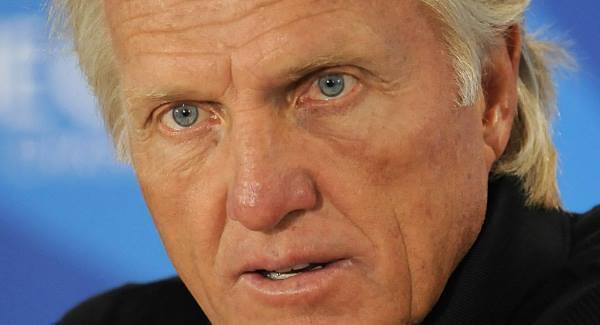
Until Scott’s play-off victory over Angel Cabrera in 2013, Masters near-misses had been to Australians like penalty shootouts to the English, sporting scars worn collectively by a nation desperate for its athletes to reach their potential. And in the Aussies’ case, the deepest cut had been inflicted by Greg Norman.
The Great White Shark would win the British Open twice and head the world golf rankings for 331 weeks for periods between 1986 and 1997 but he never could manage to conquer Augusta National.
Norman had led the 1986 Masters going to the 72nd hole only to let it slip as 46-year-old Jack Nicklaus scored a win for the ages.
A year later he had seemed primed for the breakthrough only to see relative unknown Larry Mize chip in against all odds from 140 feet at the 11th to win a play-off with both Norman and Seve Ballesteros.
Yet the greatest heartache was still to come, and a decade after the Golden Bear had landed the first blow it was Nick Faldo who delivered the knockout punch.
The 1996 Masters has gone down as one of sport’s greatest collapses, Norman having gone into the final round with a six-shot lead over Faldo only to lose the tournament by five.
It was excruciating to watch and award-winning golf author Andy Farrell has brought the memories back to life in a wonderful and detailed hole by hole account of one of the most famous duels in golfing history.
The book, Faldo/Norman carries the sub-heading ‘The 1996 Masters: A duel that defined an era’, and over 18 chapters Farrell, who was reporting from Augusta National that day, makes a successful case for that assertion.
We are not yet 20 years removed from that duel and yet it feels like a very different time in golfing terms, as the author explains.
“Two things happened,” Farrell said during a conversation at Augusta National this week. “Equipment was just beginning to really take off and then Tiger Woods came along. So it really was the last really big thing that happened in the era of golf before the Tiger Woods era. It was a slightly different time, even though it was only 18 years ago, we’ve lived with Tiger being golf for so long.
“Who knows whether or not Tiger is now winding down following his latest surgery but I felt it was good to be reminded of a time before him when there were also fantastic golfers doing fantastic things.”
The changing of the guard would come at Augusta 12 months later when Faldo passed on the baton almost literally to Woods by placing a green jacket on him in the Butler Cabin after the 21-year-old American blew away the field for a first Masters victory that ushered in a decade of dominance. Farrell contends that Woods’s success in winning 14 Majors between 1998 and 2008 was borne of a blend of those 1996 protagonists’ strengths.
“Tiger at his best, in 2001/2002, was the perfect combination of Norman and Faldo. The power of Norman and his ability to overpower courses with fantastic shots but also the mental strength that Faldo had, the course management and the ability to assess a situation and being so good at when he got in the lead, defending that lead and not doing anything that was going to endanger that lead as Norman ended up doing on that day.”
What Norman did that day is the stuff of golfing infamy. Having been so dominant over three rounds, equalling the course record with a 63 in the first round, the Shark lost his teeth on the Sunday, his game unravelling with those in the galleries averting their gaze as he trudged between holes, so painful it was to witness while the massive TV audience watched through scarcely believing eyes.
Farrell writes that Faldo saw the signs early as Norman bogeyed the first having driven into the trees on the left and the Australian looked ill at ease, constantly re-gripping with his club before shots. He would card a miserable 78 as the Englishman, so often his nemesis in the Majors, put together the lowest round of the day, a magnificent 67, thereby turning a six-shot deficit into a five-shot winning margin before the pair shared an emotional embrace on the final green.
Faldo himself said the day would be remembered only for Norman’s demise rather than his contribution but the book gives credit where it is due, Farrell arguing that his compatriot’s reputation as a golfing automaton, artlessly grinding out six Major victories, was ill-deserved.
“What interested me was that image and perception of Faldo as being robotic and closed off to everything that was going on around him, in his own bubble, and that he was difficult for spectators to warm to,” Farrell said.
“Underneath it all he was taking in everything that was happening. He knew what was happening with Norman, knew what the situation was. He was feeling it, he just wasn’t letting it show in any way.
“And all that refining and retuning he was doing with [David] Leadbetter after he’d starting winning Majors following the initial revamp of his swing, that was about being able to hit finesse shots under pressure rather than just hitting robotic stock shots.
“He was not known as a flair player but won here at Augusta and at the Open, where you have to be so creative, rather than the US Open and PGA which perhaps lent itself more to the robotic sort of golf that gets the job done. So the reality is somewhat different to the image.”
The images of that day in April 1996, though, are permanently etched and though Farrell’s research required him to pore over the footage of 18 years ago, he admitted it was something of a trial reliving Norman’s anguish.
“I’ve watched it quite a few times now but never managed it all in one sitting because I remember how painful it was the first time!”
n’Faldo/Norman The 1996 Masters: A Duel That Defined An Era’ by Andy Farrell is published by Elliott & Thompson. It is available online through Easons (www.easons.com)