How Dublin can adapt to get more out of their central man
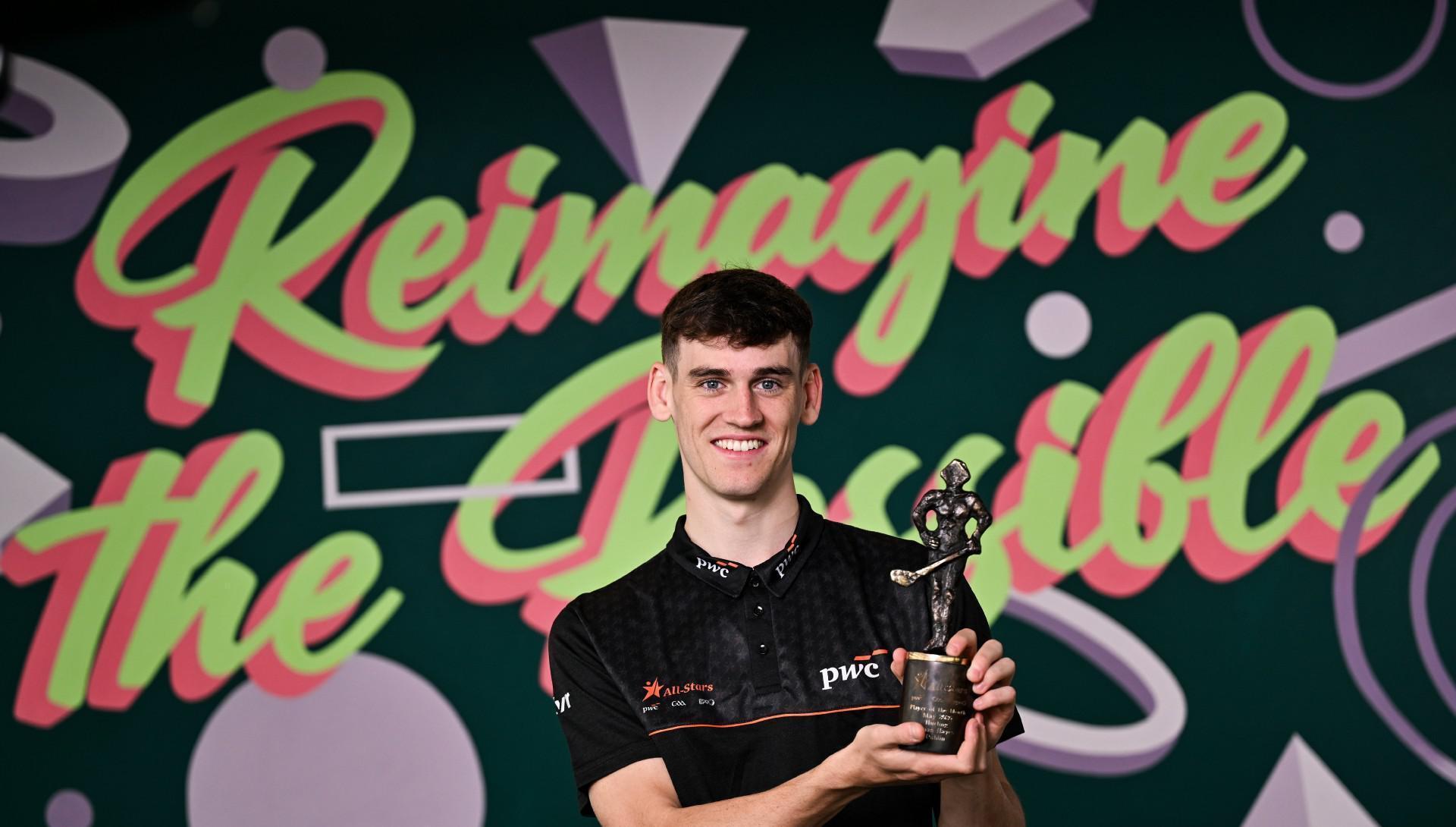
CENTRAL MAN: PwC GAA/GPA Player of the Month for May in hurling, Brian Hayes of Dublin, with his award at PwC offices. Pic: David Fitzgerald/Sportsfile.
The progression was like a Ferrari finding another gear at every straight. A decent club hurler, a county champion, a county panellist and now a cornerstone in the team. Brian Hayes has lit a spark with Dublin. He was what they sorely needed.
The Kilmacud Crokes clubman was part of a gifted generation that progressed together, but he never featured at minor or under-20 for Dublin. That exclusion led to an internal burn, a point to prove.
“For myself, definitely,” he told last year. “The lads who have played the whole way up, it is just different. Their confidence is higher. They know their ability. Whereas I got in the door and I just wanted to make the panel. Once you start getting better, it is always changing.”
The evolution of the midfielder has always been a delicate balance, with defensive cover as vital as attacking potency. Kilkenny’s Michael Fennelly brought the brute force required to clog the 'D' and choke out the opposition’s attack to a new zenith.
It was his colossal display in 2015 that eventually broke Galway’s resistance.
“His domination there around the middle of the field, his physical presence, and you can’t just judge him on possessions,” said Ger Loughnane as they awarded him Sunday Game Man of the Match.
“You judge him on the physicality he brings to it, the earnestness he brings to it, the genuine effort you’re guaranteed that he’ll make throughout the whole game. And he’ll also always come in with a few points. Two points today from midfield. He is just an absolute powerhouse.”
Hayes first operated in the front six under Micheál Donoghue, much like his brother Ronan still does. Yet his fearsome athleticism and ball-carrying ability meant he was always likely to be deployed further out the field. His idol growing up was Noel McGrath. His skills were improved thanks to a motto etched in his mind: always go to the wall.
Gaelic football had a hold as well until he was a minor. Gradually, he became more preoccupied with the small ball. The 23-year-old’s importance to Dublin is unquestionable. He has scored 2-5 from 11 shots and is their leading creator as well.
To understand how Dublin could further benefit from the potency of a weapon like Hayes, we must appreciate how such a role is about an attacking platform as well as a shield.
Declan Hannon, John Conlon and Jamie Barron were disciples of the same crew. They lined out in different positions, at number six or midfield, but executed a similar role. Their defensive instincts stemmed from a tactical awareness that meant once their side retained the ball, they could utilise it effectively.
It doesn’t necessarily need to be a seventh defender. The nuance is purely that they are less occupied with their direct men, allowing a retreating half-forward line to compensate for their natural tendency to drop back. Then, they attack.
There was a telling passage in the league final between these teams that hinted at what Niall Ó Ceallacháin may change after the Leinster decider disappointment. Clare defender Rory Hayes drove a ball long that the Dublin goalkeeper was able to collect.
They proceeded to play six passes inside their own 65 before Hayes, wearing 11, dropped deep to collect possession. He tore away from Diarmuid Ryan all the way to the opposite 'D'. A handpass to a runner off his shoulder was cut out by the retreating Mark Rodgers.
Clare’s tendency to push up means Dublin can suck them back and draw them out. That should create more space for long deliveries to their target men, who were choked out by a deep-lying Galway defence and hanging deliveries in Croke Park.
Hayes is already central to this. Dublin need him to be. Hurling’s latest tactical blueprint has been built upon a relentless ability to leave the opposition legless. Constant tracking, tackling, take them on, up, down. Again and again. Limerick’s engine is powered from their half-forward line; Tipperary last year were similar.
Last time out, Hayes was isolated in the middle. Bypassed by blind deliveries with possession, unable to influence the play amidst the sea of maroon and too high up to provide cover without it.
It can seem counterintuitive, but the bedrock of Tipperary and Limerick’s All-Ireland triumphs, or Galway’s improvement, hinged on this singular idea: to progress forward, drop back.
CONNECT WITH US TODAY



Be the first to know the latest news and updates