Talking Points: Limerick show where bar is, Beggan leads by example
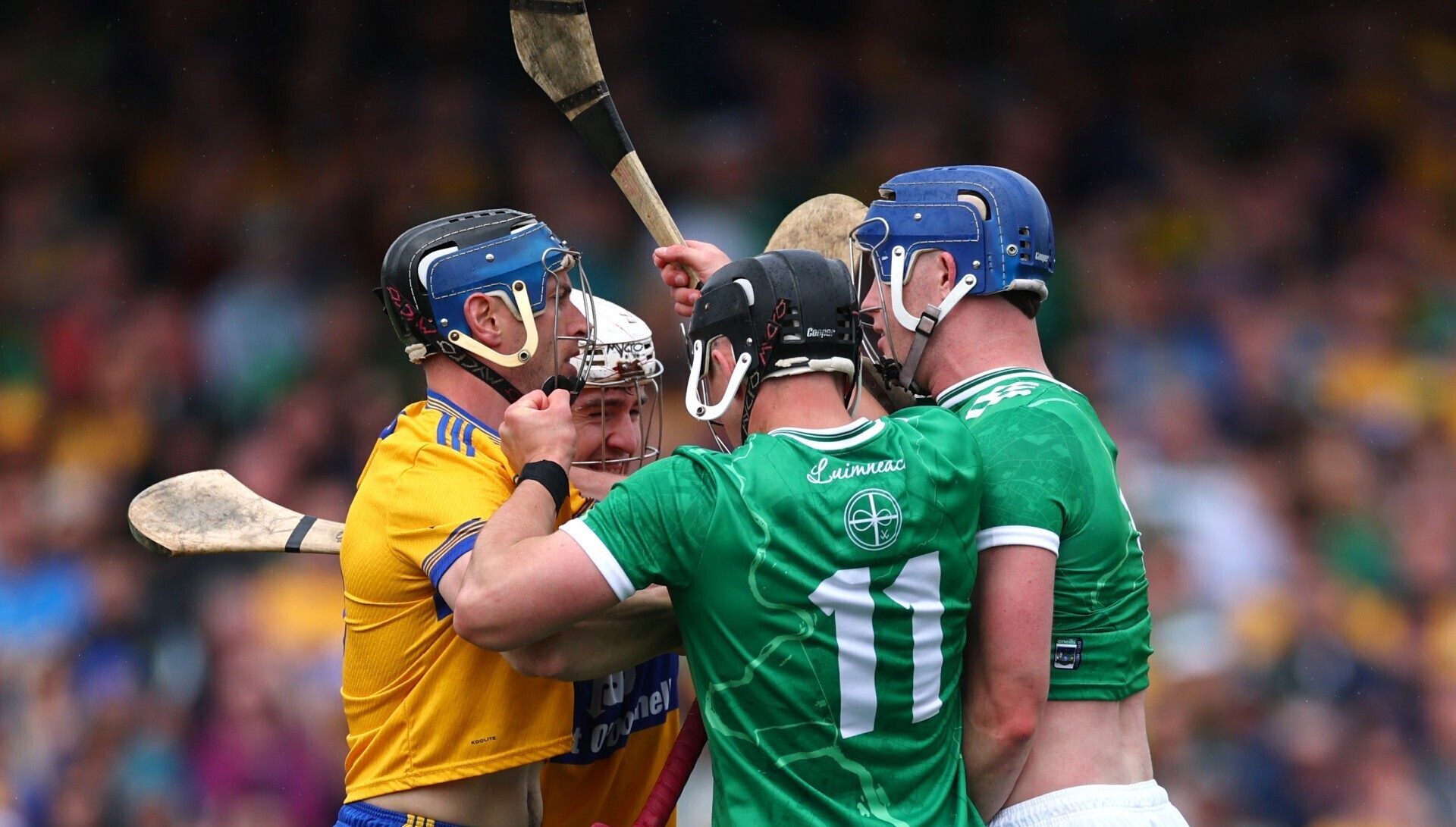
BATTLE LINES: Clare’s Adam Hogan and David McInerney clash with Aidan O'Connor and Shane O'Brien of Limerick. Pic: INPHO/James Crombie
Adam Hogan tried to clip a sideline cut to Jack O’Neill but he scuffed the attempt and the ball went straight to Cathal O’Neill, who drove it over the bar.
Eibhear Quilligan pinged the resultant puckout to Diarmuid Stritch but his shot was blocked down by Ethan Hurley. Aidan O’Connor flicked the loose sliotar to Fintan Fitzgerald, who passed to Hugh Flanagan who set up Shane O’Brien for another score.
The game was long over by then. Those two points were Limerick’s last two scores, but they still effectively told the story of this game. Clare were sloppy, casual, their afternoon laced with unforced errors, but Limerick were ruthlessly effective and efficient. And they murdered Clare off turnovers.
Clare turned over the ball a staggering 38 times, with Limerick mining 19 shots and 0-15 from that possession. Limerick were playing right on the edge, especially in defence, but 25 of the turnovers Clare coughed up were in their attack.
Read More
Limerick were on a different level with their accuracy and efficiency levels; their overall conversion rate was a hugely impressive 79%, 78% from play. Clare’s conversion rate from play was just 42%.
Nobody underlined Limerick’s greater efficiency more than Shane O’Brien, who nailed 0-6 from six shots. O’Brien was also fouled for a converted 1-2. From 12 possessions, O’Brien’s return was effectively one point from every possession.
This was a statement performance from Limerick, especially when their credentials had been questioned after losing to Cork. Limerick had lost their previous four championship matches. Limerick did lose to Clare and draw with Tipperary in successive games in the 2023 campaign but Ed Donnelly smartly pointed out in the match programme how Limerick have never lost successive games in the Munster championship.
This was a huge wake-up call for Clare, especially in how Limerick exposed their defensive shape and structure. Limerick were far more direct than they had been last week, especially with ball into O’Brien, but they also exploited Clare’s openness in defence, particularly when that first line of cover is breached. By pushing defenders forward into that space, Barry Nash, Seán Finn and Kyle Hayes had assists for 1-2 in the first half, playing the last pass when they were within 25 metres of the Clare goal.
When Will O’Donoghue released Peter Casey with a handpass on the half-way line for Aidan O’Connor’s goal, Clare had just four players inside their own half of the field. Clare’s post-match analysis will surely start with that clip. They were a mile off the pace. But Limerick were right at it.
All afternoon.
Clarity. Composure. Conviction. Experience. All the great players have it but those qualities are never just restricted to those players' talents on the field. Sometimes their words, and how they relay that message, are far more important than what they do.
The referee Noel Mooney had blown the full-time whistle in the Athletic Grounds on Saturday evening when Beggan went after him, informing the referee that he’d got his decision-making wrong around the closing moments of the last play.
Monaghan were debating their options on a 2-point sideline attempt they needed to equalise when the hooter sounded. Mooney was headed for the dressingroom, but Beggan – along with team-mate David Garland, who is also a club referee in Dublin and has umpired at inter-county level for Martin McNally - got Mooney to realise his error. And the referee was big enough to admit it. Technically, Monaghan should have been given time to take the kick when the ball was out of play. So Mooney reversed his decision. The game was back on. Momentarily.
Jack McCarron still had to try and convert a 2-point free from just outside the 20-metre line, but he exquisitely nailed it to bring the match to extra-time.
And yet, the drama was only beginning. Derry went ahead with 55 seconds remaining in extra-time when Beggan got off the kickout and Conor McCarthy was fouled 48 metres from goal. Up stepped Beggan to nail a 2-point free to give Monaghan the most incredible one-point win imaginable.
This match was loaded much so high-wire drama that it was almost unbelievable. And then it wasn’t really with a weapon like Beggan around. One of the most important scores in normal time came from the goalkeeper winning a kickout and lasering a pass into Micheál Bannigan whose goal reduced the margin to three points in the 64th minute.
There were stages in the first half of normal time when Derry looked like they’d rattled Beggan. As well as winning nine of his 20 kickouts, Derry translated that possession into 1-4. None of that though, was down to Beggan because there was nowhere near enough movement on their own kickout from the Monaghan players. And still, every one of Monaghan’s six first half points were sourced from Beggan’s restarts.
Monaghan were a completely different animal in the second half in terms of their energy, intent and aggression levels. Beggan led the charge with a 2-pointer in the 37th minute. He was out around the middle of the field driving on the team and trying to win Derry kickouts. He ended with 0-6 from three shots. And yet, the clarity around his decision making under the most extreme pressure was as important as any of the kicks he made.
The smart money was on Beggan taking that last sideline. It suited a right footed kicker like Beggan. It required McCarron having to nail the chance from just outside the 20-metre line, with the outside of his left boot. But Beggan spoke to McCarron and trusted him to convert such a difficult shot.
The greatest players always do far more than what they say but they still sometimes show their greatness more by what they say than what they do. And Beggan already has to be considered one of the greats.
In the 40th minute of the Dublin-Louth Leinster semi-final on Saturday evening, Louth broke down the field off a turnover and Ciarán Lennon set up Ryan Burns just outside the square but his shot was brilliantly blocked by goalkeeper Evan Comerford, who deflected the shot onto the post. The ball rebounded back to Lennon but his goal shot was nicked by Davy Byrne.
Sam Mulroy converted the ’45 to reduce the margin to two points. Louth had 0-7 on the board by then but they only managed 0-3 across the remaining 30 minutes.
The lowest score in last year’s championship was the 0-12 Cork registered against Meath in the round robin. Offaly only recorded 0-12 in their defeat to Laois six weeks ago, but, prior to Saturday, the lowest championship score hit since the introduction of the new rules was the 1-7 Carlow recorded in their defeat to Wicklow, and the 1-7 Waterford hit in their defeat to Tipperary, both of which were played in April.
Louth though, were reigning Leinster champions and had hit 1-25 against Wexford in the Leinster quarter-final. Their conversion rate was an abysmal 28 per cent on Saturday but much of that was down to the excellence of Dublin’s defensive display.
In 232 games across the last two national leagues, there was only 13 occasions when a team hit 0-10 or less. So to restrict Louth to the joint-lowest championship scoring total under the new rules was a huge testament to Dublin’s performance on Saturday.

CONNECT WITH US TODAY



Be the first to know the latest news and updates