GAA Congress: All-Ireland finals to remain in July next year
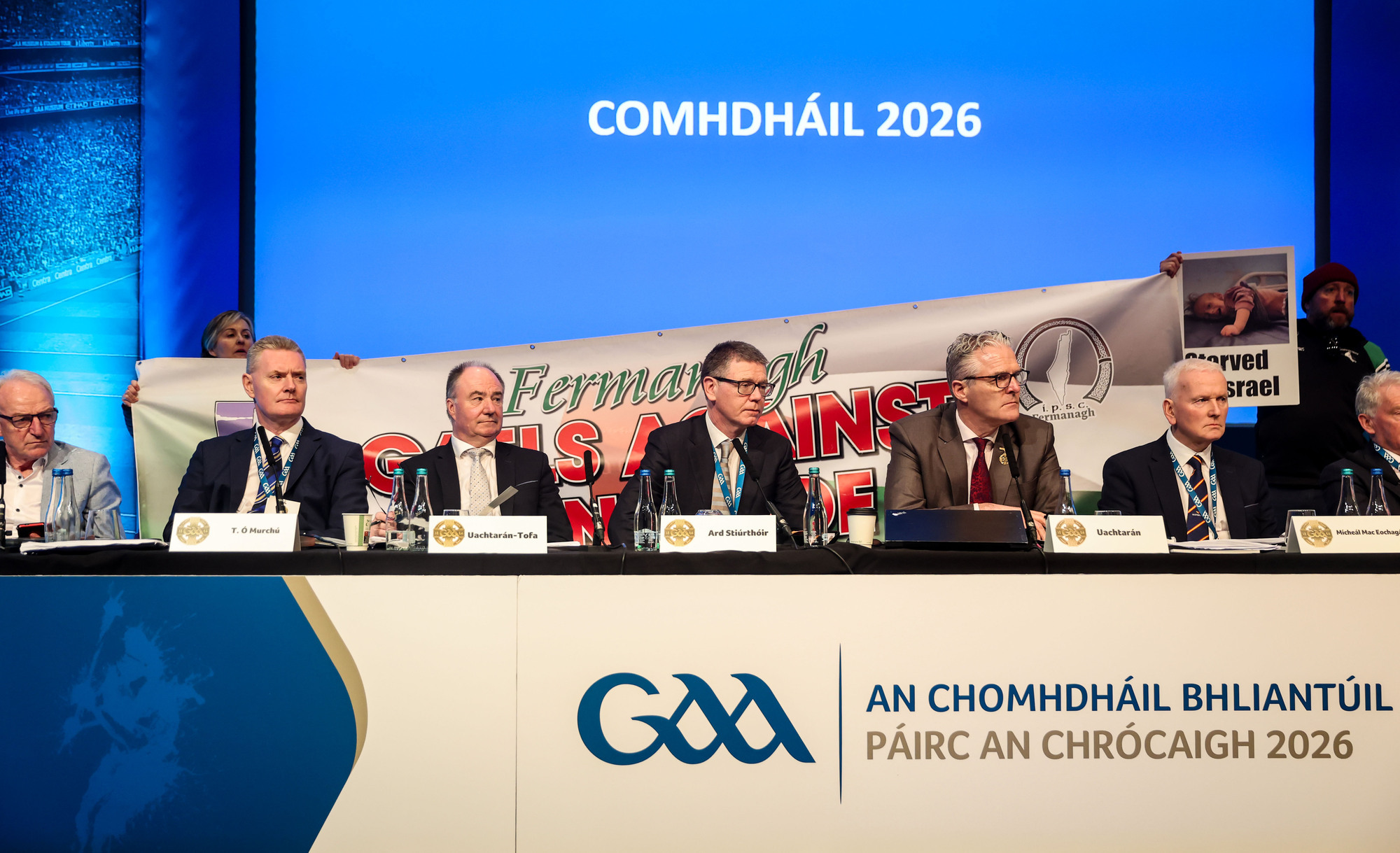
Tim Murphy, Derek Kent, Tom Ryan, Jarlath Burns and Michael Geoghegan at the congress meeting. Pic: Nick Elliott/Inpho
Facing a heavy defeat, the All-Ireland senior finals will remain in July next year after a motion to extend the inter-county season by two weeks was withdrawn at Annual Congress on Saturday.
The proposal, which also called for the disbandment of January’s pre-season competitions, was opposed by a number of speakers.
GAA director general Páraic Duffy outlined the reasons why his committee recommended the changes. He highlighted the four All-Ireland senior semi-finals and finals were played over just 22 days and the “overload” impinged on the promotion of games.
Galway chairman Paul Bellew said the growth of Gaelic games was experienced most at club level and the certainty of fixtures provided by the split season was assisting that.
Wexford’s Micheál Martin said the scope of the committee’s work was limited and there was reason to stage more inter-county games in June, the last month of the primary school year.
Suggesting a withdrawal, Duffy concluded: “The calendar is too condensed. The season is probably too long. Have we too many inter-county games?” GAA president Jarlath Burns acknowledged support for the split season was “very definitive”. Bellew requested the motion not be withdrawn as competition reform was still possible, but Burns chose to remove it.
Requiring a simple majority, the Gaelic Players Association’s (GPA) recommendation to define the inter-county window as 30 weeks garnered 66.7% support.
The All-Ireland senior preliminary hurling quarter-finals are no more after a Laois proposal received 94.1% backing. Instead, the Munster runners-up will this year face the third-placed team in Leinster and vice-versa in All-Ireland quarter-finals with the provincial finalists expected to have home advantage.
Also, a Joe McDonagh semi-final will be part of the 2027 season. The second and third-placed counties will face off to meet the table-toppers in the second-tier final.
From this season, replays will apply to provincial football finals that finish level after extra-time. Almost three-quarters of delegates (73.5%) endorsed the Central Council motion.
Ulster GAA chief executive Brian McAvoy highlighted the province’s two final penalty shoot-outs in recent years and that there should be a second bite of the cherry where possible when there is silverware at stake. Meath’s Conor O’Donoghue stressed those involved in provincial final replays face fixture pileups.
Clontarf’s motion to introduce an inter-county eligibility level for players was withdrawn. Presented by club member Jack McCabe in the absence of Dr Noel McCaffrey, a player would have had to line out eight times for his club in either or both codes in the previous year to play for his county the following season.
On the proviso there is further engagement on the matter, McCabe withdrew it after strong debate. He had argued that the motion would help address the imbalance between club and county. “If we truly believe in the primacy of our clubs, it must be reflected in our rules, not just in what we say.”
London’s Tony O’Halloran was strongly opposed to the idea due to their significant turnover of players. GPA chief executive Tom Parsons complimented the sentiment of the motion but criticised its “blunt nature” and pointed out meeting the eligibility would be difficult for players in the west of the country who live outside their counties.
Cork GAA chief executive Kevin O’Donovan also supported the spirit of motion but said adding a playing requirement was a worrying move.
Former GAA president Seán Kelly said some inter-county managers were preventing players from lining out more for their clubs and defeating the proposal would not make the problem go away. He pointed to the larger size of inter-county panels as impacting clubs.
Fermanagh’s motion to reattach the All-Ireland minor finals as the curtain-raisers to the senior deciders was soundly defeated, receiving just 15.8%.
Fermanagh’s Phil Flanagan, whose club Tempo proposed it, was happy for it to be debated even though he accepted it was doomed to fail following a series of opposing speakers including the Dublin, Galway and Waterford chairmen.
Waterford chairman Neil Moore said the experience of the county’s All-Ireland minor hurling success as a standalone game in Thurles last June was superior to the 2013 victory when it felt like the teenagers were being rushed afterwards to make way for the senior clash.
*********
After Congress resumed following the protestors entered the Hogan Stand Suite, delegates endorsed a new inter-county certification programme.
Although there was significant opposition aired about the lack of detail around the licensing initiative, Burns allowed the motion to go to the floor and, requiring a simple majority, it received 59.1% backing.
To be certified, counties will have to adhere to a number of measures such as providing GPS data, annual maximum expenditure limits, inter-county mangers undertaking induction courses and a limit of 10 paid backroom team members.
A new dissent rule will be introduced to hurling. A free will be advanced 30 metres in such an instance. At under-age level, such a player found to have committed the infraction will also be sin binned and replaced by 10 minutes.
Both demographic committee motions were backed including allowing 12-a-side teams to reflect the difficulties faced by rural clubs in fielding sides.
CONNECT WITH US TODAY



Be the first to know the latest news and updates