Old habits dying hard for score-shy Mayo
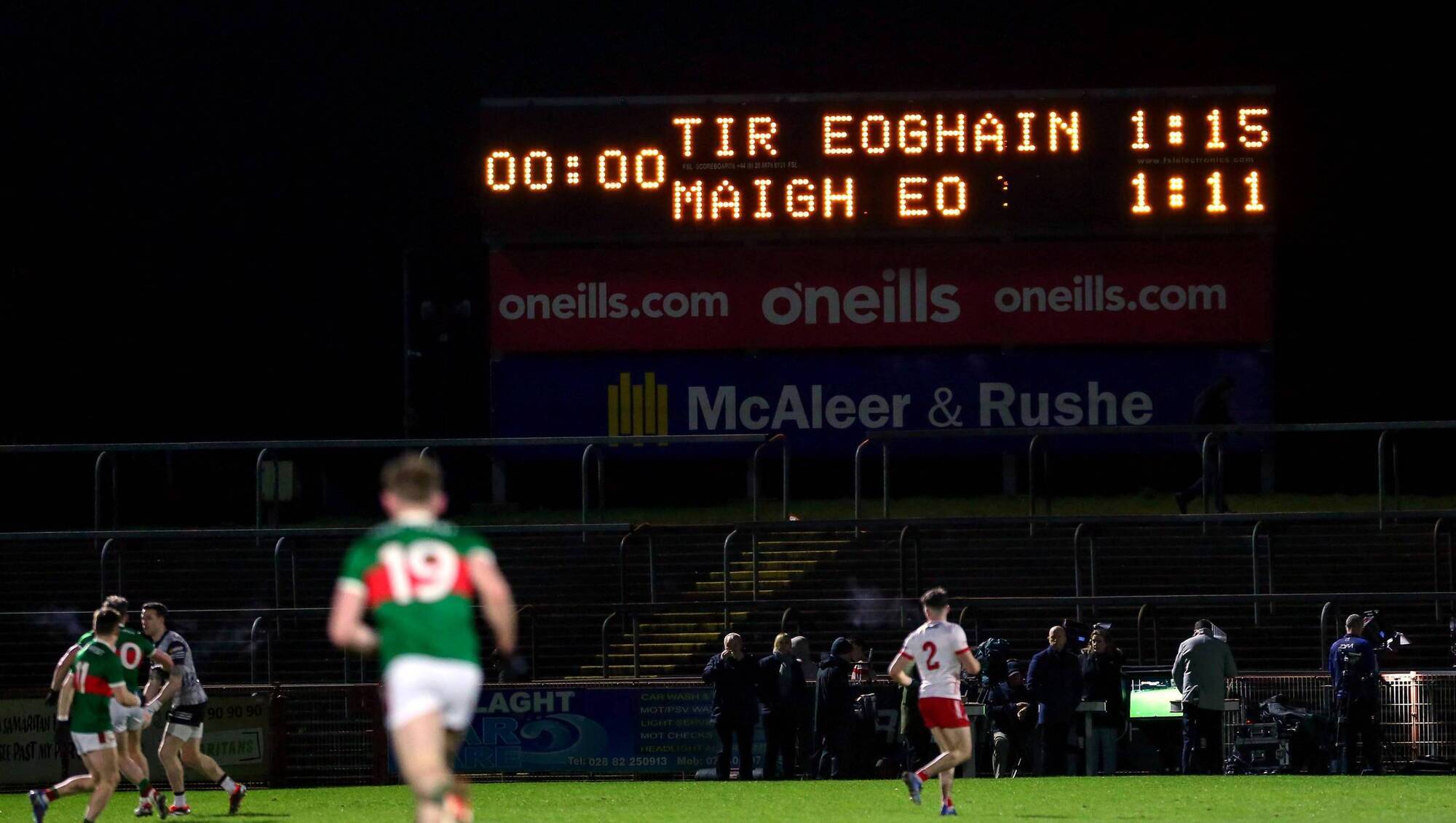
OLD HABITS: The scoreboard at the end of the game.Pic:©INPHO/Lorcan Doherty
Eighteen games into his management of the Mayo senior football team and after suffering his sixth loss, Kevin McStay’s usual cheery tone was absent last Saturday evening.
The team that started in Omagh was not as strong as the line-ups in the three previous games but post-defeat McStay wasn’t his usual glass-half-full self. “It’s a disappointing performance and a disappointing result,” he told RTÉ. “We were expecting a bit more from ourselves at half-time, I can assure you.”
“We’ll go home with our tail between our legs,” he told MidWest Radio and the Mayo Football podcast.
Mayo couldn’t give a damn about defending their Division 1 title. New York calls the weekend after the league final on Easter Sunday and Roscommon loom two weeks later. The perception that Mayo need to be winning national finals has gone and a league final is a luxury they can do without. Nevertheless, they would have expected to have all but sealed their top-flight status by this stage.
The top-line statistics scream of their issues being in the opponent’s half of the field. A team that averaged a total score of 18 points and concession of 14.6 points per game in last year’s league is currently registering an average 15.5 points per outing and giving up 14.5. Keep in mind that Mayo’s 2023 championship average was just above 12 points per game and the fear is history will repeat itself.
It’s startling to think that the last Mayo starting forward to score a goal from play in league and championship was Ryan O’Donoghue against a lowly Donegal in March 19 last year. Since then, Mayo have had six goalless outings and scored seven across the other half a dozen matches - two by Eoghan McLaughlin, one by David McBrien and Stephen Coen, another from Tommy Conroy as a substitute and a couple of Cillian O’Connor penalties.
No stranger to finding the net, former star Lee Keegan this week questioned if the practice that he mastered of coming off the shoulder late for scores was still working for Mayo.
“I wonder does our devotion to running the ball from deep starve our forwards inside, who then don't get enough supply to do consistent damage,” he mentioned in his RTÉ column. “Certainly, we're not creating enough goal chances.
“We did hit the net twice against a Galway team, who weren't switched on in Salthill. The goal against Dublin came from a point attempt which dropped short. In Omagh, we got a goal through a fortuitous penalty. In Tralee, I don't think we even created a goal chance, let alone score one. I know McStay is keen to develop and fine-tune Mayo's attacking game. We're waiting to see real evidence of that yet.”
It's not difficult to plot a line between Keegan’s words, Mayo’s green flag shyness, and the parting shot of Liam McHale after he left the set-up last year. Pointing out that the rest of the management team “had a totally different philosophy on how this team should play than what I had”, he also spoke of how Mayo when it mattered most down through the years were not “able to score”.
McHale spoke of his surprise in his brother-in-law McStay’s stance “because normally we would be in sync”. The pair were fully aligned in the Roscommon management team eight years ago when it was Fergie McDonnell who stepped down as joint-manager.
This time around, McStay has fully bought into the coaching led by his assistant manager Stephen Rochford. McStay is chairman and facilitator and Rochford’s stamp is all over the team’s style. Donie Buckley worked with him for three seasons as manager, Damien Mulligan is a Crossmolina club-mate of his and this season’s new addition to the management Joe Canney played under him in Corofin.
Rochford was of course manager in 2017 when scores from deep were a characteristic of Mayo’s make-up. A telling one too. “That was a massive part for us leading up to the game,” said Dublin forward Ciarán Kilkenny of that year’s final. “To mark their runners and make sure we can look after that for the team.
“I think there was a stat there, 48% of their scores come from their defence, so we knew that was a massive challenge for us as a forward unit as well, so we put a lot of emphasis on that.”
The figure wasn’t as high as that but Dublin were justified in honing in on the perception that Mayo’s attacks are deep-rooted. In last year’s championship, that percentage of total scores from defenders and midfielders was 31%.
Before the 2017 final, Mayo were averaging an aggregate of 22 points scored and 16 conceded per championship game, the same they were coughing up per SFC match in 2023. The simple conclusion is they are not scoring enough.

CONNECT WITH US TODAY



Be the first to know the latest news and updates