Talking points: Monaghan's bravery, Cahill's class, Cora's insight
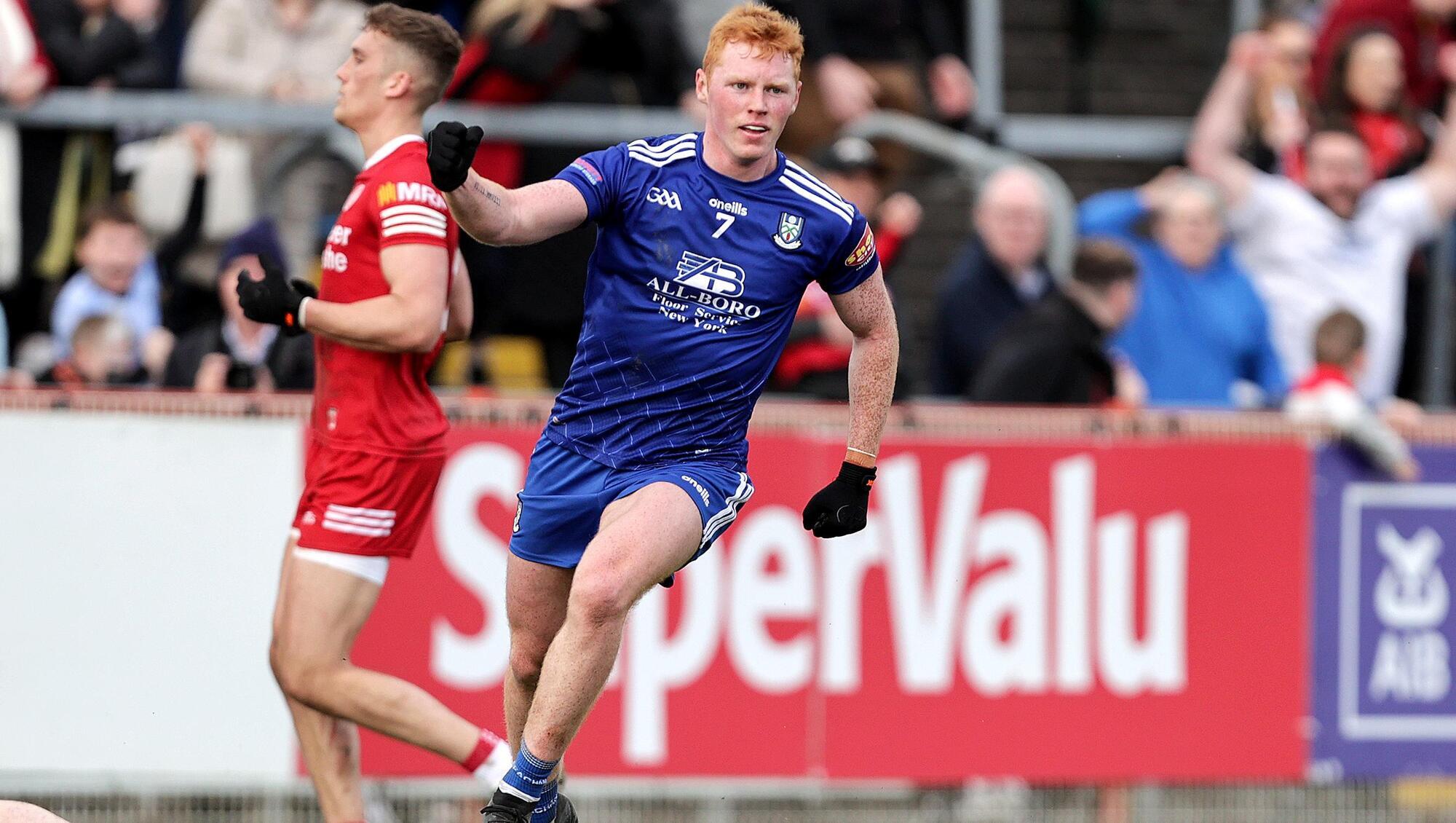
BRAVE MANS GAME: Monaghan's Ryan O'Toole celebrates scoring the winning goal. Pic: INPHO/Laszlo Geczo
In the modern game, percentage has long been king. Safety is paramount. Risk is deemed reckless. Every Monaghan supporter in Healy Park was roaring at a young debutant defender to punch the ball over the bar late on Sunday, but youth, innocence and inexperience often overrides all of that other stuff to produce the most glorious outcome imaginable.
Ryan O’Toole’s winning goal was adorned by bravery and level-headedness but the boldness of his decision making, never mind the effectiveness of his strike, encapsulated everything about Monaghan’s second half performance. After taking zero risk in the first half, albeit against a tricky breeze, Monaghan threw off the shackles and just went for it.
The second half was an Ulster championship classic but Tyrone effectively did what they wanted to in the opening half. From 20 attacks, they got off 18 shots. Tyrone had 15 shots from play. Monaghan had only three. Tyrone should have been out of sight. But they weren’t.
Monaghan had been far too passive but they showed a whole new level of intent from the first whistle of the second half. In the opening 11 minutes of the half, Monaghan had six more shots at the target than Tyrone. The momentum had clearly changed. And so had the tone and complexion of the match.
After failing to win a Tyrone kickout in the first half, Monaghan won Niall Morgan’s first two long kickouts and translated both possessions into points. Monaghan would have had the game level just nine minutes into the half if Morgan hadn’t saved a goal attempt from Conor McManus.
Monaghan were a totally different team as they hunted Tyrone down. Even after Darren Hughes went off injured in the 54th minute, Monaghan didn’t even deploy a sweeper until they had to get bodies behind the ball after O’Toole’s goal.
As soon as the second half began, every aspect of Monaghan’s play was more aggressive and loaded with attitude and intent. They mined 1-3 off Tyrone turnovers in the third quarter. Two of those turnovers – including Stephen O’Hanlon’s goal – originated from a Tyrone player being pulled for overcarrying in the face of incessant Monaghan heat in the tackle. Monaghan only lost one of their own kickouts after the break while they scored 1-3 off Rory Beggan’s kickouts in the final quarter.
It was clearly much easier for Monaghan to shoot in the second half than against the breeze in the first half but, while their intensity wasn’t where it needed to be in that period, their efficiency in front of goal was outstanding all afternoon. In the first half, Monaghan’s conversion rate was 80%; in the second half it dropped to 65% but it was still an impressive 72.5% overall.
Tyrone did play their part in such a brilliant second half but the outcome may have been far different if Beggan hadn’t made a fine save from Ronan McNamee in the 60th minute.
Tyrone won’t take any satisfaction from being involved in a classic because this was another disappointing championship day since their 2021 All-Ireland win. What will infuriate them most is their turnover rate in that third quarter, much of which stemmed from sloppiness, along with the ease in how Monaghan engineered the winning goal from a kickout.
On the other hand, Tyrone can’t say this hasn’t been coming either. They conceded nine goals in the league, which was more than any other team in Division 1. Tyrone will feel that O’Toole got in far too easily for his goal, and that Morgan could have done better, but had Tyrone done their homework either? O’Toole scored an almost identical goal from the same position in Monaghan’s last league game against Mayo.
Maybe it wasn’t all just down to the confidence of youth either.
Scoring goalkeepers is nothing new in the GAA anymore, in either hurling or football, but some contributions still stand out a mile; in Sunday’s Joe McDonagh Cup game between Kildare and Offaly, Kildare goalkeeper Paddy McKenna scored 1-5.
All of that total was from placed balls but McKenna nailed one of the scores of the league when bagging a monstrous point from play against Kerry in St Conleth’s Park in early March.
Goalkeepers are becoming more and more important in the modern game, so much so that outfield players are repeatedly being converted into goalkeepers, especially in football. Yet not everyone follows that path, with some having gone in the other direction.
One of the purest, best, longest and most accurate freetakers of modern football, Bryan Sheehan, started out his Kerry minor career as a goalkeeper, also performing the same role with Coláiste na Sceilge.
One of the standout performers in Division 2 of the hurling league, and the Joe McDonagh Cup this year, Eoghan Cahill, also went in that direction. Cahill has now scored 3-101 in both competitions this season. In Offaly’s two Joe McDonagh games, Cahill has bagged 3-21, scoring 1-10 on Sunday against Kildare.
Cahill is a brilliant forward but he is also an outstanding goalkeeper. Offaly goalkeeper in 2018 and 2019, Cahill was a rock of dependability during 16 league and championship matches in those two seasons. He also gave one of the goalkeeping displays of the 2018 season in Offaly’s opening championship match against Galway.
An impressive goalkeeper for Mary Immaculate College in the Fitzgibbon Cup in 2018 and 2019, Cahill was also racking up huge scores for Birr around the same time, which increased the clamour for him to be handed a role as a forward with the county.
By 2020, Cahill was operating as a forward with Mary I and when Michael Fennelly took over as Offaly manager at the outset of that season, he rang Cahill and asked him where he wanted to play. It was always Cahill’s dream to play out the field for Offaly.
And now he has developed into a scoring machine.
At the end of Sunday’s Division 1A camogie final between Cork and Galway, Cora Staunton was spotted on the sideline. Staunton has been a visible face as a TV pundit with RTÉ in recent seasons but her presence in Croke Park on Sunday was in a completely different capacity.
Staunton had informed the GWS Giants before Christmas of her decision to retire from AFLW but the announcement was only made at the end of March. By that stage, Staunton had been with the Galway camogie squad over the month, having come on board as a performance coach.
By the time Staunton officially hung up her boots last month, she had no other frontiers to conquer. Possibly the greatest ladies Gaelic footballer of all time, Staunton was still able to take up a totally new sport in the late autumn and winter of her career and effectively dominate it.
In the short history of the Giants, Staunton was their highest goalscorer. She was also the joint second-highest goalscorer in the history of the league. Staunton didn’t miss a match for the Giants in five seasons, making 50 consecutive appearances. Last season, she broke her nose in round two and her thumb in round three, and, still, she didn’t stop.
No matter what sport she played, Staunton showed that same devotion to learning and improving, always striving for more. Staunton may have no background in camogie but her immense insight, knowledge and insatiable desire to challenge herself to get better, and to inspire those around her, is something that Galway are clearly tapping into.


CONNECT WITH US TODAY



Be the first to know the latest news and updates