DAVID
In Blackrock, in Cork, there was no shortage of hurling heroes growing up. The backbone of the county winning teams — the Brownes, the Cashmans, Wayne Sherlock, Brian O’Keeffe, Fergal Ryan. We loved having underage games when the seniors were training and we were wondering would they be watching.
Then we’d all get the bus down to Páirc Uí Chaoimh to see the Rockies seniors play. But my No.1 hurling hero growing up was from East Cork.
We’re all glory-hunters when we’re kids, so we gravitate towards one forward. Joe Deane was this five feet and six inches scoring machine.
He floated around popping over points and I loved watching him. His free-taking style was distinctive, hunched low over the ball with the hurley positioned between his legs before he would lift and strike.
Joe had a yellow Cooper helmet. So I badly wanted one as well.
My helmet was a blue Mycro. I used to pester dad. He eventually sorted me a green Gola helmet. Came downstairs one morning... it was there on the island in the kitchen. That was more valuable for trading.
I managed to swap it for a yellow Cooper.
When I got to play in Semple Stadium in 2002, I’d the yellow Cooper and red jersey on a big hurling day, just like Joe Deane.
I was a slave to sporting fashion in other ways too. Adidas Predators were the kings of boots.
I still have about 12 pairs in the garage. One day I want to get into management and I think I’ll wear them. A good luck charm.
When we were younger, the new releases would drop in Cummins Sports in Douglas. The Manias came out around the 2002 World Cup; they cost €192. Everyone wanted them. I watched all the Cork players who had them... Sean Óg and John Gardiner for the hurlers...
Colin Corkery with the white ones for the footballers.
We’d a match with St Michael’s that summer. Eric Hegarty’s mum drove up beforehand and handed him a pair of boots. She’d queued up; now he was wearing the Manias. I was insanely jealous.
Went home after and started to make the case to dad that these boots will make me play better. He set up one of his ‘challenge and reward’ systems over a few games, then got me the boots. I looked the part.
They’re my favourite boot of all time. When Hull played Wolves in 2017, I scored a penalty late in the game in injury-time and had those boots on. I’m retired now but if Adidas put them back for resale, I’d probably buy three or four pairs anyway.
I was fortunate to have the support where dad would shell out nearly €200 on a pair of boots for a 13-year-old. Thankfully I paid him back over the years.
JOHN
The GAA is built on the stories told of icons, stories that pass down through generations.
When I was young, we had no access to video footage so I relied on word of mouth.
Whatever my parents were telling me, that was the Gospel truth as far as I was concerned.
My mother had worked as manageress of Murphy Floods Hotel in Enniscorthy.
When the Wexford hurlers played in the town, she told stories of how the players would come off the pitch and into the hotel, where she would feed them dinner. It built up a mystique surrounding these men.
Ned Wheeler was from Faythe Harriers, midfield on that Wexford winning team in 1956. Phil Wilson from Ballyhogue played in the same position when Wexford won the final in 1968.
The two of them worked as oil truck drivers and would call to our yard at home. More often it was Wheeler who would park up and empty the load of 400 gallons of paraffin oil into our tank. My mother would make tea with corned beef or ham sandwiches. While she was preparing the food, there was a small window of free time. Perfect chance for a puck around in the back garden?
Imagine this colossal figure... six feet and three inches tall, a huge man who had done it all with Wexford hurling... and him taking a break out of his day’s work to hurl with me. Those few minutes were precious until my mother would rap at the window and we’d be called in.
Same story when I got to hurl with Wilson. Playing with two of my heroes left a huge imprint.
My parents would make me aware if I was in the company of someone special. There was a different atmosphere if someone like Billy Rackard came into our shop or pub.
DAVID
Dad used to set me a challenge. The match reports would be brief in the local paper, the Evening Echo. To get mentioned, you needed to score a goal. Hitting the net was the challenge and €50 for every goal the proposed reward.
That prize drove me on. One weekend, I scored nine goals across four games; pushing to take free-kicks and penalties. He paid up every time but, eventually, it had to stop. The initial aim was for more recognition, now I was emptying his wallet.
JOHN
Being A GAA player afforded us a status in Gormanston College. In the big hall where food was served, we got an extra potato or piece of meat with dinner.
A bit of preferential treatment.
We played a lot of the schools in Dublin in those days, like Brunswick Street, O’Connell Boys and Joey’s. After, we might get a mixed grill in the Castle Hotel on Parnell Square. And a few quick pints.
Back to the school after, get out the toothbrush straight away and a bit of toothpaste into your mouth... rid the smell of alcohol that would spell trouble.
The dormitories would be checked at night.
‘Were you drinking today after the match?’
‘No Father... I don’t drink.’
Boarding school is hard; you’ve got to fight to stay alive at times, to look after yourself. It was challenging. If some fella took you on, you had to stand your ground. Some struggled. You’d get whipped once or twice; that was the way.
Five times down on each hand with the broomstick.
DAVID
When I was younger, dad would sometimes bring me to Cork City games at Turner’s Cross.
The team of Declan Daly, John Caulfield, and Patsy Freyne! As I got older, I went to fewer games but would still look out for their results. By the time I signed I was no fanatic... I wasn’t at the back of The Shed every week, singing... Cork City til I die.
But it was still a big deal to sign for them.
When I started to train with the first-team, it was a dressing-room with big midfield names...
Colin Healy and Gareth Farrelly... Joe Gamble.
When I was younger, I was more interested in the fella doing the step-overs or scoring goals. Now, I was trying to learn more about positional play. Roy Keane would later be great for advice on that.
If the ball is in front of you, you’ve done your job. Everyone at times is so quick to press, but the higher level you go up, the better the players are and they’ll pop the ball around you.
When you’re running back to your own goal and the ball is gone behind you, then you know you’re in trouble.
JOHN
Sport provided the early gateway for settling into life in Cork. I arrived in UCC with a GAA focus but football, or soccer, soon consumed me.
We’d play games in school on Sunday evenings. My brother Gerry had started a local soccer team in Wexford... Tacumshane Albion.
There was a huge passion for soccer in Wexford at the time. You played GAA in the summer, soccer in the winter. Took a field, measured it out, put up posts and nets... that was it.
Growing up I had been a Leeds fan and can still vividly recall watching them lose 2-1 to Liverpool in the 1965 FA Cup final on the BBC. Gerry was a huge Spurs fan; he would get Goal and Shoot! magazines all the time.
Myself and John Costello used to go running together; we went out to UCC’s sportsgrounds at The Farm one day and saw 20 fellas training over on a pitch.
There was no problem falling in with them.
It was the UCC fresher soccer team and the manager was Ger Canning. I spent plenty of time later in life chatting at hurling matches with Ger when he was working for RTÉ, but UCC soccer provided our first sporting connection. Ger was very organised and dedicated to his role; a good guy.
After a few sessions, I must have made an impression as he made me captain. We all came back in September 1975 and went into the UCC Munster Senior League team. We finished runner-up twice but just could never quite win it.
I played centre-forward in soccer; the main target man but I could score as well. I got 35 goals one season, and a hat-trick when we won the Collingwood Cup — the premier inter-varsity competition — in 1978, beating Trinity College 6-1 in the final.
DAVID
When we flew over and met the Sunderland chief executive Margaret Byrne, the negotiations started.
A contract was put in front of us and they left the room to give us time to think about it.
I almost wanted dad to make the decision for me. I’d trust him with my life. He’s one of my closest friends. He wasn’t looking to cash in on a son with sporting talent. His goal was to see me achieve something.
All the previous moves, from Corinthians to Cobh Ramblers to Cork City; he got those decisions right.
He always had a plan and steered me right the whole way.
Now, he might have a Masters in Business; he is a very educated man but when it comes to football negotiations, he wouldn’t be the best.
Sunderland’s executives came back into the room.
“Maybe we can bump it up a little there,” dad suggested, and threw out a figure.
“No, this is the offer... take it or leave it.”
“Right so, David will sign there,” dad told them.
There was no negotiating. Then we left.
We always said it’s not about money. If you take care of the work on the pitch, the money follows.
It was a good mindset to have.
We checked into the Marriott Hotel that night down by the seaside in Sunderland. He had a flight back first thing in the morning and I was staying.
I was asleep when he left, so he pushed a note under my door. I kept it for years.
This is it.
This is all you’ve ever wanted.
This is your opportunity.
JOHN
Joining St Finbarr’s at the age of 24 was a huge opportunity; moving from a junior club to a powerful senior force. I started out as a footballer but struggled initially to reach the senior standard.
One night, Con Roche and Charlie McCarthy came down near the end of football training to ask me up to join the hurlers on another pitch. They’d heard I’d played with Wexford. I jumped at the chance.
I was playing half-forward.
There was a small bit of pulling and blood drawn.
That set the tone. I had shown my interest and enthusiasm to those watching. When there was hurling training the next night, I was in from the start.
There was a pattern of players coming to the Barrs... Tomás Maher from Waterford, John Allen from Aghabullogue.
The club were open to outsiders.
I was familiar with Cork hurling history. Midleton, Sarsfields, and Na Piarsaigh came strong during the 80s but there was no doubt that it was the era of the big three from the city — the Barrs, the Glen and Blackrock.
DAVID
The first morning after dad had left, I went into training. After that finished, I was back in the hotel by early afternoon. How would I fill my days? The focus was getting somewhere to stay and getting a car.
The club helped find me an apartment. Once I got the initial help, I was off on my own. I was completely lost, a 19-year-old in a new city in the north of England. I got the apartment and rang my mother to check what I needed. Microwave, kettle, cutlery... kitchen essentials.
“Have you got a bed?”
No I didn’t have a bed, and had to go get one. I got organised; sorted a TV, chased up Sky and an internet connection. A big culture shock.
Mum talked me through everything... but I’d never cooked in my life. “Mum, what food do I need?”
“Right, get yourself some chicken, put it in the freezer. Take it out and defrost it... put it in the oven and you’re sorted.”
I listened closely. The problem was I didn’t defrost the chicken properly. I was ill for about four days; I’ll never forget it.
Then I came across Nandos. That sorted me.
I’m just over a year older than Jordan Henderson. When I signed, there was a little pre-season tournament down the coast in Hartlepool. James McCarthy was playing for Hamilton in it; people were raving about this kid. My registration hadn’t gone through so I wasn’t allowed play. Jordan had a quad injury.
So we were told: “When the game is on, you two go sit behind the dugout’.”
We just got chatting and struck up a friendship. Jordan was shy and reserved, in this bubble of wanting to be a footballer, determined not to let any other distractions interfere with that.
Our relationship evolved over time; we started doing stuff together outside of training and matches.
We laugh about it now, but I used to ring Jordan in the evenings.
“What are you up to... will we go to Nandos, to the cinema after?”
“I can’t, I don’t have the money for it.”
“Ah come on, I’ll pay for you.”
We were on different contracts, myself and the future Liverpool captain, and Premier League and Champions League winner. But I knew him when he needed a dig out for chicken and chips for his dinner, some money for popcorn and a film ticket after. We joked about those times when he got the big move to Liverpool.
We’d play with the reserves on a Tuesday or Wednesday night. Jordan never went out or drank but I’d go out at times with his mates, who were all in university.
That’s how we became friends and over a decade on we’re still close.
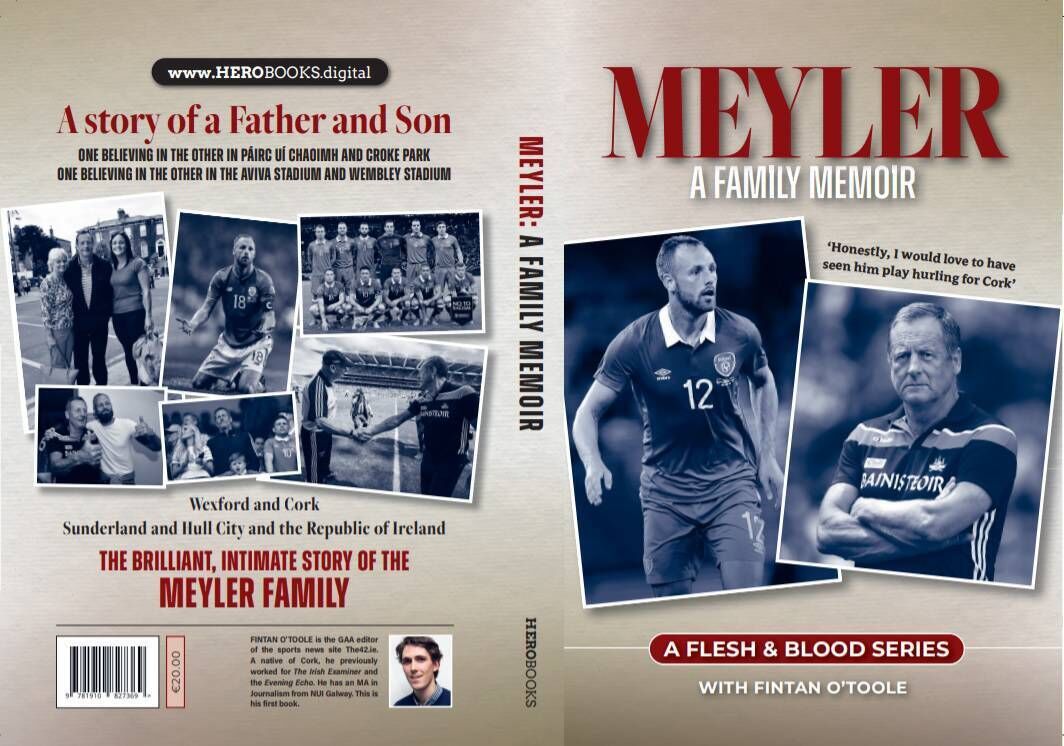
Meyler: A Family Memoir’ is published by Hero Books and is available in all good book stores and also online (€20)
CONNECT WITH US TODAY



Be the first to know the latest news and updates