Martin Storey: 'I was lucky. I was 32, married with three kids, when we made the All-Ireland final'
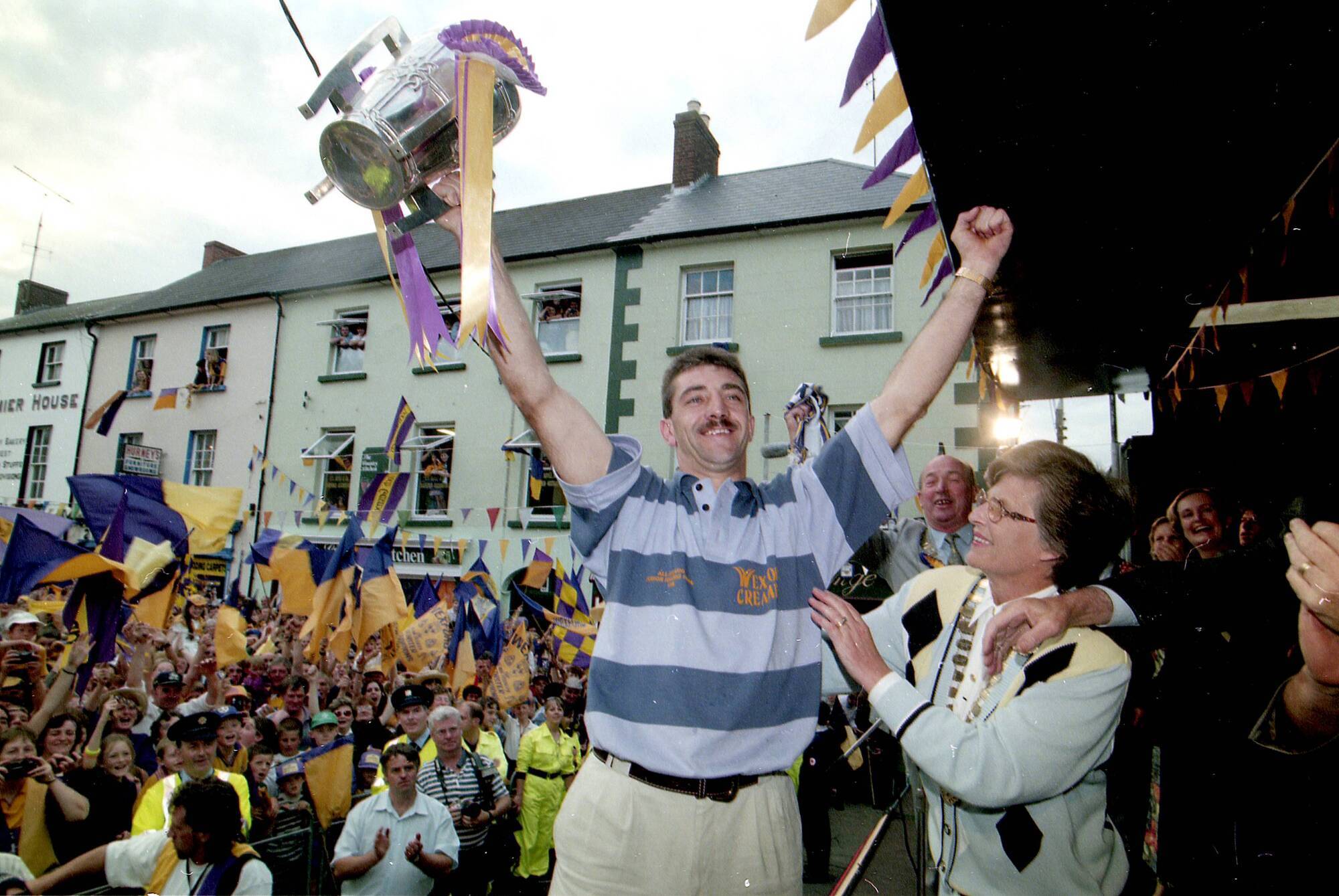
Wexford captain Martin Storey with the Liam MacCarthy Cup at the homecoming for the team who won the All-Ireland in Gorey. Picture: INPHO/Lorraine O’Sullivam
Croke Park met Martin Storey in many moods.
He smiles, acknowledges this truth. Storey is a gracious, articulate, and thoughtful man. He sits down in a Wexford Town hotel and begins to speak with fervour. But then breaks off, wants to make a general point.
“I just was lucky,” Storey states. “Real lucky. I was lucky with Oulart-The Ballagh, my club, and I was lucky with Wexford. I came along at a time when Oulart-The Ballagh were strong enough to win a senior title, which ultimately made me captain in 1996. But this was something that had never happened before in the club’s history. 1994 was our first senior title. We won again in 1995.
“Then I ended up part of a Wexford set up with 15 to 20 good hurlers, which meant we could get near an All-Ireland. I started hurling with Wexford in 1986, and we didn’t always have the 15 hurlers required. I was 32, not a youngster, married with three kids, when we made the All-Ireland final.”
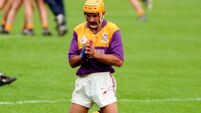
Croke Park saw the ultimate form of exultation, after he captained Wexford to a sixth senior title on September 1, 1996. Slaney deep, hurling high. The county’s supporters swayed and roared before the Hogan Stand, a predictable and gorgeous riot, as Storey threw the Liam MacCarthy Cup at the sky. Two points separated them from Limerick, even though his side played with 14 men for the entire second half.
They were brave and they were good and they were fast and they were skilful. Under Liam Griffin’s management, this panel likewise became highly organised. Griffin oversaw many innovations in diet, sports psychology, and statistical analysis. These advances, probably because of how Clare dominated the mid 1990s, remain underappreciated.
Storey is clearcut: “I was always a fierce Liam Griffin man. I didn’t mind saying that back then and I’ve no problem saying it again now. Liam, above all else, brought belief.
“And belief is the most massive thing in Wexford. It’s our biggest bugbear.
“Liam also brought organisation and discipline. There are no ifs, buts, or maybes with Liam. He is not a hugely successful businessman by accident.
Not everyone in the county appreciated, until success arrived, the hotelier’s input.
Griffin likes to tell the odd story against himself. One concerns the advice tendered by a cluster of irate supporters after a poor result: “Stick to frying rashers, you long-nosed hoor!”
Griffin had a t-shirt done up with ‘The Long-Nosed Hoor’ emblazoned on its front.
Most of all, Wexford in 1996 were strong enough to win. Most years, the county had not even been close. Now this group pushed surgeon close. The 28-year gap to 1968’s fifth senior title got sutured.
Here were the game’s revolution years. Offaly, Clare, and Wexford set tradition blazing, with Limerick heartbreakingly close, twice, to their own bonfire night. Who could the future hold but more of the same?
The future held a bucket of water. Hurling’s party, after 1999? Dominance by Cork, Kilkenny, and Tipperary.
The clock on one county’s seventh senior title still ticks. Now comes Martin Storey’s fervour: “It’s not looking, currently, like Wexford are in the top three or four teams. We might be in the top six and are definitely in the top eight. We had a chance in 2019 to get to the All-Ireland final.
“We had that opportunity to beat Tipperary and get there, but that is as close as we have come since 1996, since 1997, when we were still strong. Tipperary were a man down two years ago. But things didn’t pan out, whether it was a lack of experience on the big day or whatever.”
He sketches a broader picture: “You have to be playing in those really big games to deal with what happens in them, the pressure. You have to get all the little battles right, all the little ducks lined up in the one tight line.
“You have to know exactly how to react, to whatever crops up.”
Personal experience speaks: “A Munster final is a big match, don’t get me wrong. I’m not taking from those days. But it’s still not a big day in Croke Park. To win the All-Ireland, you have to be able to handle a massive Croke Park day at least twice.”
Storey stands as no fan of contemporary developments: “We’ve gone away from Wexford’s style of hurling. We had always been coached to win your own ball. It is evolving to possession in Wexford, same as everywhere else. What happens at inter-county filters down to the clubs.
“If you go through Conor McDonald and Lee Chin and all our lads, they grew up on the ability to win their own ball. It was a general thing, a Wexford thing: ‘Hit the ball into the forwards and see could they catch it.’ We sort of liked the high ball coming in. But it was a Kilkenny thing, a Dublin thing, as well as a Wexford thing.”
He continues: “Cork in 2004 and 2005 evolved the running game. It took hold in other counties as well, mainly Munster counties, and especially in Clare for 2013. I was thinking: ‘This might pass.’ But it hasn’t, and it has actually gotten worse. Look, it’s a spectacle to watch, with the high scoring game. It’s phenomenal. Sometimes you have more than a score a minute.
“But hurling didn’t originate as a score a minute game. Hurling originated as a man-to-man battle of the best, as a type of going to war: ‘You get the better of me. I’m not going to effin’ give in to you. And you’ll earn it.’ And that’s gone out of hurling. The close contact is now mainly scrimmage after scrimmage.
Juvenile development? Another reality gets canvassed: “I don’t think sport originated to do that, to level up everything. It’s not about accommodation. It’s not about making it easy. Sport is about the cream going to the top.
“People think I am being hard here. But if you are not the cream that goes to the top, there’s nothing wrong with second or third or fourth. But you have to find your level.
"Not everyone is at the one level.”
Storey admires Limerick’s drive but not their style: “They’re still ultra-defensive. They’re not like the Limerick we played 25 years ago. Or they’re not like the Limerick that played Kilkenny in that storm a few years ago [in 2014]. They are playing the same ultimate defensive system, except they’re bigger, stronger and better at it.
“They have that ability to put that ball through the lines, because of the angles that they are running, their gameplan, their superior fitness, their superior strength. But they still are not setting up 15 on 15, or anything like it. It’s gone so programmatic. You know what’s going to happen now before you go to a match. You didn’t know 20 years ago.”
His own county receives the same treatment: “Going to any match, you could predict, the last five seasons, Wexford will line up with seven defensive players. They’ll have at least two of three puckouts going short. That stuff doesn’t make for good viewing. I don’t think we have improved or disimproved since 2017. I just think we’re stagnant at the minute. Isn’t the point to improve? I mean, winning the Leinster final in 2019 was absolutely brilliant. But is winning one Leinster title in five years such a marvellous return? Had we the talent to do better? Yes, in my view. Do we lack a certain a certain ambition? I think we do.
Storey feels the lie of home ground requires sober analysis: “We are very strong at football, and we are very strong at underage soccer as well. There’s a huge pull in Wexford to play other sports apart from hurling. I’m just pro hurling. I’m not anti anything. I played soccer. I played football. I played hockey.
“But I am pro hurling. If I had to make a choice, if there were three things clashing, there was no choice. It was hurling.”
He shies not from controversial observations: “Are we a big enough county to go so thin? No, the population is not there. That’s why Wexford are mediocre in football and half mediocre in hurling. If we could totally focus on football, it would be interesting. I’m not saying we’d win anything. But within 20 years you will get somewhere. But when you are dividing your forces you will get where you always got.
“You go to Limerick and you go to Kilkenny. You have fellas training for hurling four nights a week. And you have a dual player, wherever he is, training for hurling twice a week, for football twice a week. Who’s going to be a better hurler after eight years? The fella that’s training four times a week, by the proverbial mile.
“You go to soccer. You go to tennis. Does [Cristiano] Ronaldo play rugby? Does [Rafael] Nadal play badminton? The answer is obvious. Did David Beckham play cricket?
“No. Did Muhammad Ali play American Football? No.”
The point is pressed: “In Wexford, we split straight, hurling and football. You can’t get to the top giving 50%. You just can’t. And that’s what we are getting, near enough, all up along in underage in Wexford. I’ll be blamed as being anti football, for saying all this.
“But I’m not. I’m just realistic. We gave up playing football in Oulart-The Ballagh, back in the 1980s. Were we wrong? I don’t think so. Success came our way.
“If you’re playing football, play football only. Don’t play hurling. Play one and give it everything. Because to get to the top is near enough impossible. Give it 100%. You simply cannot get to the top giving 50%.
“Football is easier to coach, especially to kids, same as soccer. There comes a point when you can’t really be playing three sports, giving equal time to three sports. That’s a 5 personal view but I think it’s common sense at the same time. I think you have to be giving 100% to one of them, to make it, and you still have no guarantee.”
Now he must depart to see Oulart-The Ballagh in a key local game. But Martin Storey has no difficulty framing his most treasured memory of 1996.
“Has to be the Thursday night in The Ballagh at home,” he stresses. “I am a proud Ballagh man, from our village, hurling for Oulart-The Ballagh, our club. The two parts of our parish are distinct but joined. And maybe it’s good to have a little bit of tension there, to keep everyone on their toes.
“They had put up a stage, to welcome the players and the cup. I remember being up on it and looking out the crowd.
“There must have been 5,000 people there, in The Ballagh, a little Wexford village, that is absolutely nowhere, in the very best sense of nowhere. That sort of crowd was never there before, never there since.
“And I was up there thinking to myself: ‘How many would you have to put into Croke Park to be the equivalent of 5,000 in The Ballagh?’ I still have the same question.”


CONNECT WITH US TODAY



Be the first to know the latest news and updates