Cormac Costello profile: Dublin's break glass in case of emergency 
In a Dublin attack shorn of made men, Costello has stepped up
Cormac Costello profile: Dublin's break glass in case of emergency 

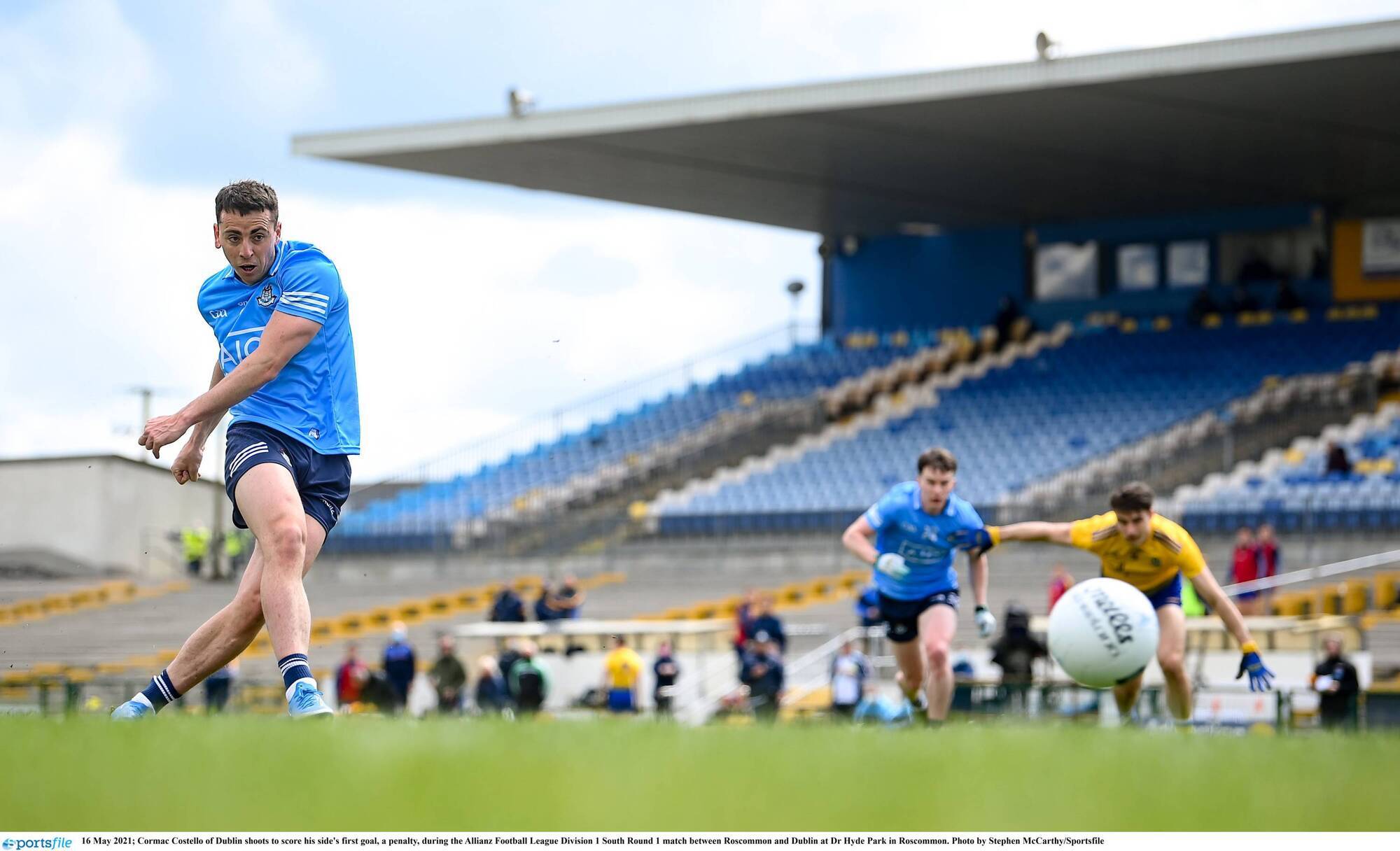
Cormac Costello of Dublin shoots to score his side's first goal, a penalty, during the Allianz Football League Division 1 South Round 1 match between Roscommon and Dublin at Dr Hyde Park in Roscommon. Photo by Stephen McCarthy/Sportsfile

Will they? Could it be? Is this it? Like, really, really it?

Can Mayo do it? Sure, Dublin are off-colour — but are they that off-colour?

Tyrone’s Covid woes have, with some courtesy, cleared the stage for Dublin-Mayo. As should be the case for any meeting of these two.

Unflinching pragmatists as they are, the turf accountants are unmoved by theories abounding.

Dublin are still strong favourites. Give us a minute to go round the loop first, and we’ll end up back at that point.

The winning margins in their three Leinster Championship games this year (eight, six, and eight) are considerably behind last year’s (11, 21, 21) and even further back on Jim Gavin’s last year in charge of 2019 (26, 15, 16).

Scholars of the Dublin football team have noticed a trend from the Jim Gavin-Dessie Farrell handover. In creating the team that are gradually tailing off, Gavin emphasised the need for players to fulfil their academic potential.

Whenever he was in one of his frequent reflective moods, he never missed the chance to talk up the need for players to be spinning the plates of academia, relationships, and sporting commitments. That there was far more to life than football.

All true. All sensible. All fair.

After they had landed their fifth consecutive title, it became something several took to heart. Dessie Farrell inherited a team bloated, like foie gras, by success.

Suddenly, there was more to life. Paul Mannion and Jack McCaffrey had taken gap years before, but there’s a semi-permanence to their absence now. Kevin McManamon put his work commitments with the Irish Olympic boxers ahead of his sporting ones this summer. The virtual certainty of Stephen Cluxton’s retirement — Farrell will
refuse to stand accused as the man who ended his career — hovers like The Ghost of Banquo at Macbeth’s Banquet.

Into this void, comes Cormac Costello. In an attack shorn of made men, he has stepped up and deputised the free-taking duties until Dean Rock returned.

Mayo know all about the 27-year-old teacher from Whitehall Colmcilles. A talent in 2011, he put down a number of low-lying years until he exploded in 2016. Despite the benefit of two Mayo own goals in the first drawn final, Dublin were struggling for authority.

Bernard Brogan was benched for the replay. Kevin McManamon had a rare start, but by the 56th minute, Gavin reached for Costello and he reeled off two almost identical points — coming into the D for a shot off his left foot — within a couple of minutes to give Dublin a three-point cushion.

When Mayo once again broke like waves against Dublin, they kept out any scores for 11 minutes; Costello again pushing the knife into their ribs.

The stats should have been with Mayo that day — 50-50% possession and Mayo conceded just 18 frees to Dublin’s 31, while they converted nine frees to Dublin’s eight. They forced two more turnovers (28) than Dublin. If they were in the mood to set Key Performance Indicators, they might have thought those numbers optimistic.

Sometimes you have to throw in a maverick. Within the panel, Costello would gravitate towards a similar-minded individual in Diarmuid Connolly. Both men’s motivation came from what could be created from little.

Val Andrews, probably one of the last Dublin football figures who is prepared to say anything interesting nowadays, has watched the development closely.

“Last year he was brought on against Laois (the Leinster semi-final) and scored 0-7. In the Leinster final against Meath, he was the fourth sub brought in by Dessie. What would you think?” he asks.

“How can you be so far down the pecking order, what do you have to do, like?

“It must be frustrating enough when you get thrown into a box, told that you are a ‘finisher’ or that David Fairclough thing of a super-sub.”

Hang on, though.

Does that notion that you have to be arm-in-arm on the pitch for ‘Amhrán na bhFiann’ still apply in the iPad analysis age?

“That is deeply rooted in all players,” says Andrews.

“The culture of a team, where we are all together and some players will do a few minutes, it will be established that you have ‘finishers’.

“But don’t tell me on a personal level that every player doesn’t want to play 70 minutes.

“It’s all set in the science that governs the game now. The game goes on with physical effort exerted. The ball in play, all these effects. Fatigue. Intensity. Levels drop, people are tired, so therefore the substitutions policy, just like rugby, is based on science.

“Costello deserves huge credit for sticking at it. It hasn’t gone smoothly for him since the start of his senior career. From the minor star he was, and you might expect him to be an established starter. There is no answer as to why he isn’t.”

Why not?

The old truism is it’s hard to break into a winning team. There was a time he was considered a hotter prospect than Mannion, for example. A series of injuries halted his gallop; achilles, ankles, hamstrings, so on.

He started the 2014 semi-final against Donegal, and the injuries started mounting thereafter. In that 2016 replay, he had been devouring opponents in the in-house games, but was just coming back from a six-month injury lay-off.

He was considered a risk for the final. By the replay, they had no choice.

Yes, the culture is shifting. And maybe it had to. The enormous contributions that players were making to the Dublin effort were characterised by Gavin being relentless in his quest to get more and more, asking them to invest ever more in the strategy side, was best characterised by Jack McCaffrey’s quote reflecting on his decision to quit last year.

“I think what broke me was the drawn final,” he said in reference to the Kerry final of 2019.

“I was walking off the pitch, I thought there was extra-time, and David Moran just stuck his hand out to shake mine, and I was like: ‘We don’t have to do this again, do we?’”

We now see the subtle changes.

That holiday picture posted on Instagram by Ciarán Kilkenny in front of a Donegal waterfall the week after the Leinster final? You can be certain none of it would have happened under Gavin.

Last year’s All-Ireland was won by the fumes of previous seasons. Dessie’s Dublin is only taking shape.

It’s the team of his minors; Costello, Murchan, Kilkenny, Byrne, augmented by the likes of Con O’Callaghan and Brian Fenton.

The wheel turns again.

More in this section

Cookie Policy Privacy Policy Brand Safety FAQ Help Contact Us Terms and Conditions

© Examiner Echo Group Limited