Christy O'Connor: Limerick move the artillery around to blow Waterford away
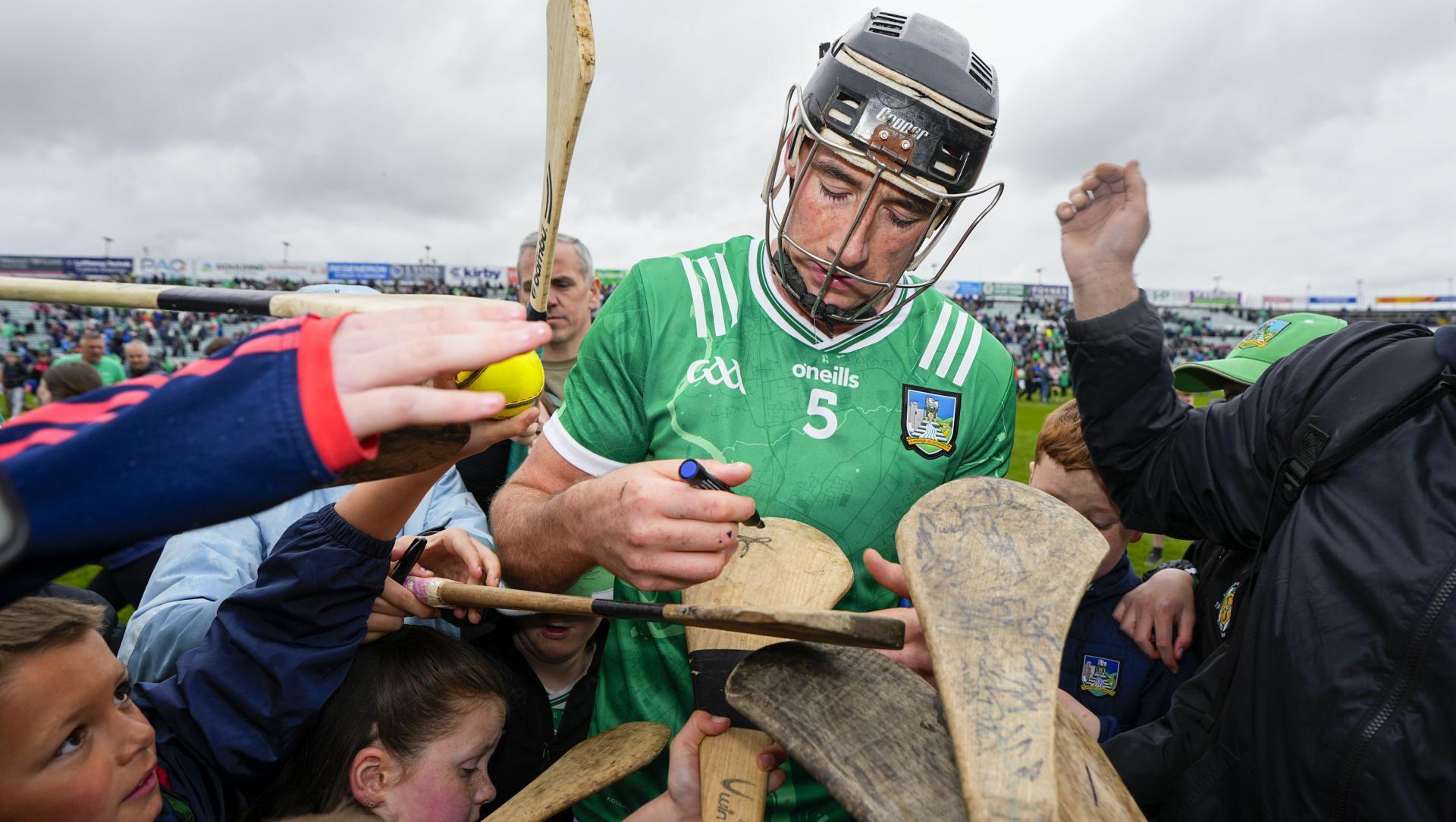
BYRNES BABY BYRNES: Limerick's Diarmaid Byrnes signs autographs for young fans after the game. Pic: ©INPHO/James Lawlor.
David Reidy delivered a ball into the corner but Mark Fitzgerald won the foot race against Aidan O’Connor and secured possession. Fitzgerald tried to work the ball out from the back but Gearóid Hegarty accepted it, took off towards goal and set up the chance for Peter Casey to bundle the sliotar past Billy Nolan and over the line.
From the resultant puckout, Aidan O’Connor raced through the centre of the Waterford defence and set up Hegarty for Limerick’s second goal. Bang. Bang. Game over in the blink of an eye. And lights out on Waterford’s season.
Limerick eventually found a way after Waterford had done so much to stop them from making their way. That delivery from Reidy was the ninth successive ball that Limerick had hit into their full-forward line which Waterford had won.
Aaron Gillane and Shane O’Brien had already been hauled off after only having ten possessions between them. O’Brien did score 0-2 from four shots while Gillane, who had to wait until the 24th minute for his first possession, was restricted to just one shot, which he missed, and two assists.
Limerick lost 15 of the 23 balls they played into their full-forward line largely because of how well Paddy Leavey did on Gillane and Fitzgerald coped on O’Brien, mostly by spoiling that possession. That lack of possession close to goal was strangling Limerick but it was also emblematic of how John Kiely’s men were losing too many individual battles.
Limerick’s tackling and intensity numbers were off their usual levels but their bench eventually began to make a difference before those two goals finally broke the game open. And once Limerick had that oxygen in their lungs, they suffocated Waterford off their own puckout in the last ten minutes, burying them beneath an avalanche of scores from distance.
Those long deliveries inside hadn’t worked, but the tide had still already began to turn; after converting only three of seven shots in the third quarter, Limerick nailed 2-11 from their last 15 shots.
Even though Waterford silenced Limerick’s two biggest guns close to goal, Limerick just shifted their artillery around the battlefield to eventually blow Waterford away.
Just seconds into the second half in Thurles on Saturday evening, Tipperary were on the attack when Darragh Stakelum was turned over by Ryan Taylor. After breaking two tackles, Taylor drove the ball into Peter Duggan and Ian Galvin scooped up the break and batted it past goalkeeper Rhys Shelly.
Clare’s first score of the second half was almost a mirror of their last score of the first half. After Andrew Ormond raced onto a long Tipp delivery, Niall O’Farrell spoiled the ball, John Conlon picked it up and picked out Seán Rynne, who pointed from just inside his own ’65.
And on it went. Tipp turned over the ball in their attacking half of the field a staggering 33 times. Tipp coughed up a colossal 1-15 from turnovers. It would have been far more if Clare hadn’t hit 17 wides.
As open as the Maginot line against Limerick, Clare had a far more stable and compact defensive structure on Saturday. David McInerney was excellent at full-back, limiting Hurler-of-the-Year John McGrath to just five possessions, one shot, one assist and no score from play. John Conlon, now 37 and who suffered a devastating finger injury last August, returned to start his first championship game in over a year and was outstanding.
Conlon wasn’t playing as a de-facto sweeper in the opening half but he was always dropping off, smartly covering space and reading Tipp’s intentions on their long deliveries. Conlon played closer to the D against the wind and made an impressive 25 plays overall.
It was a really positive night for Clare who played like a team hell-bent on atonement and in saving their summer. Tipp on the otherhand had all the hallmarks of a group strangled by fear and the self-fulfilling prophesy from another collapsed bid of trying to retain an All-Ireland.
On the evening that Galway played Limerick in the league in March in the Gaelic Grounds, they were inches from reaching a league final – and denying Limerick that passage in the process – when having a last ditch goal shot cleared off the line.
It was a disappointing end to their spring campaign but it had been a hugely productive and confidence-filling night for Galway on the Ennis Road. It was the first time in an age that Limerick had been made feel so uncomfortable in their own backyard, especially in the second half when Galway scored a staggering 0-22. And that was nearly 1-22.
Limerick had never conceded 22 scores in one half in league or championship under John Kiely but Galway were in that kind of a mood at that time. Two weeks earlier, Micheál Donoghue’s side had posted 0-20 in the second half in Salthill when whacking Kilkenny.
Prior to Saturday, Galway had become a dominant second half side. In their previous seven matches, in league and championship, Galway had outscored their opponents after the interval by a staggering 8-110 to 3-38. Filling their boots in the second 35 minutes against Kildare nine day ago did drive up those numbers but, on average, Galway had been winning the second half by 1-16 to 0-9.
Much of that though, also hinged on Galway’s strategy of playing against the breeze in the first half. That was a decision Galway had taken in their three previous championship matches but that was taken out of their hands on Saturday when Dublin won the toss and smartly decided to remove that comfort from Galway.
It didn’t suit the home side who only converted 11 of 24 shots in the opening half with the breeze. And, for the first time since Galway were marginally outscored by Cork in early February, Galway’s opponents racked up more scores than them after the interval on Saturday; Dublin won the second half by 2-11 to 0-10.
As well as this being just Galway’s second home defeat in 17 matches in the provincial round robin, it was the first time Micheál Donoghue had lost a championship match in Salthill. Galway’s scoring inefficiency in comparison to Dublin’s efficiency was the key factor. So was conceding three goals while failing to raise a green flag.
But Dublin were tactically smarter too, especially in how they managed the second half; after introducing John Hetherton and Ronan Hayes, Dublin went route one and Galway couldn’t deal with it; Hayes finished with 1-2 and assisted Brian Hayes’ late goal; Hetherton assisted 1-1 and engineered another goal chance that Darach Fahy saved.
For the first time in an age, the second half didn’t go as planned for Galway.
Shortly after the 2012 All-Ireland football final, Mark McHugh was celebrating with his Donegal team-mates when he spotted his father, Martin, who was working for BBC on the sideline. As soon as both father and son locked eyes, they shared a hugely emotional embrace.
The son finally had the coveted medal that his father had won 20 years earlier. “He was Martin McHugh’s Dad starting out and he had to make a name for himself,” said Martin McHugh on ‘The Sunday Game’ that night. “Now I’m Mark McHugh’s Dad.”
The McHughs accomplished that rare achievement as an All-Ireland winning father and son from Ulster but the pair are even more unique now after Sunday's Leinster SFC final. Just like his Dad had done with Cavan in 1997 when managing the county to a first Ulster title in 28 years, Mark McHugh managed Westmeath to yesterday’s Leinster title, just the second in their history.
Ending famines and leading counties to rare provincial titles as All-Ireland winners again underlined how much Mark McHugh is like his father.