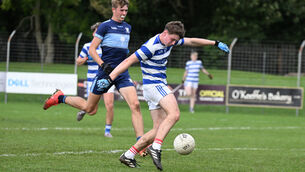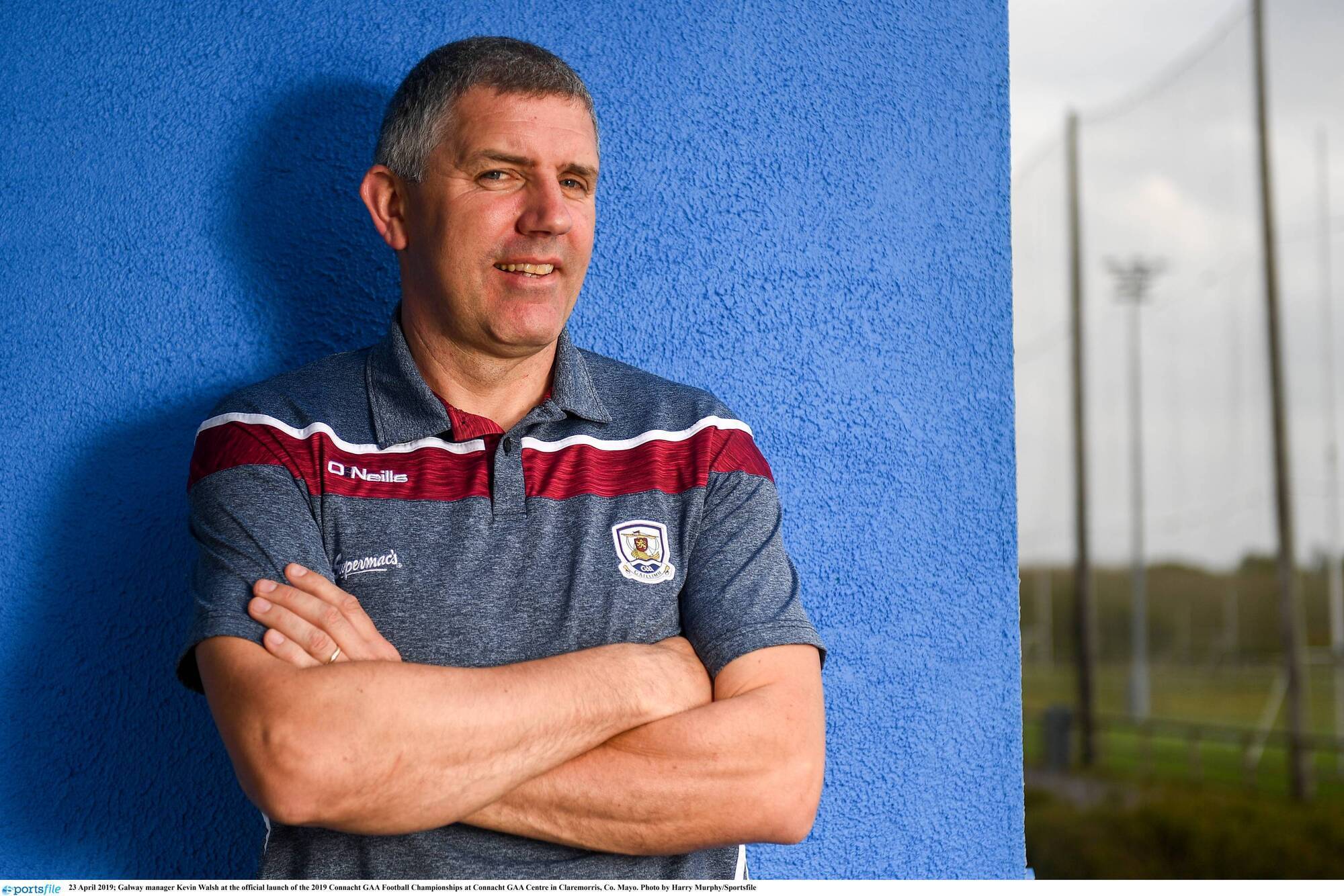
The way Kevin Walsh breaks it down, football is a game of 79:1; 69:1 at club. Allow for added time and you’re basically out there for 70 or 80 minutes, and for all but maybe 60 seconds of it, you won’t be on the ball. Yet how much thought and coaching goes into how you individually can influence the game for those other 79 minutes?
As a player he prided himself on how he operated in those other 79 minutes. Although he was capable of pulling his share of ball down back when midfield was exclusively a land of giants and he was also good to kick a point at least every second game, the biggest secret to him winning two All-Irelands and three All-Stars was his mastery of what he calls “The Invisible Game”.
He’s even gone so far as to use it as the title of his often-fascinating new book, as well as dedicate much of the new website — growcoach.ie — he’s established with a couple of his former Galway selectors to that aspect of the sport.
In his eyes, coaching has generally improved considerably in line — but…
“I see loads of drills which is great, and the moving markers have come on lovely as have the zoom and voiceovers.
But all I see is coaching on the ball. I’ve yet to see people coaching off the ball. And what I’m intrigued by is how can we grow coaches to coach players on how to impact a game when they’re off the ball, be that when their team is attacking or defending.”
Footwork is something he feels is under-coached in numerous field sports. In his book, he takes the example of Jacob Stockdale, a “try-scoring machine” but whose “absolutely atrocious” defensive footwork led to Ulster conceding two avoidable tries in last autumn’s Champions Cup quarter-final. “He didn’t know how to keep a high shoulder and coax the Toulouse players wide.”
It was a source of both enormous frustration and joy during his tenure as Galway manager in recent years to inherit players who were lovely on the ball and had won U21 All-Irelands and have to take them through the basic mechanics of how to shepherd opponents to where they didn’t want to go.
Walsh himself acquired such skills and awareness coming as he did from a less conventional background. He was a fabulous underage basketballer, at one point playing for three Irish national teams, and over the last 15 years has continued to coach and show young boys and girls in Corrib basketball some of the drills and tips he picked up under the masterful tutelage of Mary Nihill. But his footwork was also developed through more agricultural means.
He was born on a farm under Doon mountain where they had no running water; as a kid he’d have to run off with his bucket to a well quarter of a mile away. While schoolmates were watching Wanderly Wagon, he was out cutting potatoes for the cattle’s fodder. And often his father would task him with having to take their three heifers away from the four bullocks and put them in a different field.
“It might take three or four turns to get them through the first gate,” he writes. “You became better at understanding space, when to close it down and how; at knowing the difference even half a yard left or right could make, and when was the time to apply a bit of coaxing pressure rather than physical pressure.”
It was a classic example of what skill acquisition experts would call ecological dynamics and constraint-led coaching, though at the time such sophisticated concepts seemed far more rudimentary than that. “You could not come home and say [to Dad] you weren’t able.”
Such principles informed his own playing style. There’s a chapter in the book in which he describes the various strategies he’d use against the different midfielders he’d encounter. If he was up against an athlete like a Dermot Earley or an Eamonn O’Hara, he’d coax them down the wide channels like how he’d learn to coral those bullocks. If he was up against a John McDermott from Meath or a Seamus O’Neill from Roscommon, he wouldn’t even leave the ground for a kickout.
“Some were runners, some were fetchers,” he says. “Some fellas loved to leap and try to lift the crowd so you’d step across and block their run. If I timed it right they’d either bang into a static object, conceding the free, or if I was anchored enough, I could end up winning the ball.
They could get frustrated then so you also putting an emotional pressure on them, not just a physical one. It might not have been circus type of stuff but making an invisible impact like that could have the same value as a more visible one.”
Elsewhere in his book he expands on the various kind of pressures you can put on opponents when you don’t have the ball.
The first is what he calls Nil pressure — occupying a space that blocks a ball being kicked into an area — followed then by Still pressure, Coaxing pressure, Closing pressure, Chasing pressure and Physical pressure.
It’s intriguing stuff for anyone with an interest in playing or coaching the game at a higher level but he’s also aware that such detail is a turnoff and even a source of bemusement and derision to some commentators and punters.
For all the progress Galway made under his beat, becoming unrecognisable from the team that Mayo routinely bullied and cut through during James Horan’s first tenure, the public and media rarely saw the affable figure his players and management team knew. Instead Walsh often cut a prickly figure, obviously irritated by the popular narrative surrounding his team, and that annoyance also comes across in his book.
At one point he equates the way Galway would drop back to create space for Shane Walsh, Ian Burke, and Damien Comer upfront to how Roberto Firmino plays deep to create gaps for Salah and Mané. “As I will say every day of my life until I draw my last breath,” he writes, “taking players deep isn’t always about having a defensive mindset. No matter what the sport is, space is king.”
Every season bar his last, Galway made continuous progress under Walsh, culminating in 2018 when they were essentially the second-best team in the country that year. They went unbeaten in the league before narrowly losing the final to Dublin, won their second Connacht title under Walsh before exiting at the All-Ireland semi-final stage to Dublin.
That season tends to be written off as a gap year for Mayo and Kerry in their continuous pursuit of Dublin, but what tends to be forgotten is that Galway were the ones that made it a gap year for each of them, beating — and outwitting — them both.
Instead of being lauded for holding such teams to tallies like 0-12 and 1-10, however, Walsh and his men were often portrayed as being unfaithful to the best traditions of Galway football and the sport itself.
Walsh still rails against that type of analysis. It ain’t 1998 anymore, he stresses. For one thing, you’re never again going to see a bolter come along and win an All-Ireland like Galway did that year, he contends.
“Johnno [Mahony] came in and put a brilliant structure in place but there was no massive tactics back then. But now every county has got sweepers, they’ve got defensive systems, so the fella of 20 years of age isn’t going to get the same space he got before. And if he does, then there’s probably a team not doing the proper coaching.
“During the first lockdown I looked back on old matches like everyone else and my God, some of it was tripe. Even looking back on our ’98 final which was a fine game of football, I couldn’t believe the amount of hoofing and how poor the decision making was compared to what you see now.
“Nowadays you couldn’t have a John Divilly or Michael Donnellan just hoofing it in for the sake of hoofing it in because you’d have a sweeper back there to hit you on the counter-attack.
“My first year [managing Galway], we had Paddy Barnes down for a white-collar boxing night we put on. And he spoke to us afterwards and he said he loves coming to white-collar boxing because it’s great to watch. No one has a clue how to defend, it’s just everyone flaking away from all angles. Whereas with professional boxing, the fighters are properly coached. They know how to put up their hands, defend; it’s almost more boring to watch in a way because you don’t have as many belts being thrown.
“And in a way football is a bit like that. You might crave for the days when you’d just hoof the ball up in the air and there’d be lots more mistakes and it looks far more physical and chaotic. But if you look at the facts, the games are considerably higher scoring than they were in the 1990s. Backs are far more comfortable on the ball. And you have as many good games and great games now than you ever had.”
The Invisible Game also covers what we don’t see away from game day. Before he managed his native county, Walsh did some terrific work with Sligo, leading them to consecutive promotions and within a point of shocking Kerry and winning a Connacht title.
But as well as going into some of the methods he’d use to teach the players how to get free of their markers — long before the Dublin footballers were introduced to Jason Sherlock and Mark Ingle as coaches, Walsh was showing the likes of David Kelly and Mark Brehony how to V-cut — he also details how they created and maintained a team culture.
In the lead up to their 2012 Connacht semi-final against Galway, Stephen Coen, one of their best performers in the previous round, contravened a team norm.
After going over and back on it, Walsh and the team’s leadership group decided he shouldn’t be part of the 26 for that match.
They managed to avoid leaving him out to dry, putting it out there that he had pulled a hamstring, and on the day Coen would still be part of the group, taking some stats, but was still a huge call.
“You could say, ‘Well, look, ye had it down in black and white so it shouldn’t have been that hard a decision.’ But you were going up against an opponent you’d rarely beaten and never beaten in their home venue, so doubts could have come in. ‘Is our culture going to shine in this game or is abiding to it going to cost us the game?’ And there was a point where the leaders said, ‘Jesus, we need this man’ and there was a part of me saying we needed him as well.
“But I had to be true to something we had agreed upon as a group. Otherwise what were you saying to the guys who weren’t playing and had been bursting their bollix for two years? You were only devaluing yourself if you didn’t have the balls to stand by something you’d agreed on.”
As it happened the culture shone through. For the first time in Sligo’s history they’d beat Galway in Galway in championship.
To him that’s what he loves about football: working with players, collaborating with coaches and support staff.
It’s what makes all the other crap having to listen and deal with pundits still worthwhile. And so, even in these Covid times, the game and coaching still consumes him.
For the last 18 months himself, Brian Silke, and Seán Conlon talk three times a week putting together their new website and service, GrowCoach, coming up with 180 different clips illustrating different aspects of coaching and preparation.
The plan is that clubs and even counties can subscribe to access more of the material and bounce ideas off Walsh and his colleagues.
Ask about how the game should counteract the plague of massed defences and he starts talking about how he’d love to be back on the field working with a team of youngsters in the club on ways to have runners darting into that arc.
“I’d love to go back coaching now. I’ve probably enough of management at this stage. I’ve my 10 years done of it between Sligo and Galway and while I loved it, it’s too much to be both a manager and a coach.
“But I still feel I have an awful lot to offer in coaching because all that I’ve learned.
“I’ve coached in all four divisions. I’d be very happy at this point to go in as a number two to help a new number one and be a sounding board for him.”
Whether we see him again or not, he’ll still be studying and intrigued by the invisible game.
Kevin Walsh’s ‘The Invisible Game’ on ...
Dublin’s home advantage
“The skewed system that gives Dublin the huge advantage of playing all their games in Croke Park is an issue that needs to be dealt with. They play every [championship] game there. EVERY GAME. It beggars belief that you would hand such an advantage to a team in the marquee competition.
“I would categorise it as a six-to-eight point advantage. Travel is part of it, being in your own bed the night before the game. Your home dressing room, understanding the goal posts and the vagaries of the wind and other conditions.
“There’s no disputing the fact that they have excellent players who are very consistent and extraordinarily strong psychologically. They prevail when taken to the line and have shown all the traits of a brilliant team. They are a brilliant team.
“But Croke Park is the national stadium for all the counties, paid for by the members in a variety of ways and by the taxpayers of the country through state funding. It is scandalous that it used to give one county a massive advantage.
“For all their good planning, are you telling me that they could not build a 30,000 stadium like Galway, Mayo, Limerick and countless other counties? They didn’t do it because they knew they wouldn’t have to. It is a complete lack of fairness that has to be factored into their status as a six-in-a-row team.
“I acknowledge that the final will always be in Croke Park, but if Dublin didn’t play as often there, the advantage could be reduced to some extent.
“I certainly think they could play a semi-final in Páirc Uí Chaoimh, for example.
“I asked a Boylesports executive to price up Galway v Dublin at Croke Park and Pearse Stadium, with full attendances in pre-Covid times. His team came up with Dublin at 1/3 in Croker and 4/7 in Salthill. That would have Galway at around 11/4 and 7/4 respectively.
“I am not a bookie but bookies are surrounded by actuaries. Actuaries are telling us that the stats decree playing at home is an advantage. I can’t put it any simpler than that.”
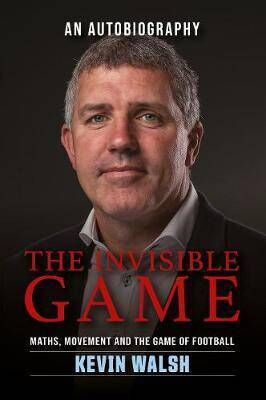
- The Invisible Game: Maths, Minutes and Movement by Kevin Walsh with Daragh Ó Conchúir is published by Hero Books


Cancel anytime
CONNECT WITH US TODAY



Be the first to know the latest news and updates