Does fouling pay in hurling? That's what the stats suggest
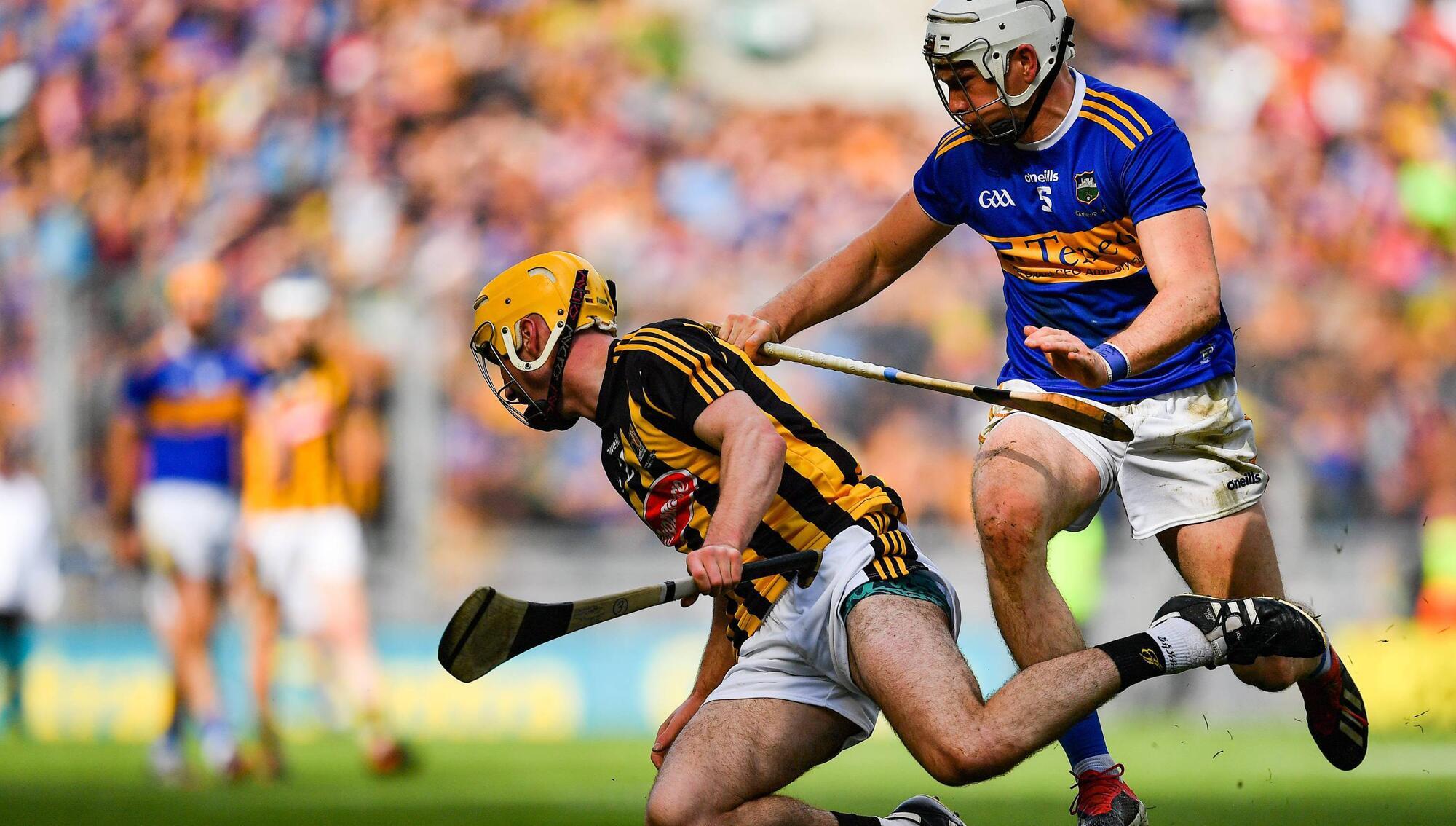
Richie Leahy of Kilkenny in action against Brendan Maher of Tipperary during the 2019 All-Ireland SHC final. Picture: Brendan Moran/Sportsfile
Does fouling pay in hurling? Intuitively, you wouldn’t think so, given the accuracy of modern free-takers.
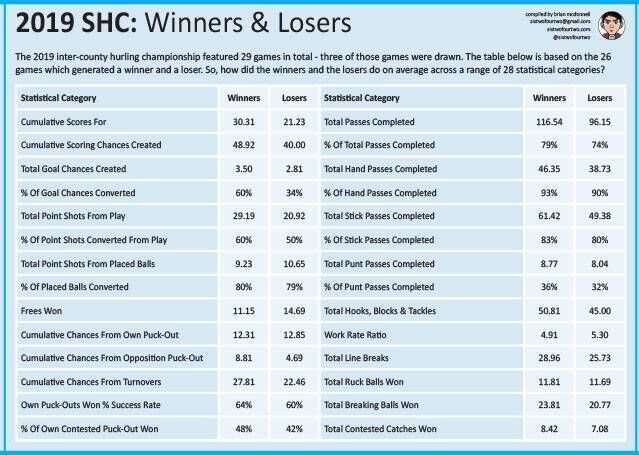
But there is an eye-catching statistic from the 2019 All-Ireland SHC: in 85% of the games that produced a winner (22 from 26), the team which prevailed conceded more frees.
In all, 757 frees were awarded, with winning teams conceding, on average, 14.69 per game, and only earning 11.15.
Tipperary, for example, lost the free count six times in their eight games. In the 14-point All-Ireland final win over Kilkenny, Tipp conceded 14 frees to Kilkenny’s 10.

The point of this project was to create a detailed picture of what an excellent hurling performance might look like and what it took, from a statistical perspective, to win games during the 2019 intercounty senior hurling championship.
Data was collected from all 29 games, almost 2,248 minutes of action (77.52 minutes per game on average) and featured 13,347 individual player possessions.
While some lop-sided games pollute the statistical picture, the ‘Winners & Losers’ table paints a picture of a winning performance in 2019.
On average, a winning team hit 30.31 points and created 48.92 scoring chances, including 3.5 goal chances, with 60% of goal and point attempts converted.
Winners had a 64% win rate on their own puckouts and completed 79% of their passes. They had 50.81 hooks, blocks or tackles compared with 45 on the losing side.
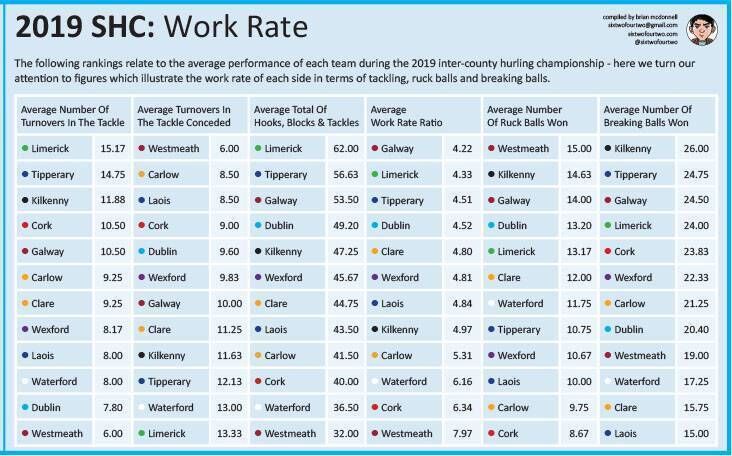
The patterns associated with the hooks, blocks and tackles are interesting and are shown in the Work Rate table.
The “Work Rate Ratio” is calculated by dividing a team’s total number of hooks, blocks and tackles into the number of possessions enjoyed by the opposition i.e. the lower the score the better.
Work Rate Ratio can be used to assess the determination of a team to tackle the opposition ball carrier i.e. how many possessions will your team allow the opposition to enjoy before getting in a tackle.
In 2019, Galway performed best in this regard, only allowing the opposition 4.22 possessions of the ball on average before getting in a tackle. Limerick (4.33) ranked second, followed by Tipperary (4.51).
Of the teams that contested the provincial championships, Cork ranked lowest for Work Rate Ratio (6.34), with only Westmeath performing worse (7.97).
The prevailing year-to-year pattern is interesting. Analysis of the 2016 championships suggested that the most accomplished sides registered an average Work Rate Ratio below 2.50. In 2017 that was 3.50, in 2018 less than 4.00.
Leading teams aren't working less hard, but it is evident that teams are being coached more and more to avoid contact and teams are making strategic choices in terms of where they wish to tackle.
That said, a strong correlation can still be identified between hard work and winning.
When studying puckout patterns, Wexford’s use of the medium delivery (between the 45 and 65-yard line) to an unmarked player was particularly noteworthy.
Wexford looked for a free man on 63 occasions from their 189 re-starts (33%) of the time, and were particularly sharp at moving the ball on from there via an off-the-shoulder runner emerging from the full-back line or with a line break or stick pass forward.
In general, there is a move away from delivering the ball into a contested area while when opposing teams set up to defend the restart they appear happy to allow the opposition to pop the ball out to a free man, get their shape right and then defend from there.
Interestingly, Kilkenny opted to pick out a free man just 23% of the time and delivered the re-start to a contested area 77% of the time.
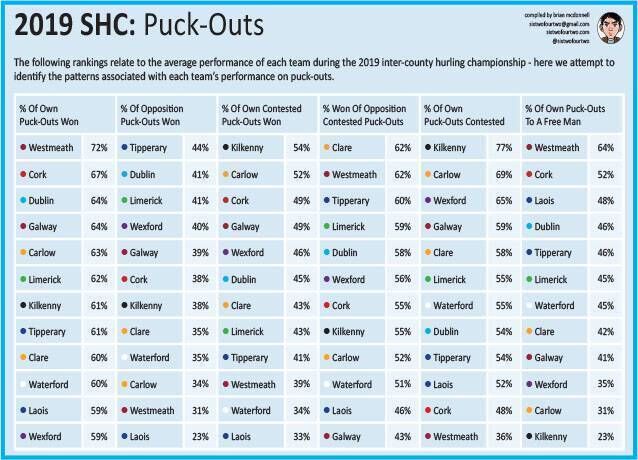
During the 2019 All-Ireland hurling final, the Cats opted to go long with 92% of their re-starts while Tipperary went long 46% of the time. Ultimately, in that final Tipperary won 77% of their own re-starts and Kilkenny 41% of theirs. Kilkenny created zero scoring opportunities off the Tipperary puck-out while Tipperary created 14 scoring opportunities which originated from the Kilkenny re-start.
CONNECT WITH US TODAY



Be the first to know the latest news and updates