From tigers to seals: Dublin Zoo dentist reveals challenges of animal dental surgery

Veterinary specialist adapts tools and techniques to treat everything from tigers to seals in high-risk, high-pressure procedures
From tigers to seals: Dublin Zoo dentist reveals challenges of animal dental surgery

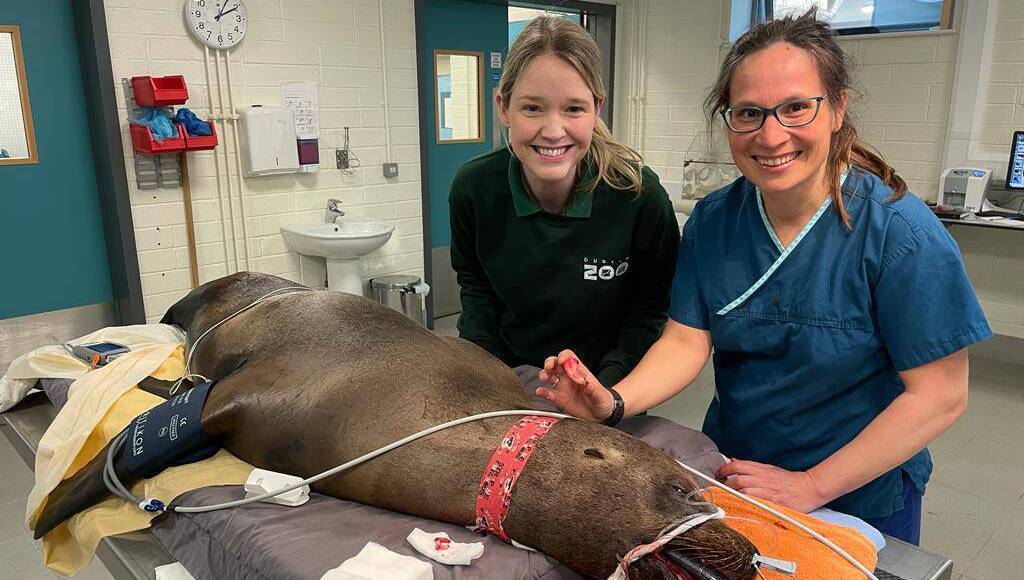
(Left to right) Dublin Zoo vet Niamh McGill and veterinary dentist Nora Schwitzer performing dental surgery on a seal.

While dentists often elicit fear, Nora Schwitzer is more likely to be scared of her patients, having carried out complex dental treatments on some of the world's most dangerous animals.

Ms Schwitzer, a renowned veterinary specialist, has achieved incredible feats, from root canal surgeries on tigers to the extraction of a chimpanzee’s upper canines. 

The graduate of Ludwig-Maximilian University in Munich has to be creative in her approach to surgeries, often needing oversized equipment to help the bigger animals of Dublin Zoo. 

“We have the same equipment all the time, but it’s just in different shapes and sizes,” she told the Irish Examiner. “I used some equipment from B&Q and local DIY stores to try to achieve the same as what a high-speed drill would, because the sheer area of bone you have to remove is different. 

"I have worked a lot with local suppliers of veterinary equipment that are developing instruments for zoo animals. When I go to them and ask them to make something for me they are very obliging. The local DIY store is not quite as reliable as real medical equipment."

Nora works with iM3, a global manufacturer of veterinary dental equipment, to help solve of the more complex problems she faces.

"If there is a problem we will try to solve it together. They’ll often offer me a prototype to try out before it gets put on the market. This is exactly the same stuff you would use for cats and dogs but it’s adapted for animals such as tigers and sealions.” 

Every day is a learning curve for Nora.

“Dentistry is quite a young field in the veterinary world. We can’t really draw on experience, so we have to find solutions from the human side which is obviously way more developed already. 

"I confide in colleagues from all over the world, including America or South Africa."

She avails of ongoing support from Dr Thomas Linehan who is based in the Seapoint Dental Clinic in South Dublin.

“We have worked together on a number of occasions and he has been kind enough to let me have some of his human equipment. We learned quite a lot after working on a chimpanzee. 

"They aren’t like humans but they’re not like cats and dogs either so we had to work together to solve the case. 

"We could choose between human and veterinary dental equipment and figure out how to make that fit best into a chimpanzee. I never leave the practice now without the human equipment Tom has given me.” 

One of their most memorable root canal surgeries was on a Siberian tiger called Tundra, back in 2022.

“This tiger had a root canal surgery. Their teeth have very long roots which almost extend to underneath the eyes. 

"We try to avoid taking the teeth out just because they are so long. The hole that it leaves is so big, there is a chance they will fracture the jaw afterwards. One way of saving them is to do a root canal. 

"They have such long roots that you have to use specialised equipment to clean the gunk out of the root. It was interesting to do this with a human dentist. We did it in two sittings with one root canal in the upper canine and one in the lower canine. 

"This category of animal is considered very dangerous. They are so dangerous in fact that we don’t even take them out of their habitat. We bring all the equipment into the habitat. 

"Marlon the chimpanzee had to be done in her habitat and likewise with Tundra. I’m so impressed by the keepers for their knowledge and ability to deal with these animals in times of need.” 

'Pressure is higher with endangered species'

Nora’s job is always unpredictable.

“I like doing cats and dogs but we don’t have the verbal feedback and can’t watch them closely to find solutions, which the owners sometimes have to wrap their head around first. 

"That is a challenge in itself but with zoo animals, these are endangered species so the pressure is much higher and the operations are way more complex because of the anatomy. Even a Dobermann is relatively small when compared to a bear.” 

The veterinary specialist embraces new challenges.

“Red pandas and tigers have to chew very hard food. In the case of red pandas, that’s bamboo. Tigers chew bones just like with all big cats. The teeth are designed in such a way that should be able to withstand the pressure but nothing in the body is perfect.

"When we fracture teeth we create an entrance for bacteria to find its way in. Eventually the tooth dies off and you can develop an abscess. There is a lot of wear and tear in the wild and they can eventually die from something like this. 

Veterinary dentist Nora Schwitzer performing root canal surgery on a tiger at Dublin Zoo.

"Interestingly, we notice these things earlier in zoo animals than in pets, and that’s why we do so many root canals. We try to keep the operations as short as possible because the longer you have an anaesthetic the more likely you are to have side-effects. 

"It’s way more important that the animal survives than we finish the operation on time. We always aim for a time of two hours. Of course, this is not always possible but I’m lucky to have such talented colleagues at Dublin Zoo. 

"Sometimes, we fly experts in from Berlin or Valencia who specialise in anaesthesia. UCD helps as well.” 

'You can’t control anything at the zoo'

The veterinary team have to be flexible in their approach.

“We have to improvise with the operating table. The keepers are brilliant and set up an allocated area for me. 

"The 24 hours beforehand are very nerve-racking. I’ve definitely had a lot of sleepless nights. I tend to be a bit of a control freak but you can’t control anything at the zoo.” 

Nora’s next operation involves root canal surgery on a seal.

“It’s amazing to be so close to a wild animal. We treat a seal next week. Dublin Zoo is involved and the plan is to release the animal into the wild afterwards. 

"That blows my mind because we are interacting at a point where our lives shouldn’t have crossed.  That, for me, is very humbling. 

"We haven’t found a way of doing the root canal because the roots don’t close so you can’t flush them out and you can’t fill them again. It’s basically like baby teeth for a long time. In this case, we have to take out the teeth to avoid abscesses. 

"Once the wound is healed and we know the animal can hunt and masticate food it can return to the wild. 

"Another seal we treated before it went on to have a pup. It’s very rewarding hearing that the animal is able to have a normal life again.” 

She has fond memories of other animal surgeries too.

“Four meerkats were among the smaller animals that I have operated on. My usual instruments were too big so I had to operate using needles. 

I’ve also repaired the beaks of birds. It’s not exactly teeth but the composite I use for repairing teeth can also be used to repair beaks. 

"I have put a gold crown on a dog. There was also a cheetah who had a malocclusion (misalignment of teeth) and the tooth was embedded into the upper gum. 

"We had to shorten it down. I thought we’d have to give this cheetah a gold crown but we didn’t need it in the end.” 

Marlon the chimpanzee was among Nora’s most memorable patients.

“The lower canines have a certain hook at the end which can be seen in x-rays but only at a certain angle. I wasn’t aware how abnormal this anatomy was. 

"We got the tooth out. Unfortunately, Dublin Zoo doesn’t have a CT scanner so in that case I had to rely on x-rays which only provide 2D projections. That was quite challenging. 

"Sometimes you only find the abnormalities during the operation. You try to minimise this by taking x-rays. That case was an interesting one and it really helped to have the human instrumentation.” 

Veterinary dentist Nora Schwitzer performing root canal surgery on a tiger at Dublin Zoo. 'We try to avoid taking the teeth out just because they are so long.'

The job can often take an emotional toll.

“It is risky and very sad when things don’t go right because you have a problem with anaesthesia or the animal doesn’t recover. 

"We are not god and can only do our best under certain conditions. You can never predict the outcome. Thankfully, we have mostly good results but you have to stay humble in the event it might turn out differently.” 

Nora is glad the profession is becoming more recognised.

“Up until recently dentistry was a really uncool profession in the veterinary world. It has become more accepted recently but I have to admit I have been the uncool kid for most of my life. 

"I can still remember the reactions of several of my former employers when I told them I wanted to do this. Some of them asked me why I would do this when I’m clearly intelligent. Others said it was disgusting. 

"The reality is that somebody has to do this for the welfare of animals. It also helps that I adore what I do.”

More in this section

Lunchtime News

Newsletter

Get a lunch briefing straight to your inbox at noon daily. Also be the first to know with our occasional Breaking News emails.

Cookie Policy Privacy Policy Brand Safety FAQ Help Contact Us Terms and Conditions

© Examiner Echo Group Limited