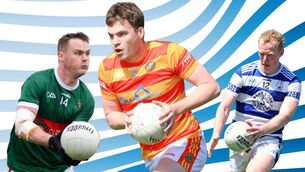
Croke Park’s céad míle fáilte for Renault World Games finals
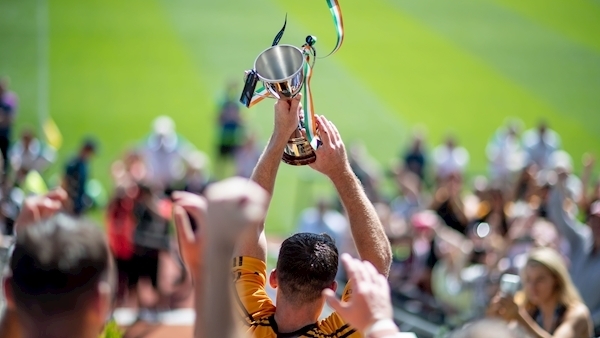
Croke Park isn’t supposed to be a bundle of fun when three-quarters of the place lies out of bounds and the crowd can be corralled into a few sections of the Lower Hogan Stand.

Croke Park’s céad míle fáilte for Renault World Games finals

Croke Park isn’t supposed to be a bundle of fun when three-quarters of the place lies out of bounds and the crowd can be corralled into a few sections of the Lower Hogan Stand.

But if that picture proves anything then it is just how the inter-county game has come to colour our view of everything that happens in the GAA.

Today proved yet again that a full house, an abundance of household names and a full court media press aren’t the only means by which ‘Croker’ can be made magical as the Renault World Games moved from Waterford Institute of Technology to ‘Croker’ for finals day.

Foreign accents are far from rare in Dublin 2 these days. Like pretty much everywhere in modern Ireland, it is a venue that leans heavily on employees and volunteers from around the world while curious tourists tend to swell the attendances on any given matchday during the summer.

But this was different.

GAA jerseys bearing the names of locations as diverse as Ottawa, Prague, Helsinki, Clermont, Asia, Galicia, New York and Australia were sprinkled around the Lower Hogan which provided the viewing platform for somewhere between 6,000 and 8,000 spectators.

Among those present was a Portuguese referee who many in WIT felt was the best official on show this week, a German who is fluent in Irish and chairman of his local Conradh na Gaeilge branch and some Finns eager to make links between their own indigenous sport of Pesäpallo and hurling.

A hybrid game of lacrosse and hurling, brought about by some Germans and Americans and facilitated by the GAA, brought events on the pitch to an end today evening and Pat Daly, the GAA’s director of games development and research, spoke of a hitherto unknown group playing a form of hurling in Romania.

John Heneghan of the Australasia team with his 10-month-old son Séan on the Croke Park pitch. Picture: Morgan Treacy/inpho

“Basically, what you are starting to do is make connections and build a sense of community,” said Daly during today’s finals. “Professional sport is heading in one direction and we are trying to go in another direction and just ground it back in communities and people.”

Daly is a Waterford native who saw for himself how the World Games were embraced in his own neck of the woods this week, starting with a parade through the city and a concert on Sunday, continuing through the week with the games and incorporating a twinning event on Tuesday evening.

South Africa were paired off with Ballyduff Lower; the Russians ended up in Tooreen; Argentina were introduced to An Sean Phobal, and the German hurling and football panels toured out west to Daly’s own club in Tallow where the locals were astonished to hear the Irish-speaking chairman.

The growth in native-born players (i.e. those born abroad rather than in Ireland and many of whom have no familial links with this country) has been a key feature of this event. Approximately 60% of the 1,500 or so participants were drawn from that pool. That’s the highest ever percentage.

The idea for the World Games originated with The Gathering six years ago when Aer Lingus decided to fly 16 ex-pat teams home to Galway for the once-off event and the GAA lobbied for some native-born sides to be included. Five came in 2013. There were 58 in Waterford this week.

The numbers are impressive whatever way you look at it. From 25 teams in total in 2013, the tournament grew to 56 at a football-only tournament in the Middle East three years later and that shot up again, to 84 teams, this month. Every continent was represented this week.

Katrina Terry, Camogie Collective Warriors, has some distinctive tattoos. Picture: Morgan Treacy/inpho

“There has been phenomenal growth (among non-Irish people) in places like Europe,” said Daly. “Like in France. It’s a sport on the curriculum now in Brittany.”

None of which would have happened, of course, were it not for the generations of Irish people who emigrated to various corners of the world and brought their love for the national games with them.

Some of those intrepid travellers returned home this week for these World Games.

Caroline Kelly among them.

Part of the Kerry side that lost to Cork in the All-Ireland Ladies SFC final at HQ back in 2012, the Brisbane-based teacher went a step better today by captaining Australasia to a superb win in a brilliantly entertaining Irish-born final against Parnells of London.

Kelly, who won an All-Star before making the switch Down Under in 2017, spoke eloquently this week about how special it was for her and her teammates to return home. Watching on today were her parents Séan and Theresa as well as her sister Mary with her husband Damien and their five kids bedecked in green and gold kits that represented both their aunt’s county and her adopted country.

“It’s unbelievable,” said Séan. “We’ve seen her play for Kerry and this compares with it. Even down in Waterford was great. The facilities were excellent and it was a great atmosphere. And the standard of football is very good as well. We thought Croke Park would be empty for the finals but there is a great atmosphere here as well. A mighty atmosphere.”

It’s impossible to overstate what a week like this must mean to the Kellys - and to the many families like them who snatched a small pocket of time with sons and daughters who had returned home this week - even if they couldn’t stay for the closing banquet held in Croke Park last night.

Something to do with Irish dancing classes in Cahirciveen today.

“Ah, we’ll be happy going back down,” said Séan. “We won’t feel the journey this time.”

Dalo's extra-time podcast: Should there be two referees in inter-county hurling?

x

More in this section

Cookie Policy Privacy Policy Brand Safety FAQ Help Contact Us Terms and Conditions

© Examiner Echo Group Limited