‘The ball crawled over the line. I’ll carry that to my grave’
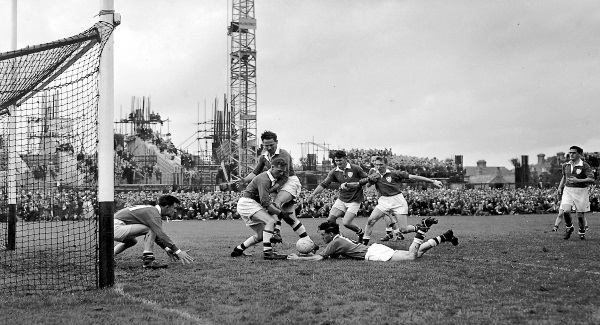
The biggest and smallest counties in Ireland don’t have a huge amount of shared history, but they did fight out one memorable hour more than 60 years ago.
The 1957 All-Ireland football final pitted Cork and Louth against each other in one of the most dramatic deciders ever played, or at least one of the most dramatic finales.
Frankly, tomorrow’s league encounter between the two sides has a fair bit to live up to.
Cork were on the way in the middle of the 50s. They had won a league title in 1952, and in 1955 Kerry only just scraped past them in the Munster final. They knew they were close to the breakthrough.
Some years ago Dan Murray, a mainstay on that Cork team, told this writer about their gradual progression to the big show in September.
“In 1955 we should have won the Munster final, and Kerry went on to win the All-Ireland that year. They only beat us by a point or two in ’55 so we knew we were there or thereabouts.
“We had experienced players — Toots Kelleher, Neally Duggan, Denis Bernard, they were the men driving the thing, while Eamon Young was training the team, and he’d have been the dominant force.”
They finally escaped Munster in 1956, when the county footballers joined their hurling counterparts in their respective All-Ireland finals. Along the way they beat Kildare in a bruising semi-final.
“The most physical game we had,” Murray said of the Kildare match.
“They were very dirty. Toots and Denis Bernard were hospitalised after it. Boots to the head, anything that came along. They’d hadn’t been in an All-Ireland final for years so I suppose there might have been a bit of desperation.”
In the decider Cork came up against Galway, which meant the Terrible Twins. Frank Stockwell and Sean Purcell were a dazzling combination up front, but Cork weren’t helped by vagueness about tactics.
“Supposedly the plan was that I’d take Stockwell if he went out and that Donal O’Sullivan would take my place,” says Murray.
“But I didn’t play the game that way — if you were corner-back you were corner-back, and you marked your man: if Donal was marking Stockwell, then I didn’t see myself following him out and leaving my man behind me. I don’t recall being told to do that.
“They (Galway) were better than us in ’56, no doubt about that.”
Still, the experience was bound to benefit Cork. 1957 couldn’t come fast enough.
That year Louth were the surprise packet in the championship; they started sluggishly enough in Leinster, beating Carlow and Wexford before getting into gear.
They upset the odds by beating Dublin and 1956 Leinster champions Kildare on the way to the provincial title, powered by the free-scoring Jimmy McDonnell, who helped himself to 5-5 in those two games alone.
In the All-Ireland semi-final, they faced Tyrone, led by the superb Iggy Jones, but Kevin Beahan and Dan O’Neill’s power in the middle of the field helped Louth win relatively easily, 0-13 to 0-7.
Cork could draw on the lessons of ’56, and they put those into effect in 1957.
On the morning of the All-Ireland semi-final against their conquerors the previous year, Galway, Dan Murray was told to pick up Stockwell.
The decisiveness stood to the Rebels, and Murray excelled; the Galway man only scored one point and Cork got through, 2-4 to 0-9. Based on their display in the semi-final and their experience the previous years, they were installed as favourites for the final.
As an example of inexperience in action, Louth almost started that All-Ireland final without their captain, Dermot O’Brien, who later enjoyed huge success as a singer.
O’Brien had been having intensive treatment on a shoulder injury and didn’t travel with the rest of the team to Croke Park on the day of the All-Ireland final (it was a bad year for Louth captains and arm injuries — O’Brien’s club mate Patsy Coleman was the original skipper for the 1957 season but he broke his arm against Dublin).
As a result, when O’Brien got to the stadium he was locked out of the Cusack Stand and had to hurry around to the Hogan Stand side to get in, the PA in the stadium calling for him to go to the Louth dressing-room the entire time.
Afterwards, O’Brien said it had taken him the entire first half to settle down.
Louth led early on, 0-5 to 0-3, before Cork struck for a goal — Tom Furlong got his fist to a dropping ball and when Niall Fitzgerald added a point, Cork were ahead: they led 1-4 to 0-5 at half-time.
The Rebels shaded the second half and were 1-7 to 0-9 up with time running down, though most observers said Cork were guilty of missed chances which would have made the game safe long before the final whistle.
Then came the decisive twist in the game with minutes remaining. A Cork defender blazed a wild clearance out of play, and Louth’s Kevin Beahan lined up the sideline kick.
“The ball came in high and I shouted for it, that I had it covered,” said Murray.
“I’m convinced I caught it and Sean Cunningham, the Louth player, reached in and pulled my hand out. The ball dropped down on the line and I could do bugger-all about it.
“I would think about it a lot. It’d be on my mind quite a lot. I prided myself on never being beaten for a high ball, no matter how big the man I was on, and the fact that I felt the goal was scored because of my own stupidity . . . whether that was the case I don’t know. But I can still see the ball dropping down, crawling over the line.
“I’ll carry that to my grave. It was the one opportunity to win an All-Ireland, and we should have won. We should have been well ahead of Louth at that time.”
There was still time for Cork to rescue the game, and twice they came close to a winning goal, but Louth held out — the Leinster side’s Jim Meehan made one terrific intervention when the house was all but down.
At the final whistle it was 1-9 to 1-7: Dermot O’Brien, late to the game, was the man who accepted the cup.
Neither team kicked on after 1957. Louth were beaten well by Dublin in the following year’s Leinster final, while Kerry were far too strong for Cork in the southern decider.
Dan Murray injured his cartilage in the 1959 county final in Cork, a blow that ended his inter-county career. But he wasn’t finished with old opponents.
Long after he finished playing he was driving near Tuam and realised he hadn’t seen Frankie Stockwell since shaking hands after the 1957 semi-final: so he dropped in for a cup of tea.
In 2007, Louth celebrated the 50th anniversary of their All-Ireland win. Sean Cunningham had passed away, and it was a long haul north, but Murray didn’t let the occasion pass.
He and another former Cork player, Sean Moore, headed up.
At the function they met up with Sean Cunningham’s sons, and they chatted about an autumn afternoon in Croke Park when they waited for a ball to drop in the square that would change their sporting fortunes forever.
CONNECT WITH US TODAY



Be the first to know the latest news and updates