Five reasons why Kerry are Munster champions
W
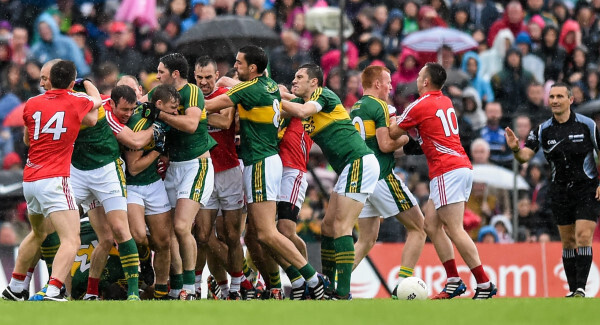
For long periods on Saturday night, Cork tried to funnel the ball via hand-passes through the crowded central spine of the pitch.
Sometimes they were slick enough to pull it off and when executed perfectly, it led to scores. However, the percentages were not in their favour.
Playing the ball in such narrow channels resulted in many balls being lost through a mix of errors and tackles as Kerry pressed high, closing in on the Cork ball carrier from both sides. Only Paul Kerrigan possessed the speed required to get through these closing corridors of Kerry players. Too often, a Cork player received a ball under pressure in the middle or was blind to an oncoming tackle from the side or behind.
And so it followed, out of the first six points which Kerry scored, five were from Cork giving away possession (two of these were tap-overs after Cork were robbed on the edge of their own D).
Contrast this with Kerry, whose transition from defence to attack was all about width and safety from the back out. Whenever Kerry began to build from the back, their trainer, Cian O’Neill, could not have been more animated on the sideline screaming at his players to ‘pull wide’.
With their attacking players spaced out across the full width of the pitch, it stretched the Cork defence and opened up channels for penetration. When Cork refused to be spread, Kerry simply progressed up the flanks with full sight of the pitch and no fear of a tackle from the blind side. Jonathan Lyne has been a selfless revelation in this wide role, drawing reluctant defenders out to him on the touch line. Michael Geaney was a mirror image when introduced while Donnchadh Walsh has been doing it for years.
Adaptability was previously identified as Kerry’s greatest attribute in their march to All-Ireland success last year.
On Saturday night, they again displayed an ability to utilise two distinct game plans. They started with Kieran Donaghy at full forward and sent 13 long high balls his way. While he won only five of these long deliveries, the tactic was still worthwhile. When Cork did win possession from these long balls, it was near their own goal line. The journey back up the field was inevitably hazardous in the conditions, more so in the aforementioned corridors they tried to work through.
While not always pretty, Kerry’s route one policy was also extremely energy efficient. Gas was maintained in the Kerry tank and it saw them well positioned to switch into pass and move mode on Colm Cooper’s introduction at the three quarter mark. Cue game plan number two. The direct replacement of Donaghy with Cooper left none of the Kerry players in any doubt as to the switch in style now required. For any player in a Munster final, this level of collective clarity in a fevered environment is a godsend.
In senior inter county football, 48% of all attacks originate with kick-outs.
Alan O’Connor’s aerial influence in the drawn match and Kevin O’Driscoll’s workrate gave Cork the platform they needed to release the team’s potential.
However, too many Cork players were caught on their heels instead of timing their runs into the breaking ball area with momentum. Two weeks ago, this breaking ball issue also manifested itself in goal chances for Stephen O’Brien and Paul Geaney whose well-timed runs onto breaking ball saw them through on goal.
On Saturday night, clean catching was rare and breaking ball was all important. The reunited David Moran and Anthony Maher axis provided a size and athleticism that was never going to be dominated a second time. For Cork, the breaking ball situation did not appear to improve and so their platform was taken away.
The competitive advantage afforded to Kerry through Bryan Sheehan’s free-taking ability needs little explanation. It was evident in stark visual terms in this game.
In the conditions, scores were at a premium and fouls were a regular occurrence. He scored five frees in the first half but his two intercontinental strikes were simply not scorable opportunities for any other team bar Donegal and Michael Murphy.
Both Cork and Kerry have options off the bench. However, the message is clearer with Kerry — you don’t perform, you don’t play.
This was evidenced by the withdrawal of Johnny Buckley before half-time after giving away possession twice.
Kerry’s depth in this area is illustrated not so much in who came on but in who didn’t. Earlier in the year, Darren O’Sullivan was reported to have given up his day job to concentrate on playing football with Kerry for a period. He has 4 All-Ireland medals, an All-Star and he is not yet 30. On Saturday night, he was one of Kerry’s 5 unused subs.
Another was Tommy Walsh, former Young Footballer of the Year and a professional athlete for five years.
He must be chomping for action since his return home from Australia. Not a bad headache to have with a quarter-final against Westmeath or Fermanagh coming up in two weeks’ time.
In the post-match interviews, both Eamonn Fitzmaurice and Aidan O’Mahony noted that the two tough games will stand to Kerry.
While Cork will be hurting, the same benefits must apply to them. For all the talk of the game being an anomaly and the need for Cork to simply forget about it with another game next weekend, it will be important for Cork to identify the key lessons from the two matches when they face Kildare. They have shown something in the two matches that promises brighter days ahead and have come a long way in people’s hearts and minds since three weeks ago. If they can park the emotion but take the learning, they can still have a big say in this year’s All-Ireland series.
Stats courtesy of www.dontfoul.wordpress.com @ConorMcCarthy